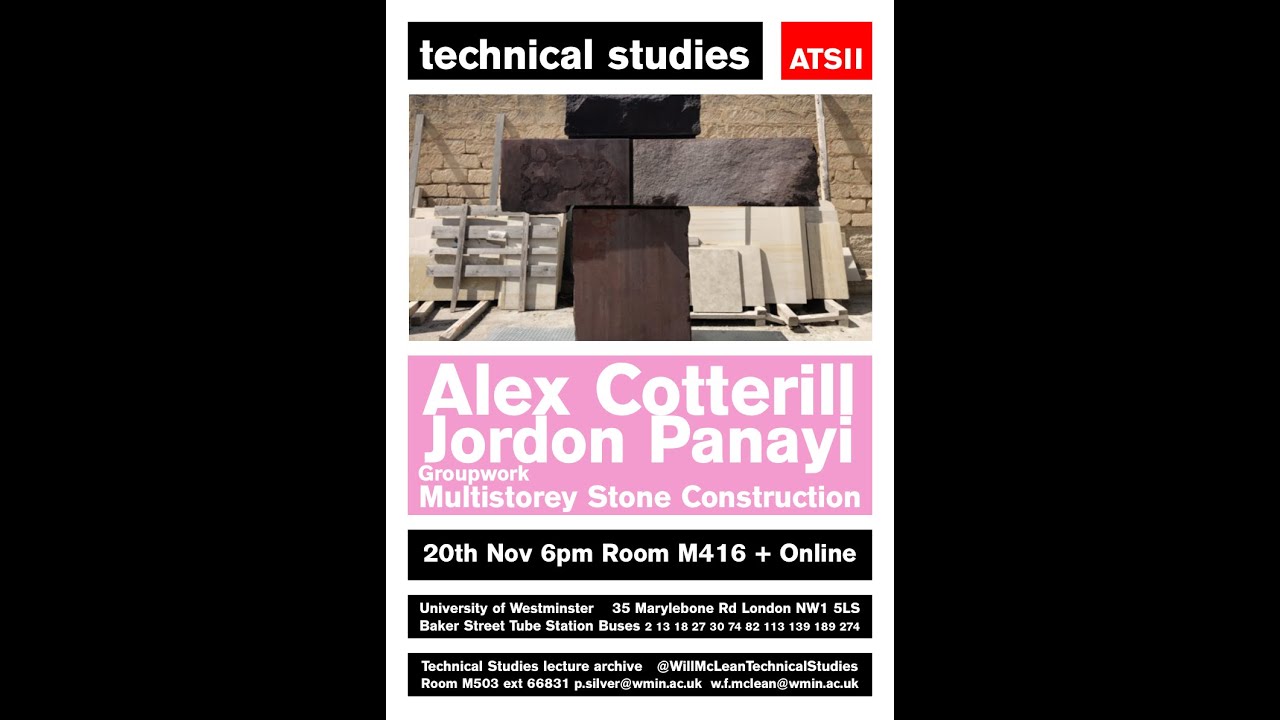
Alex Cotterill & Jordon Panayi (Groupwork) 20 /11/2025
Keywords
Summary
177 words
Critical Evaluation
Value of the Information & Strength of the Argument
The lecture provides valuable insights into the practical application of stone as a structural material, backed by real project examples and quantitative claims about carbon reduction. The argumentation is solid, as the speakers logically connect the environmental benefits of stone to its material properties and construction methods. They address potential concerns such as resource availability and fire safety, demonstrating a thorough understanding of the subject. The presentation is persuasive, but it is primarily based on their own experience and advocacy, lacking independent verification or comparison with alternative sustainable materials.
Scientific Rigor, Source Quality, Title Accuracy
The lecture demonstrates scientific rigor by referencing established standards (EN15978) and collaborating with institutions like BSR and the University of Bath. However, the sources cited are not explicitly listed in the video description, and the claims are not peer-reviewed. The title accurately reflects the content, which is a technical lecture on stone construction. The presentation is well-structured and informative, though it could benefit from more detailed citations and data to support the carbon savings claims.
179 words
Title / Content Match
The title accurately reflects the content: a lecture by Alex Cotterill and Jordon Panayi from Groupwork, presented on the specified date.
Quality & Reliability
8/10
The lecture presents a coherent and detailed account of the Finchley Road project and the Stone Demonstrator, grounded in practical experience and referencing standards like EN15978. The claims about embodied carbon reductions are plausible and supported by the described construction methods, though not peer-reviewed.
Key Moments
Markers derived by PSI from the transcript: the creator did not define chapters.
- Introduction to the lecture and the Finchley Road project.
- Discussion of embodied carbon in materials and the EN15978 standard.
- Explanation of why stone has low embodied carbon and its abundance.
- Overview of the Clerkenwell project as an early example of stone exoskeleton.
- Detailed presentation of the Finchley Road project, including structure and materials.
- Discussion of the Stone Demonstrator project and its various stone applications.
- Explanation of post-tensioned stone beams and columns.
- Presentation of the Albania project and the use of stone in a tall building.
- Conclusion and summary of the benefits of stone construction.
Cited Sources
- EN15978 — Referenced as the global standard for measuring carbon in buildings.
- BSR and University of Bath study — Mentioned as the basis for the embodied carbon list of materials.
Concurring Sources
- Groupwork's website — Official website of the architecture firm, likely containing project details and further information.
Contribution & Novelties
The lecture provides an original contribution by showcasing real-world applications of post-tensioned stone as a structural material, demonstrating its viability for multi-storey buildings. It offers practical insights into construction details and the use of waste stone, which is innovative. The presentation also highlights the potential for stone to replace conventional materials in a sustainable way.
Pour aller plus loin :
- Post-tensioned stone — Related concept, though not exactly the same, provides background on post-tensioning techniques.
- Embodied carbon in construction — Overview of embodied carbon and its importance in building sustainability.
- Stone as a structural material — Historical and contemporary uses of stone in construction.
104 words
Radar Profile
The radar profile shows high scores in information quantity, quality, and technical level, indicating a dense and informative lecture. The reliability score is also high, reflecting the practical experience and references to standards. The overall profile suggests a well-rounded and credible presentation.