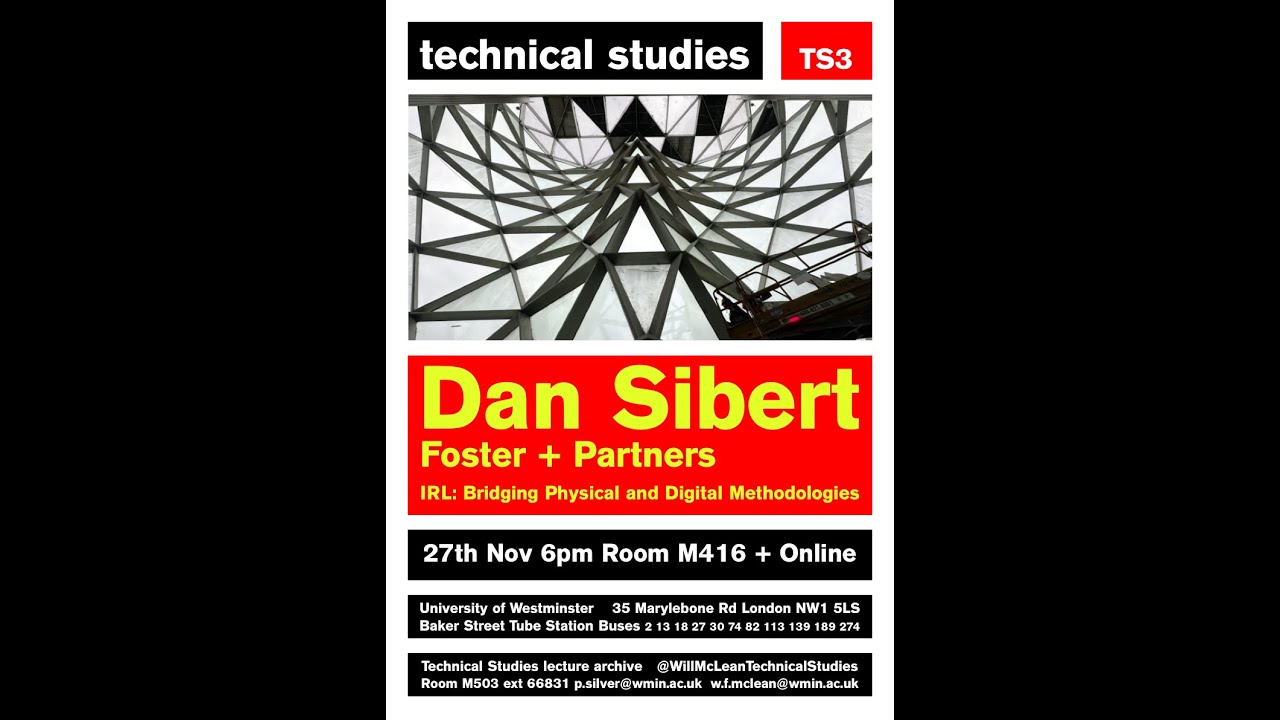
Dan Sibert (Foster + Partners) 27/11/2025
Keywords
Summary
153 words
Critical Evaluation
Value of the Information & Strength of the Argument
The lecture provides valuable insights into the practical application of digital and physical design integration in a leading architectural firm. The argumentation is strong, grounded in real project examples and the speaker’s extensive experience. The value lies in the detailed description of workflows that combine scripting, simulation, and physical prototyping, demonstrating how these methods enhance design quality and construction feasibility. The speaker effectively argues that technology is not just a tool but an integral part of the design process, enabling innovation and precision.
Scientific Rigor, Source Quality, Title Accuracy
The lecture is scientifically rigorous in the sense that it is based on professional practice and documented projects. The speaker references specific projects and processes, but does not cite external sources or academic literature. The title accurately reflects the content, as it is a lecture by Dan Sibert of Foster + Partners. The quality of sources is high in terms of professional credibility, but the lack of external references limits its academic rigor. The lecture is well-structured and the content aligns with the title.
182 words
Title / Content Match
The title accurately reflects the content, as the lecture is given by Dan Sibert of Foster + Partners and focuses on the integration of digital and physical design processes.
Quality & Reliability
8/10
The lecture is delivered by a senior partner at Foster + Partners with 30 years of experience, providing firsthand insights into the firm's design and construction workflows. The content is based on real projects and practical experience, but it is not peer-reviewed and represents a professional perspective rather than academic research.
Key Moments
Markers derived by PSI from the transcript: the creator did not define chapters.
- Introduction: Dan Sibert introduces himself and the topic of the lecture.
- Smithsonian Courtyard: Overview of the project and the use of early mockups.
- Smithsonian Courtyard: Detailed discussion of acoustic challenges and full-scale testing.
- China Merchants Bank: Introduction to the tower and its parametric design.
- China Merchants Bank: Explanation of the scripted workflow and physical models.
- Dubai project: Brief discussion of the CEA project and its design approach.
- Conclusion: Summary of key principles and the importance of integrating digital and physical design.
Cited Sources
- Foster + Partners official website — Referenced as the firm's official site, providing background on projects and the practice.
Concurring Sources
- Foster + Partners official website — Provides information on the projects discussed, such as the Smithsonian Courtyard and China Merchants Bank.
Contribution & Novelties
The lecture provides an insider’s perspective on how a leading architectural firm integrates digital and physical design processes, offering practical insights into the workflow that are rarely shared publicly. It highlights the importance of continuous iteration between scripting and physical mockups to achieve design excellence.
Pour aller plus loin :
- Parametric design — Overview of the design approach used in the lecture.
- Building information modeling — Related to the digital workflow discussed.
- Digital fabrication — Relevant to the physical mockups and CNC cutting mentioned.
84 words
Radar Profile
The radar profile shows high scores in information quantity, quality, technical level, and reliability, indicating a well-rounded and informative lecture. The speaker's expertise and practical examples contribute to a strong overall assessment.
💬 Sur les 0 commentaires analysés, aucune tendance n'est disponible.