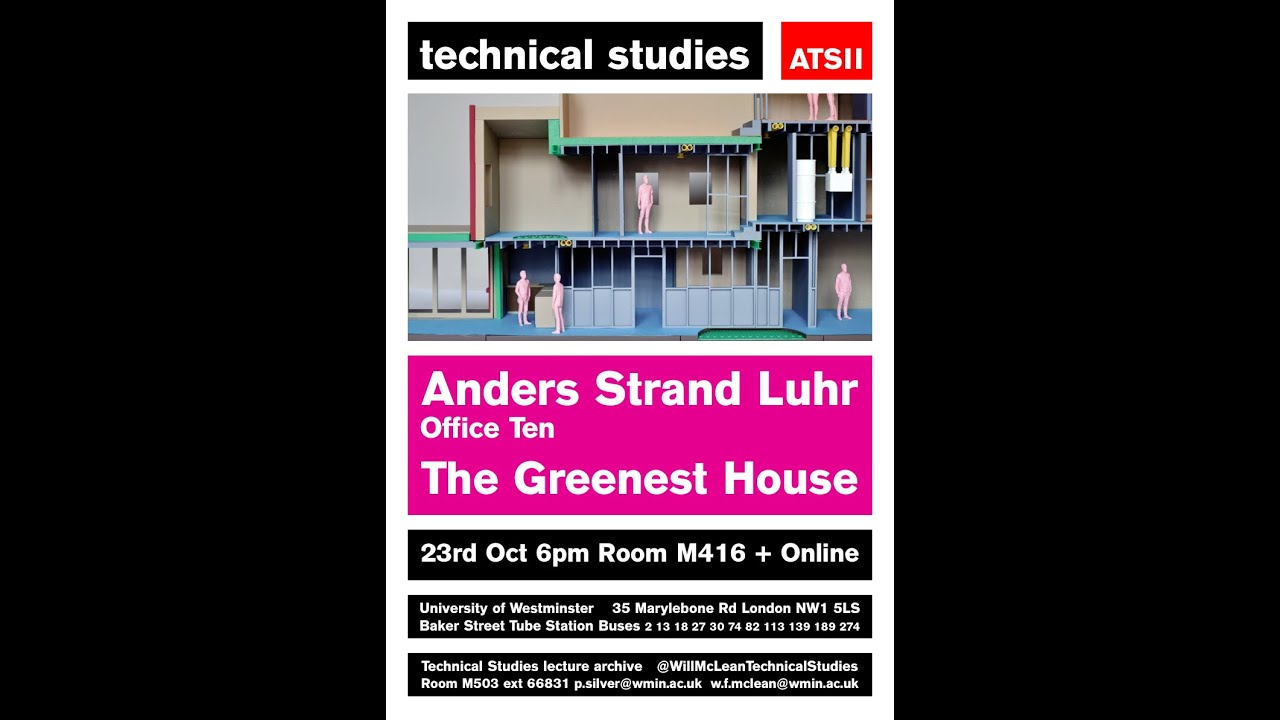
Anders Strand Luhr 23/10/2025
Keywords
Summary
186 words
Critical Evaluation
Value of the Information & Strength of the Argument
The talk provides valuable insights into the practical challenges of sustainable retrofitting and proposes a concrete, economically viable model. The argumentation is solid, drawing on real-world examples and personal experience. The speaker effectively critiques the current demolition-oriented approach and offers a compelling alternative. However, the presentation is more conceptual than technical, with limited quantitative evidence. The carbon savings are based on a single assessment, and the financial model, while plausible, is not backed by detailed calculations. The argument would be strengthened by more data on costs, energy performance, and scalability.
99 words
Title / Content Match
The title is simply the speaker's name and date, which is appropriate for a lecture recording but does not convey the content.
Quality & Reliability
7/10
The talk presents a well-argued, practice-based proposal for retrofitting existing housing, grounded in real-world experience and referencing specific partners and an energy assessment. However, it lacks detailed quantitative data and peer-reviewed sources, and the claims about carbon savings are based on a single assessment.
Key Moments
Markers derived by PSI from the transcript: the creator did not define chapters.
- Introduction: The speaker introduces the topic and the context of the talk.
- The speaker discusses the three things needed to create architecture: site, client, and resources.
- The speaker explains the obstacles to sustainable retrofitting: cost, legislation, and knowledge.
- The speaker introduces the Ise Shrine and the concept of rebuilding every 20 years.
- The speaker explains the Norwegian concept of 'dugnad' and its relevance to the project.
- The speaker describes the partners and the exhibition at the Venice Biennale.
- The speaker presents the core idea: extending and subdividing terrace houses, reinvesting profits.
- The speaker discusses the design improvements, such as adding an extra stair and using glass for light.
- The speaker presents the energy assessment results and the potential carbon savings.
- The speaker concludes with the current status and next steps for the project.
Cited Sources
- European Cultural Center Italy - TIME SPACE EXISTENCE exhibition — The project was exhibited at the Venice Biennale as part of this exhibition.
- Architecture Declare — Office Ten is a signatory to this declaration.
- UK Green Building Council — Office Ten became a member to find partners.
- Alliance for Sustainable Building Products — Office Ten became a member to find partners.
Concurring Sources
- UK Green Building Council - Retrofit — The UKGBC promotes retrofit as a key strategy for reducing carbon emissions.
Contribution & Novelties
The talk presents a novel economic model for sustainable retrofitting that combines elements from Japanese and Norwegian traditions. The cyclical approach of reinvesting profits into the building, rather than extracting them, is a distinctive contribution. The emphasis on retaining knowledge through repeated cycles is also innovative. The project is still in development, but the concept offers a scalable alternative to demolition.
Pour aller plus loin :
- Ise Shrine — The 20-year rebuilding cycle is a key inspiration for the model.
- Dugnad — The Norwegian tradition of collective voluntary work.
- Embodied carbon in buildings — The concept of embodied carbon is central to the argument for retrofitting.
106 words
Radar Profile
The radar profile shows a balanced performance across all dimensions, with slightly higher scores in information quantity and quality, and lower in technical level and reliability. This reflects a talk that is informative and well-argued but lacks deep technical detail and robust scientific backing.