Day 1: Maria Loureiro - AI Driven Damage Functions | ADIA Lab Symposium 2025
Keywords
Summary
168 words
Critical Evaluation
Value of the Information & Strength of the Argument
The talk provides valuable insights into the limitations of current damage functions and the potential of AI to address them. The argumentation is coherent, moving from the problem of underestimation to specific examples and proposed solutions. The speaker supports her claims with references to her own research and general trends, but the presentation is more of an overview than a detailed exposition, leaving some arguments underdeveloped.
Scientific Rigor, Source Quality, Title Accuracy
The speaker references established models (e.g., Nordhaus, DICE) and mentions her own publications, but specific citations are not provided in the talk. The title accurately reflects the content. The talk is based on the speaker’s expertise and ongoing research, which adds credibility, but the lack of detailed references limits the ability to verify all claims.
136 words
Title / Content Match
The title accurately reflects the content, which focuses on AI-driven damage functions for climate policy and risk assessment.
Quality & Reliability
7/10
The speaker is a recognized expert in environmental economics, and the talk presents ongoing research with references to established models and empirical data. However, the presentation is a high-level overview without detailed methodology or peer-reviewed citations, limiting its immediate verifiability.
Key Moments
Markers derived by PSI from the transcript: the creator did not define chapters.
- Introduction to the talk and the problem of underestimating climate damages in macroeconomic models.
- Discussion of traditional damage functions and their limitations.
- Introduction to the speaker's work with a 57-region integrated assessment model.
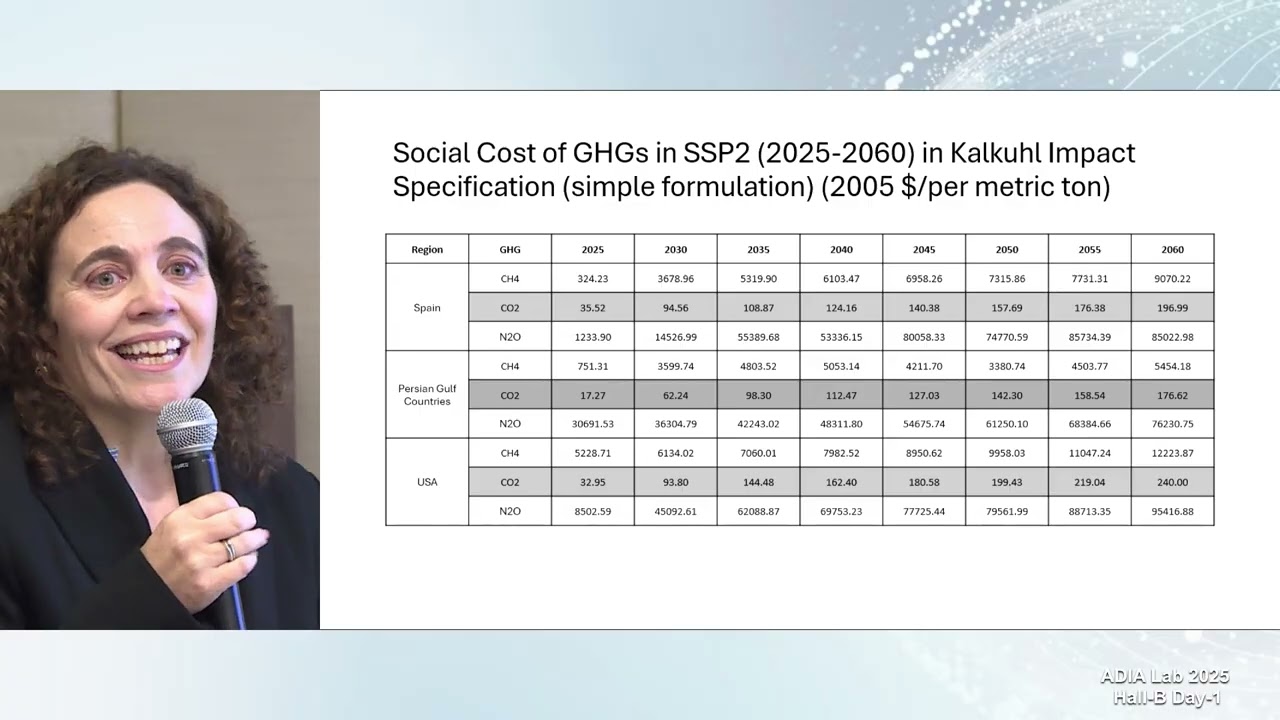
- Presentation of social cost of carbon estimates and their variation across regions and time.
- Emphasis on the importance of extreme events and health impacts in damage functions.
- Example of agricultural yield impacts in Spain using micro data.
- Discussion of misinformation in climate discourse, using the Dana floods as a case study.
- Conclusion on the role of AI in improving climate impact modeling.
Cited Sources
- ADIA Lab Symposium — Event page for the symposium where the talk was presented.
Concurring Sources
- ADIA Lab Symposium — Event page for the symposium where the talk was presented.
Contribution & Novelties
The talk presents an ongoing research agenda that applies AI to improve damage functions in climate-economic models, addressing limitations of traditional approaches. It highlights the importance of incorporating extreme events, health impacts, and regional heterogeneity, and demonstrates the use of micro data and social media analysis. The speaker’s work on the social cost of carbon with a 57-region model provides new insights into temporal and regional variations.
Pour aller plus loin :
- Integrated assessment models — Overview of IAMs used in climate economics.
- Social cost of carbon — Definition and estimation approaches.
- Nordhaus’s DICE model — A prominent IAM with a quadratic damage function.
- Climate change and health — WHO fact sheet on health impacts of climate change.
- Misinformation and climate change — Overview of misinformation in climate discourse.
129 words
Radar Profile
The radar profile shows balanced scores across information quantity, quality, technical level, and reliability, with a slight emphasis on quality and reliability. This suggests a well-rounded presentation with solid content and credible sourcing, though not extremely technical or exhaustive.