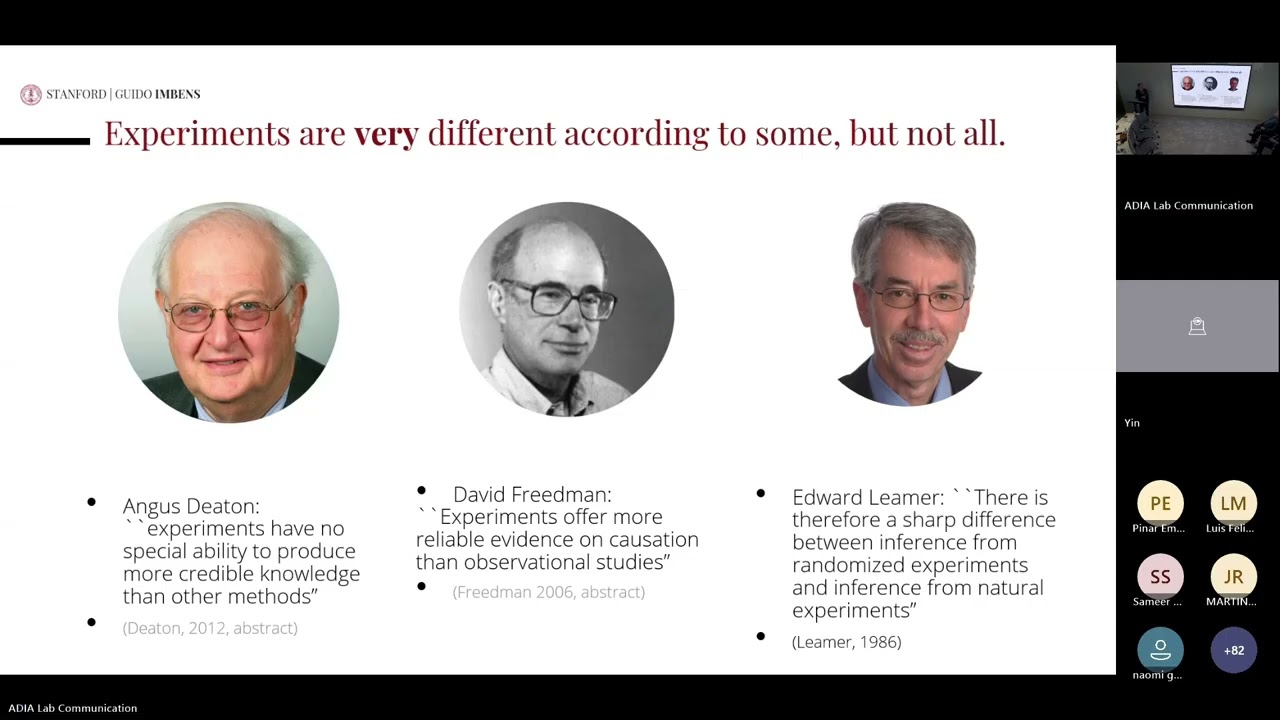
ADIA Lab Seminar with Guido Imbens and Geoffrey West, on February 4, 2026
Keywords
Summary
158 words
Critical Evaluation
Value of the Information & Strength of the Argument
The talk provides valuable insights into the theory and practice of randomized experiments, grounded in the speaker’s extensive expertise. Imbens effectively argues for the superiority of randomized experiments over observational studies, while acknowledging their limitations and potential for misuse. He supports his points with concrete examples, such as the West Point laptop study and the eBay advertising experiment, which illustrate both the power and the nuances of experimental design. The argumentation is clear and persuasive, though some examples are presented briefly without deep methodological detail.
Scientific Rigor, Source Quality, Title Accuracy
The presentation demonstrates high scientific rigor, consistent with Imbens’s reputation. He references key figures like Fisher, Neyman, and Rubin, and discusses the philosophical debates around experimentation. The sources cited are primarily academic studies and historical references, though specific citations are not always provided in the talk. The title accurately describes the seminar’s content, which is a lecture on randomized experiments. The talk is well-structured and maintains a high level of intellectual integrity.
172 words
Title / Content Match
The title accurately reflects the content, as the seminar features two distinguished speakers, with Imbens focusing on randomized experiments.
Quality & Reliability
8/10
The talk is given by Nobel laureate Guido Imbens, a leading expert in causal inference and randomized experiments. The content is rigorous, well-structured, and based on established scientific principles. However, it is a seminar presentation without peer review, and some claims rely on specific studies that are not fully detailed.
Key Moments
Markers derived by PSI from the transcript: the creator did not define chapters.
- Introduction to randomized experiments and the fundamental problem of causal inference.
- Discussion on the importance of defining interventions, with example of child poverty and lottery study.
- Critique of significance testing and example of data manipulation in a medical trial.
- Presentation of West Point laptop experiment and its findings on student performance.
- AI in call centers: experimental evidence on productivity improvement.
- AI in management consulting: differential effects on routine vs. frontier tasks.
- Remote work experiment at a Chinese travel agency: effects on attrition and satisfaction.
- eBay advertising experiment: demonstrating the value of proper experimentation.
- Introduction to multi-armed bandit designs for efficient treatment selection.
- Dealing with interference: randomizing markets and crossover designs.
Cited Sources
- Randomized Experiments, Then and Now — Main topic of the talk by Guido Imbens.
- Hidden Laws of Life, Growth, Death, and Innovation — Title of Geoffrey West's talk, mentioned in the description.
Concurring Sources
- Rubin Causal Model — Framework for causal inference discussed in the talk.
- Multi-armed bandit — Experimental design approach mentioned for efficient treatment selection.
Contribution & Novelties
The talk offers a comprehensive overview of randomized experiments, bridging historical foundations with modern online experimentation. It highlights recent developments such as multi-armed bandit designs and interference handling, providing valuable insights for practitioners. The speaker’s expertise adds credibility, and the examples illustrate practical applications.
Pour aller plus loin :
- Potential Outcomes Framework — Foundational framework for causal inference.
- Multi-armed bandit — Key concept for adaptive experimental designs.
- Randomized controlled trial — Standard for clinical trials and experiments.
77 words
Radar Profile
The radar profile shows high scores in information quality and reliability, reflecting the speaker's expertise and rigorous content. The technical level is moderate, suitable for a general academic audience. The overall balance indicates a highly informative and credible presentation.