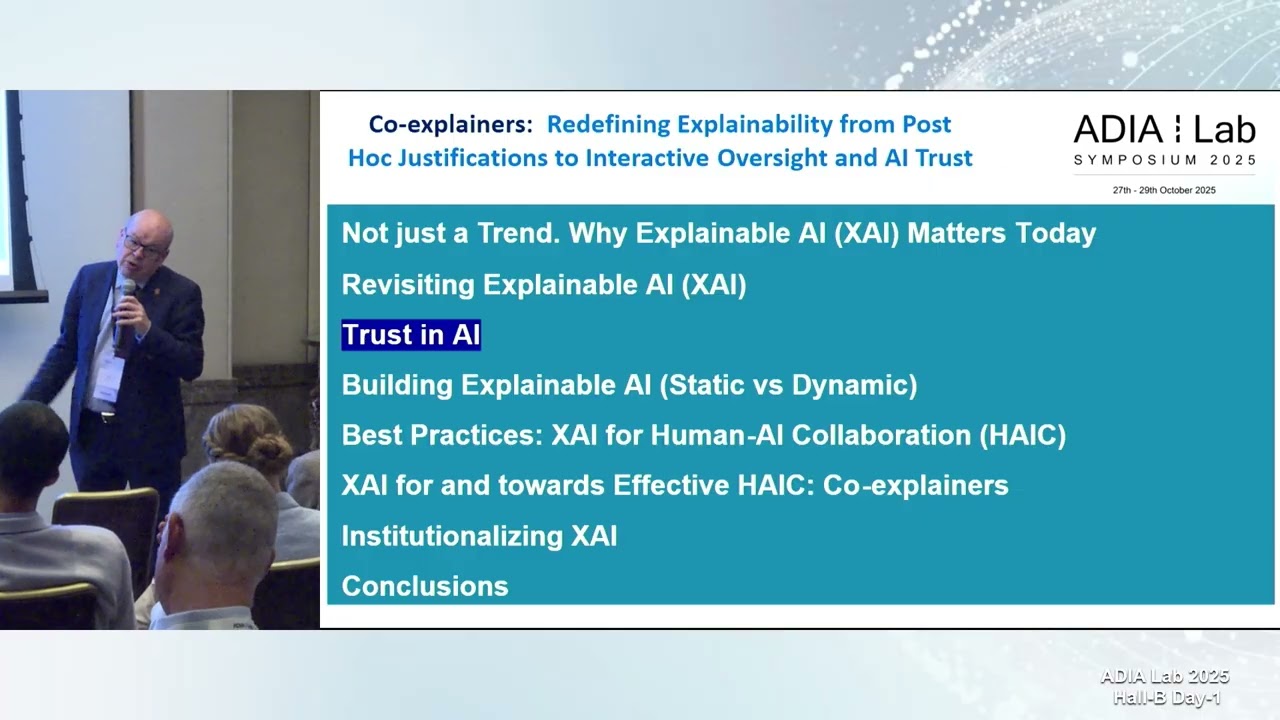
Co-explainers: Redefining XAI from Post Hoc Justifications to Interactive Oversight & Trust
Keywords
Summary
140 words
Critical Evaluation
Value of the Information & Strength of the Argument
The talk provides a valuable conceptual contribution by proposing a shift from static to interactive explainability. It synthesizes existing ideas from human-AI collaboration and XAI literature, offering a coherent argument for why co-explainers are necessary. The argumentation is solid, drawing on examples from healthcare and referencing regulatory frameworks like the EU AI Act. However, the talk is largely theoretical and lacks concrete implementation details or empirical evidence, which limits its immediate applicability.
Scientific Rigor, Source Quality, Title Accuracy
The speaker references several key concepts and frameworks, including the EU AI Act, the NIST AI framework, and the work of Dario Amodei on co-intelligence. However, specific citations are not provided in the talk, and the description only includes a link to the ADIA Lab symposium page. The title accurately reflects the content, and the talk is well-structured, but the lack of explicit references to peer-reviewed sources reduces its scientific rigor.
158 words
Title / Content Match
The title accurately reflects the content, which focuses on redefining explainability through interactive co-explainers.
Quality & Reliability
7/10
The talk is an expert opinion by a recognized professor in AI, presenting a conceptual framework. It references established concepts and recent research, but lacks detailed empirical validation or citations to specific studies. The argumentation is coherent and grounded in existing literature, but the novelty is primarily conceptual.
Key Moments
Markers derived by PSI from the transcript: the creator did not define chapters.
- Introduction: The speaker introduces the topic of explainability and the need for a new approach.
- Discussion on opacity, over-reliance, and under-reliance in AI systems.
- Definition of explainable AI and the importance of audience and context.
- Comparison of static vs. dynamic explainability approaches.
- Introduction of the co-explainer concept and its theoretical foundations.
- Proposed co-explainer framework with four steps: generation, feedback, update, and governance.
- Application example in radiology, illustrating interaction with junior and senior clinicians.
- Discussion on embedding explainability in the AI lifecycle and governance.
- Conclusion: The need for interactive explainability to increase trust and improve decision-making.
Cited Sources
- ADIA Lab Symposium — Event page for the symposium where the talk was presented.
Concurring Sources
- Explainable AI: A Review of Machine Learning Interpretability Methods — A review article that supports the need for context-aware explainability.
Dissenting Sources
- The Mythos of Model Interpretability — This paper argues that interpretability is often ill-defined and may not be achievable, contrasting with the talk's optimistic view of interactive explainability.
Contribution & Novelties
The talk introduces the concept of co-explainers as a novel framework for interactive and iterative explainability, emphasizing the importance of audience and context. It proposes a concrete loop of generation, feedback, update, and governance, which is a step beyond static post hoc methods. The framework is positioned as a sociotechnical infrastructure for governance and harm mitigation, which is a fresh perspective in XAI research.
Pour aller plus loin :
- Explainable AI (Wikipedia) — Provides an overview of XAI, its goals, and methods.
- Human-in-the-loop (Wikipedia) — Discusses the role of human oversight in AI systems.
- EU AI Act (European Commission) — Official information on the EU’s regulatory framework for AI, relevant to the talk’s discussion on governance.
116 words
Radar Profile
The radar profile shows high scores in information quantity and quality, reflecting the speaker's expertise and the depth of the conceptual discussion. The technical level is moderate, indicating that the talk is accessible to a broad audience. The overall reliability is good, but the lack of specific citations and empirical evidence prevents a higher score.
💬 No comments were provided for analysis.