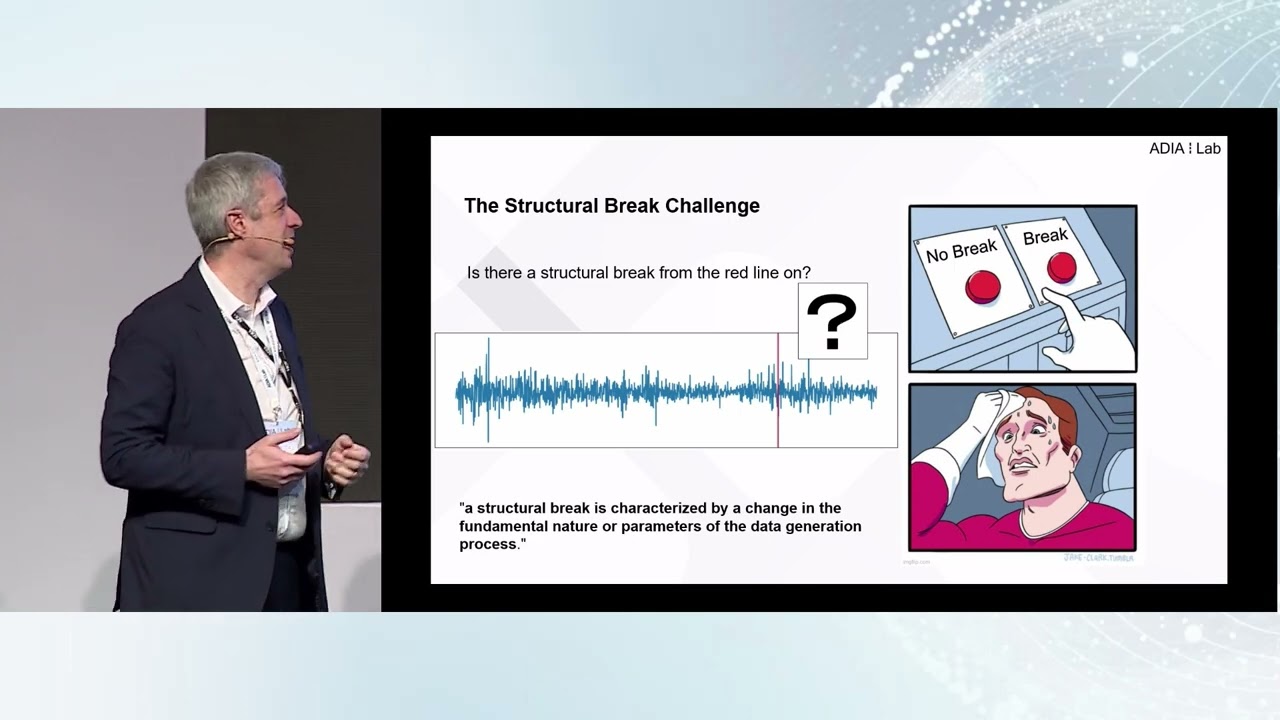
Day 2: Award Ceremony - ADIA Lab 2025 Structural Break Challenge | ADIA Lab Symposium 2025
Keywords
Summary
165 words
Critical Evaluation
Value of the Information & Strength of the Argument
The video provides valuable insights into the design and outcomes of a large-scale data science competition. It explains the concept of structural breaks and their applications, and presents the winning strategies, which are based on feature engineering and ensemble methods. The argumentation is coherent and supported by data on participation and performance. However, the presentation is largely descriptive and promotional, lacking critical analysis of the methods or limitations.
Scientific Rigor, Source Quality, Title Accuracy
The video is produced by ADIA Lab, a reputable institution, and the speakers are directly involved in the challenge. The information is likely accurate, but no external sources are cited. The title accurately reflects the content. The video does not include any comments or audience feedback.
129 words
Title / Content Match
The title accurately describes the content: the award ceremony for the ADIA Lab 2025 Structural Break Challenge.
Quality & Reliability
7/10
The video is an award ceremony and presentation of a data science competition, providing insights into the challenge design, participant demographics, and winning approaches. The information is presented by organizers and is likely reliable, but it is promotional in nature and lacks peer-reviewed validation.
Key Moments
Markers derived by PSI from the transcript: the creator did not define chapters.
- Introduction and welcome to the award ceremony.
- Emanuele Oliveti explains the concept of structural breaks and the challenge.
- Discussion of the dataset creation and its diversity.
- Jean introduces Crunch Lab and the collective intelligence approach.
- Presentation of the solution map and the dominance of feature engineering.
- Announcement of winners from 10th to 6th place.
- Announcement of winners from 5th to 3rd place.
- Announcement of the overall winner and closing remarks.
Contribution & Novelties
The video provides a unique overview of a large-scale competition on structural break detection, highlighting the effectiveness of feature engineering over deep learning for this problem. It also demonstrates the use of LLMs to analyze and cluster thousands of code submissions, offering a novel approach to understanding solution landscapes.
Pour aller plus loin :
- Structural break — Wikipedia article on structural breaks in time series.
- Feature engineering — Wikipedia article on feature engineering.
- Gradient boosting — Wikipedia article on gradient boosting.
- Crunch Lab — Official website of Crunch Lab, the platform used for the competition.
- ADIA Lab — Official website of ADIA Lab.
103 words
Radar Profile
The radar profile shows a balanced performance across all dimensions, with slightly higher scores in information quantity and quality, reflecting the video's informative but not deeply technical nature.