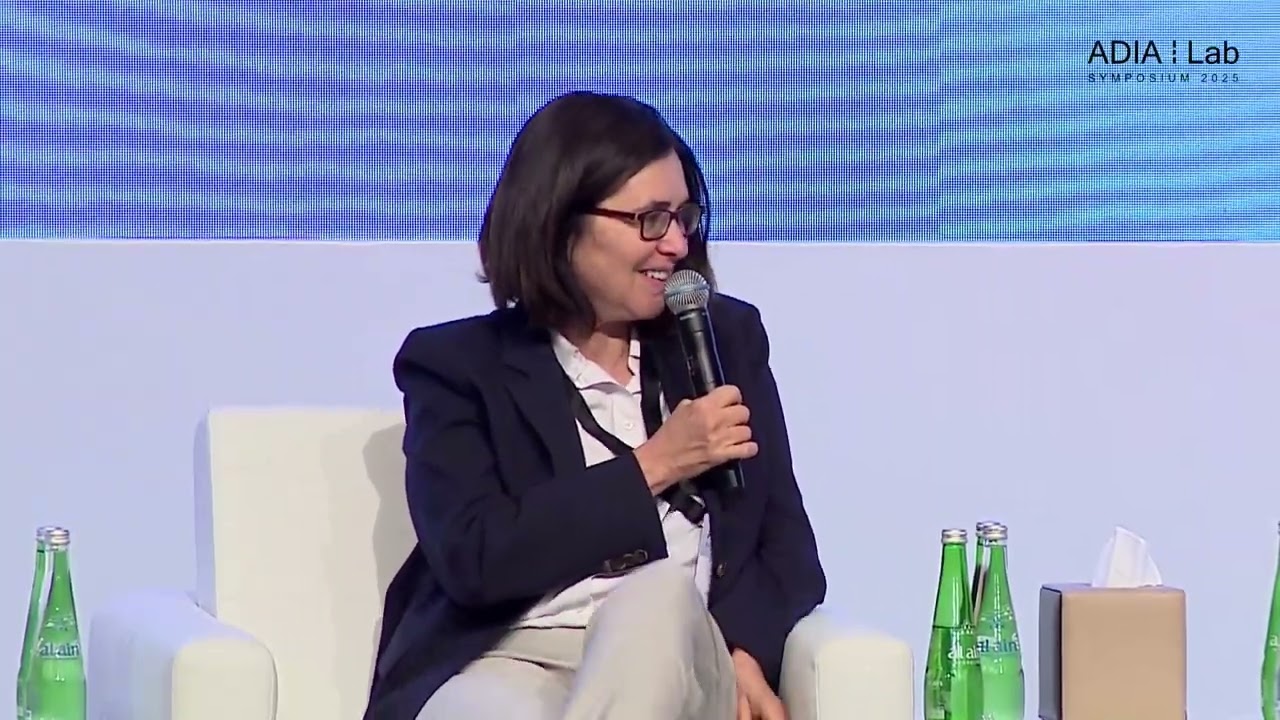
Day 3: Panel Discussion - AI and Economics, What to Prepare for? | ADIA Lab Symposium 2025
Keywords
Summary
151 words
Critical Evaluation
Value of the Information & Strength of the Argument
The panel provides valuable insights from multiple expert perspectives, enriching the discussion on AI’s economic impact. Arguments are generally well-reasoned, though some claims lack empirical backing. For instance, the MIT calculation is mentioned but not detailed, and the discussion on energy costs and algorithmic efficiency would benefit from concrete data. The panelists effectively challenge the productivity paradigm, highlighting broader societal and coordination effects. However, the argumentation sometimes relies on anecdotal evidence, such as personal experiences with AI in education, rather than systematic analysis.
Scientific Rigor, Source Quality, Title Accuracy
The panel references several sources, including MIT research and the Nobel Prize for protein folding, but these are not systematically cited. The discussion is more opinion-driven than evidence-based, which is typical for a panel format. The title accurately reflects the content, as the session is a panel discussion on AI and economics. No specific sources are provided in the video description, limiting the ability to verify claims. The panelists’ expertise lends credibility, but the lack of detailed citations reduces the overall scientific rigor.
181 words
Title / Content Match
The title accurately reflects the content: a panel discussion on the economic implications of AI.
Quality & Reliability
7/10
The panel features renowned experts in AI and economics, providing informed opinions and references to research, but the discussion is largely qualitative and lacks detailed citations or empirical data.
Key Moments
Markers derived by PSI from the transcript: the creator did not define chapters.
- Introduction of panelists and moderator.
- First question: MIT calculation on AI productivity impact and potential bubble.
- Discussion on AI's impact beyond existing tasks, including new tasks and coordination costs.
- Debate on whether productivity gains translate to societal benefits.
- Discussion on AI's role in science and drug design.
- Second question: limitations of AI, including data, energy, and infrastructure.
- Views on energy consumption and potential for more efficient algorithms.
- Discussion on geopolitical factors and the AI infrastructure bubble.
- Advice for younger generations: critical thinking, interdisciplinary skills, and human connections.
- Closing remarks and thanks to organizers.
Cited Sources
- MIT calculation on AI productivity impact — Referenced by Hido Imbans as a starting point for the discussion.
- Nobel Prize for protein folding — Mentioned by Sandy Petland as an example of AI's impact on science.
Concurring Sources
- OECD AI and Productivity — Provides data on AI's impact on productivity, aligning with the panel's discussion.
- NBER Economics of AI — Research on AI's economic implications, supporting the panel's themes.
Dissenting Sources
- MIT study on AI productivity — The panelists challenge the MIT calculation, suggesting it underestimates AI's impact.
Contribution & Novelties
The panel offers a nuanced perspective on AI’s economic impact, moving beyond simple productivity metrics to consider broader societal and coordination effects. It highlights the potential for AI to create new tasks and transform industries, while also cautioning against overinvestment and infrastructure bubbles. The discussion underscores the importance of critical thinking and interdisciplinary skills for future generations.
Pour aller plus loin :
- AI and Productivity — OECD insights on AI’s impact on productivity.
- The Economics of Artificial Intelligence — NBER research on AI economics.
- AI and the Future of Work — ILO report on AI and employment.
97 words
Radar Profile
The radar profile shows high scores in information quality and reliability, reflecting the expertise of the panelists. However, the technical level is moderate, as the discussion is accessible to a general audience. The overall balance suggests a well-rounded but not deeply technical analysis.