Day 3: Guido Imbens - AI and Productivity | ADIA Lab Symposium 2025
Keywords
Summary
231 words
Critical Evaluation
Value of the Information & Strength of the Argument
The talk provides valuable insights by synthesizing evidence from multiple randomized experiments on AI’s productivity effects. Imbens presents a balanced view, highlighting both the potential benefits and the challenges of generalizing from these studies. His argumentation is rigorous, as he carefully discusses the internal validity of each study and the limitations of extrapolating to the macroeconomy. He also introduces a framework for aggregating task-level productivity gains to GDP, which is a novel contribution. The discussion of heterogeneity, particularly the finding that AI may benefit less experienced workers more, adds depth and nuance to the analysis.
Scientific Rigor, Source Quality, Title Accuracy
Imbens demonstrates scientific rigor by referencing specific studies and their methodologies, including randomized experiments and their limitations. He acknowledges the challenges of external validity and the need for careful interpretation. The sources cited are credible, including studies from Stanford’s Digital Economy Lab and other academic institutions. The title accurately reflects the content, and the talk is well-structured. The speaker’s expertise and reputation further enhance the reliability of the information presented.
180 words
Title / Content Match
The title accurately reflects the content: a keynote on AI and productivity, with a focus on empirical studies and macroeconomic implications.
Quality & Reliability
8/10
The talk is delivered by a Nobel laureate economist, referencing multiple peer-reviewed studies and presenting a balanced view of AI's productivity effects. The speaker acknowledges limitations and extrapolation challenges, enhancing credibility.
Key Moments
Markers derived by PSI from the transcript: the creator did not define chapters.
- Introduction and overview of the talk's structure
- Discussion of the challenge of extrapolating from task-level studies to macroeconomy
- Study 1: GitHub Copilot for software engineers - 55% reduction in completion time
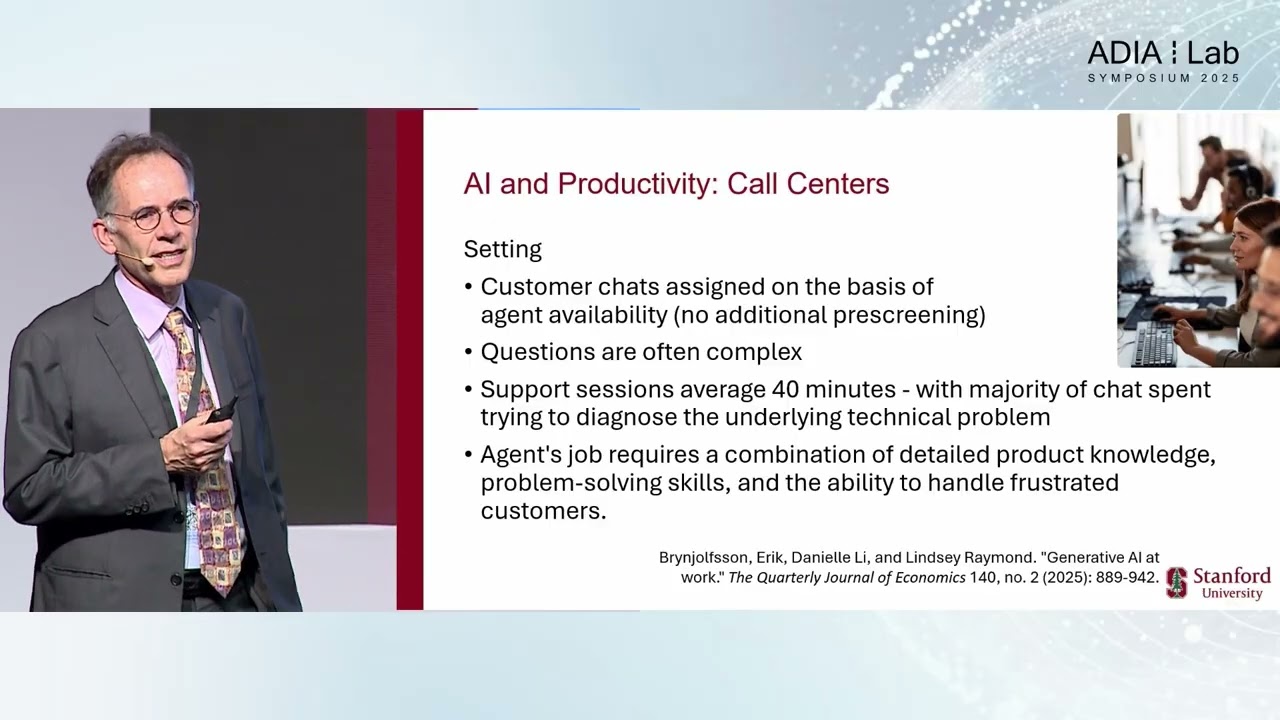
- Study 2: AI assistance in call centers - increase in resolutions per hour
- Study 3: AI for management consultants - positive effect on easy tasks, negative on hard tasks
- Study 4: AI for writing tasks - improved speed, quality, and enjoyment
- Study 5: Laptops in classroom - negative effect on exam performance, heterogeneity by gender and ability
- Study 6: AI for radiology - AI outperforms radiologists, but providing AI predictions does not improve human accuracy
- Aggregating task-level gains to GDP - exposed tasks see 27% productivity gain, but overall cost savings only 14%
Cited Sources
- GitHub Copilot experiment — Study on software engineers' productivity with Copilot
- Call center AI study — Study by Erik Brynjolfsson and group at Stanford on AI assistance in call centers
- Management consultants experiment — Randomized experiment on AI assistance for management consultants
- Writing tasks experiment — Experiment on AI assistance for writing tasks
- West Point laptop study — Study on the effect of laptop use in classroom on exam performance
- Radiology AI study — Randomized experiment on AI assistance for radiologists
Concurring Sources
- GitHub Copilot experiment — Study on software engineers' productivity with Copilot
- Call center AI study — Study by Erik Brynjolfsson and group at Stanford on AI assistance in call centers
- Management consultants experiment — Randomized experiment on AI assistance for management consultants
- Writing tasks experiment — Experiment on AI assistance for writing tasks
- West Point laptop study — Study on the effect of laptop use in classroom on exam performance
- Radiology AI study — Randomized experiment on AI assistance for radiologists
Contribution & Novelties
The talk provides a comprehensive overview of empirical evidence on AI’s productivity effects, synthesizing multiple randomized experiments. Imbens introduces a framework for aggregating task-level gains to GDP, which is a novel contribution. He also highlights the heterogeneity of effects, particularly the potential for AI to benefit less experienced workers, which contrasts with traditional technologies. The discussion of the challenges of integrating AI into professional settings, such as radiology, adds practical insights.
Pour aller plus loin :
- Causal Inference — Foundational concept for understanding the experimental studies discussed.
- Productivity — Economic concept central to the talk.
- Artificial Intelligence — Overview of AI technologies and their applications.
- Randomized Controlled Trial — Methodology used in the studies cited.
115 words
Radar Profile
The radar profile shows high scores in information quality and reliability, reflecting the speaker's expertise and the use of credible studies. The quantity of information is also high, with a comprehensive review of multiple experiments. The technical level is moderate, suitable for a general audience but with some depth. Overall, the talk is well-balanced and informative.