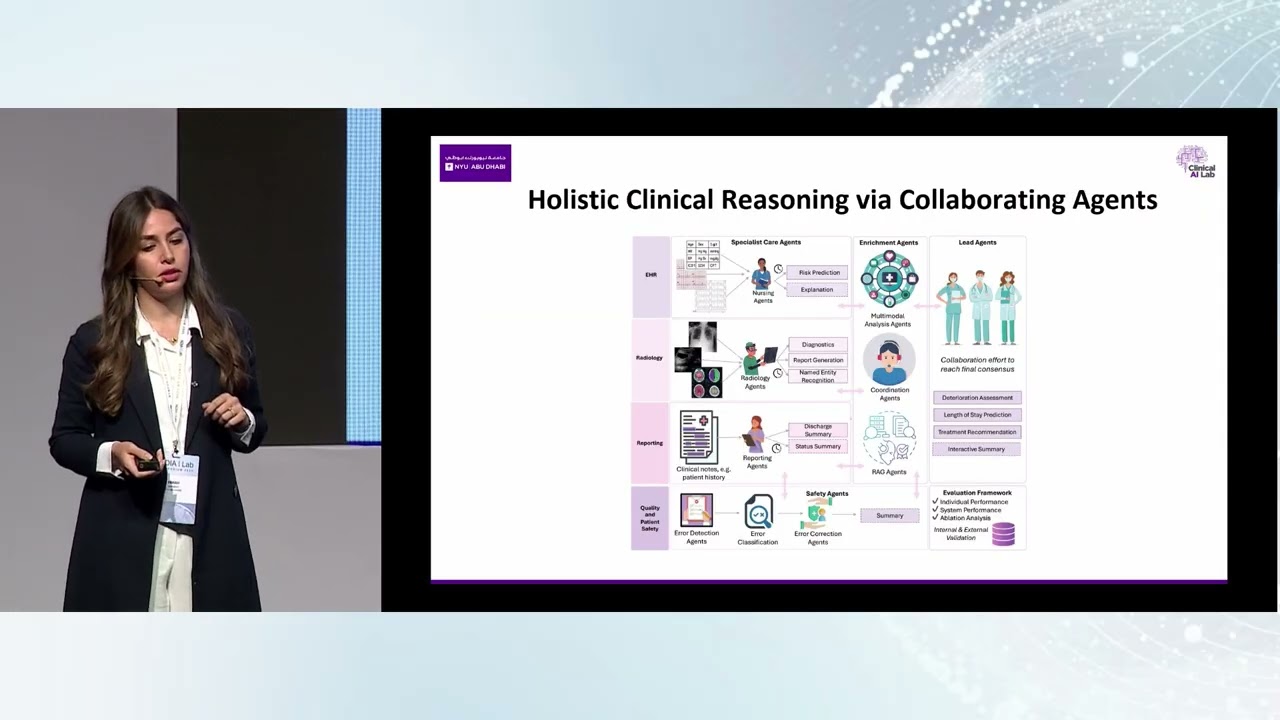
Day 2: Health Sciences Grant Awardee Presentation #1 - Farah Shamout | ADIA Lab Symposium 2025
Keywords
Summary
166 words
Critical Evaluation
Value of the Information & Strength of the Argument
The presentation offers valuable insights into the limitations of current AI models in clinical settings and proposes a novel multi-agent framework. The argumentation is well-structured, starting from the clinical problem, reviewing existing solutions, and justifying the need for a more intuitive and collaborative system. The speaker supports her claims with references to her own research and a recent Lancet study. The proposal is technically sound, building on established methods in multimodal learning and LLMs. However, the talk is a proposal, so the actual efficacy of the system is not yet demonstrated.
Scientific Rigor, Source Quality, Title Accuracy
The speaker demonstrates scientific rigor by referencing her published work and ongoing collaborations. She mentions specific datasets and partner institutions, which adds credibility. The title accurately reflects the content, as it is a grant awardee presentation. The talk is based on expert opinion and preliminary research, not a peer-reviewed study, but the sources cited are reputable. The adequacy between title and content is high.
170 words
Title / Content Match
The title accurately reflects the content: a grant awardee presentation at a symposium.
Quality & Reliability
7/10
Presentation by a recognized expert in AI for healthcare, based on her research and collaborations. Claims are supported by references to published work and ongoing projects, but the talk is a proposal rather than a peer-reviewed study.
Key Moments
Markers derived by PSI from the transcript: the creator did not define chapters.
Cited Sources
- Lancet Child & Adolescent Health study on parental concerns — Cited as a recent study showing parental concerns associated with adverse outcomes.
Concurring Sources
- Early warning scores — Background on early warning scores mentioned in the talk.
Contribution & Novelties
The presentation proposes a novel multi-agent framework for clinical decision support that integrates specialized AI models with LLMs for reasoning and explanation, addressing the lack of intuitiveness in current models. It emphasizes patient safety and workflow integration.
Pour aller plus loin :
- Multi-agent systems — Relevant to the core concept of the proposed framework.
- Large language models in medicine — Key component for reasoning and explanation.
- Multimodal learning — Basis for combining imaging and EHR data.
76 words
Radar Profile
The radar profile shows high scores in quality of information and technical level, with moderate scores in quantity and reliability. This reflects a technically detailed presentation with credible sources, but limited in scope and not yet validated by outcomes.