Day 2: Health Sciences Grant Awardee Presentation #3 - Sophia Rein | ADIA Lab Symposium 2025
Keywords
Summary
156 words
Critical Evaluation
Value of the Information & Strength of the Argument
The presentation offers high value by addressing a critical need: translating vast healthcare data into actionable evidence. The argumentation is solid, grounded in established causal inference theory (G-formula) and modern machine learning (LSTMs). The proposed method is innovative in combining deep learning with causal inference for longitudinal data, potentially improving accuracy over parametric models. The application to a clinically relevant question (GLP-1 vs other drugs) is well-justified, given the limitations of RCTs. The inclusion of uncertainty quantification and simulation validation strengthens the scientific rigor. However, as a proposal, the actual impact is yet to be demonstrated.
Scientific Rigor, Source Quality, Title Accuracy
The scientific rigor is high: the methodology is clearly described, and the use of target trial emulation and cross-fitting aligns with best practices. The title accurately reflects the content. No external sources are cited in the video, but the description provides no links either. The presentation is a research proposal, so the lack of citations is acceptable, but it limits the ability to verify claims. The adequacy between title and content is perfect.
184 words
Title / Content Match
The title accurately reflects the content: a grant awardee presentation on health sciences, specifically causal AI for real-world evidence.
Quality & Reliability
8/10
The presentation is a research proposal by a Harvard-affiliated researcher, outlining a clear methodology (deep learning-based G-formula estimator) and a concrete application (GLP-1 vs other anti-hypoglycemic drugs on cardiovascular events). The approach is grounded in established causal inference theory (G-formula, NICE) and uses validated techniques (sample splitting, cross-fitting). However, it is a proposal, not yet validated results, and no external sources are cited in the video.
Key Moments
Markers derived by PSI from the transcript: the creator did not define chapters.
- Introduction and background on healthcare data and learning health systems.
- Overview of causal inference theory: G-formula and NICE formula.
- Limitations of parametric models and motivation for deep learning approach.
- Project aims: develop software tool for causal AI and apply to cardiometabolic disease.
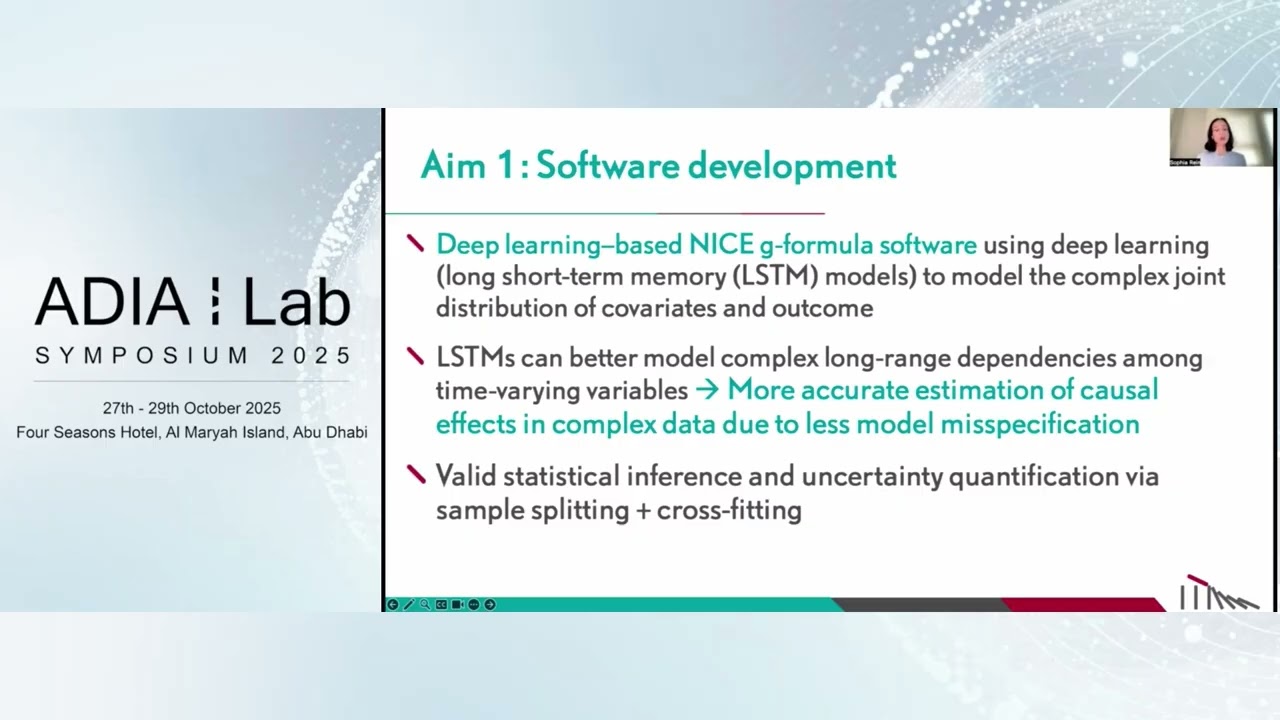
- Description of LSTM-based NICE estimator and cross-fitting for uncertainty quantification.
- Software features: flexibility, support for survival outcomes, parallel computing.
- Simulation study for validation and application to GLP-1 vs other drugs.
- Details of target trial emulation: inclusion criteria, treatment strategies, outcome (MACE-4).
- Data sources: MarketScan (US) and Malaffi (UAE).
- Summary of innovation and potential impact, collaboration between US and UAE.
Contribution & Novelties
The project proposes a novel open-source software tool that integrates deep learning (LSTMs) with the G-formula for causal inference from longitudinal healthcare data, addressing the limitations of parametric models. This could significantly improve the accuracy of causal effect estimates in real-world settings. The application to GLP-1 vs other drugs is clinically relevant and leverages large-scale data from both the US and UAE.
Pour aller plus loin :
- G-formula — Provides background on the causal inference framework used.
- Long short-term memory (LSTM) — Explains the deep learning architecture employed.
- Target trial emulation — Discusses the methodology for emulating randomized trials with observational data.
102 words
Radar Profile
The radar profile shows high scores in quality of information, technical level, and global reliability, reflecting the solid scientific foundation and clear methodology. The quantity of information is moderate, as it is a concise presentation of a research plan. Overall, the profile indicates a well-structured and credible proposal.