Day 3: Thomas Hardjono - Standardization Challenges in the Tokenization of Real World Assets
Keywords
Summary
166 words
Critical Evaluation
Value of the Information & Strength of the Argument
The talk provides valuable insights into the current state and future direction of tokenization, emphasizing the critical role of standards for interoperability and long-term viability. The argumentation is well-structured, drawing on analogies to the internet’s development and the IETF’s role. The speaker’s expertise and involvement in ongoing initiatives lend credibility. However, the talk is largely opinion-based and lacks concrete data or case studies to support some claims.
Scientific Rigor, Source Quality, Title Accuracy
The speaker references specific regulations (GENIUS Act, MiCA) and initiatives (FINOS CDM, IETF, SWIFT) but does not provide formal citations. The title accurately reflects the content. The talk is an expert opinion rather than a peer-reviewed study, so the scientific rigor is moderate but appropriate for the format.
130 words
Title / Content Match
The title accurately reflects the content, which focuses on standardization challenges in tokenizing real-world assets.
Quality & Reliability
8/10
The speaker is a recognized expert with extensive publications and patents, and the talk is grounded in ongoing industry initiatives and standards efforts. However, it is an opinion/expert talk without formal citations or peer-reviewed references, and some claims are anecdotal.
Key Moments
Markers derived by PSI from the transcript: the creator did not define chapters.
- Introduction of Thomas Hardjono by the moderator.
- Hardjono begins his talk, mentioning recent news and the GENIUS Act and CLARITY Act.
- Discussion of stablecoins and the need for frameworks for non-currency assets.
- Comparison of blockchain interoperability to internet service providers.
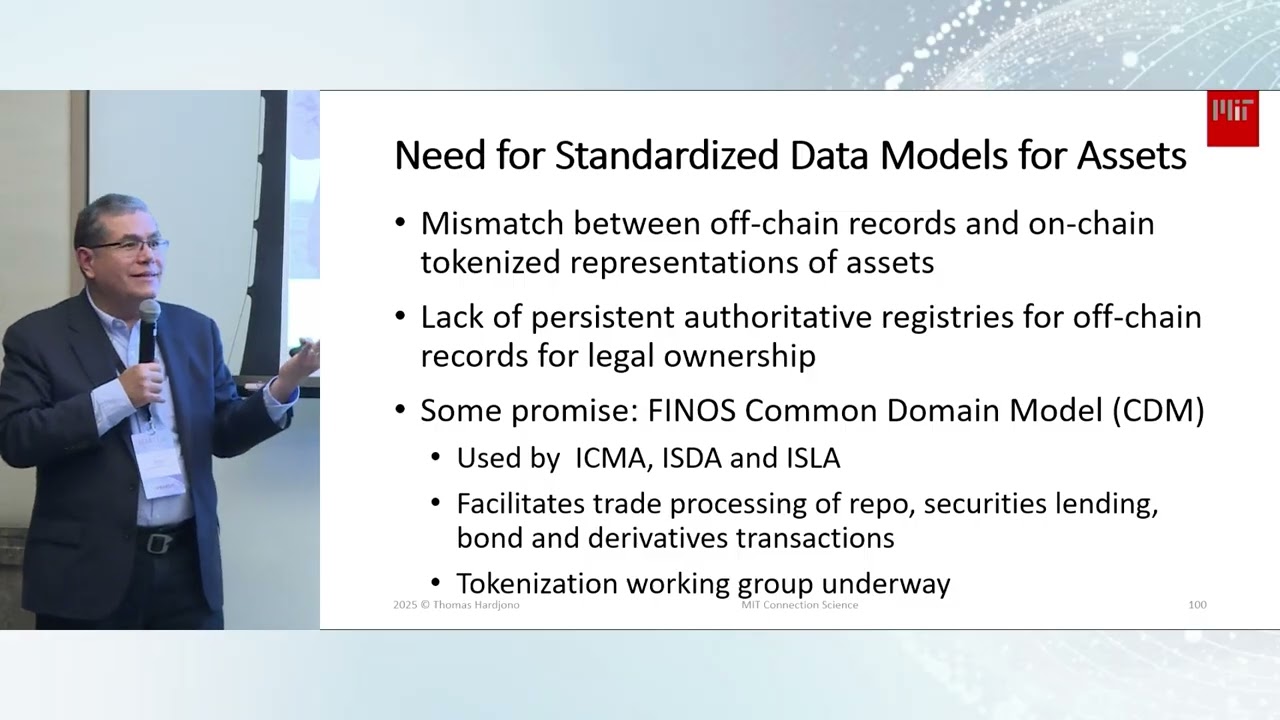
- Introduction of the data model concept and FINOS Common Domain Model.
- Explanation of the need for a general digital asset record and metadata for smart contracts.
- Discussion of the role of CSDs and the need for them to lead the dialogue.
- Proposal for a new standards development organization (SDO) modeled after the IETF.
- Q&A session begins with a question about quantum technology and Bitcoin mining.
- Discussion on quantum key distribution and the need for post-quantum cryptography.
- Question about the UAE's role in standardization and the potential for leadership.
- Debate on the role of DTCC and whether blockchain could replace it.
- Discussion on the importance of human accountability and legal liability in the workflow.
- Closing remarks and invitation for coffee and networking.
Cited Sources
- GENIUS Act — Mentioned as a US framework for stablecoins.
- CLARITY Act — Mentioned as a US regulatory framework.
- EU MiCA — Mentioned as EU regulation for crypto assets.
- FINOS Common Domain Model — Referenced as a data model for describing financial instruments.
- IETF — Mentioned as a model for standards development.
- SWIFT — Mentioned as a participant in interoperability discussions.
Concurring Sources
- FINOS Common Domain Model — Supports the need for standardized data models.
- IETF — Supports the idea of open standards development.
Contribution & Novelties
The talk provides a clear articulation of the need for standardization in tokenization, drawing parallels to the internet’s development. It highlights specific gaps such as the lack of a general digital asset record and the need for a neutral SDO. The proposal for a new standards body modeled after the IETF is a novel idea.
Pour aller plus loin :
- Common Domain Model (FINOS) — Directly related to the data model discussed.
- Internet Engineering Task Force (IETF) — The model for the proposed SDO.
- Tokenization of Real-World Assets — Provides background on the concept.
- Post-Quantum Cryptography — Relevant to the quantum threat discussion.
103 words
Radar Profile
The radar profile shows high scores in information quantity, quality, and reliability, with a slightly lower technical level. This indicates a well-informed expert talk that is accessible to a broad audience, with strong credibility but not deeply technical.
💬 No comments were provided for analysis.