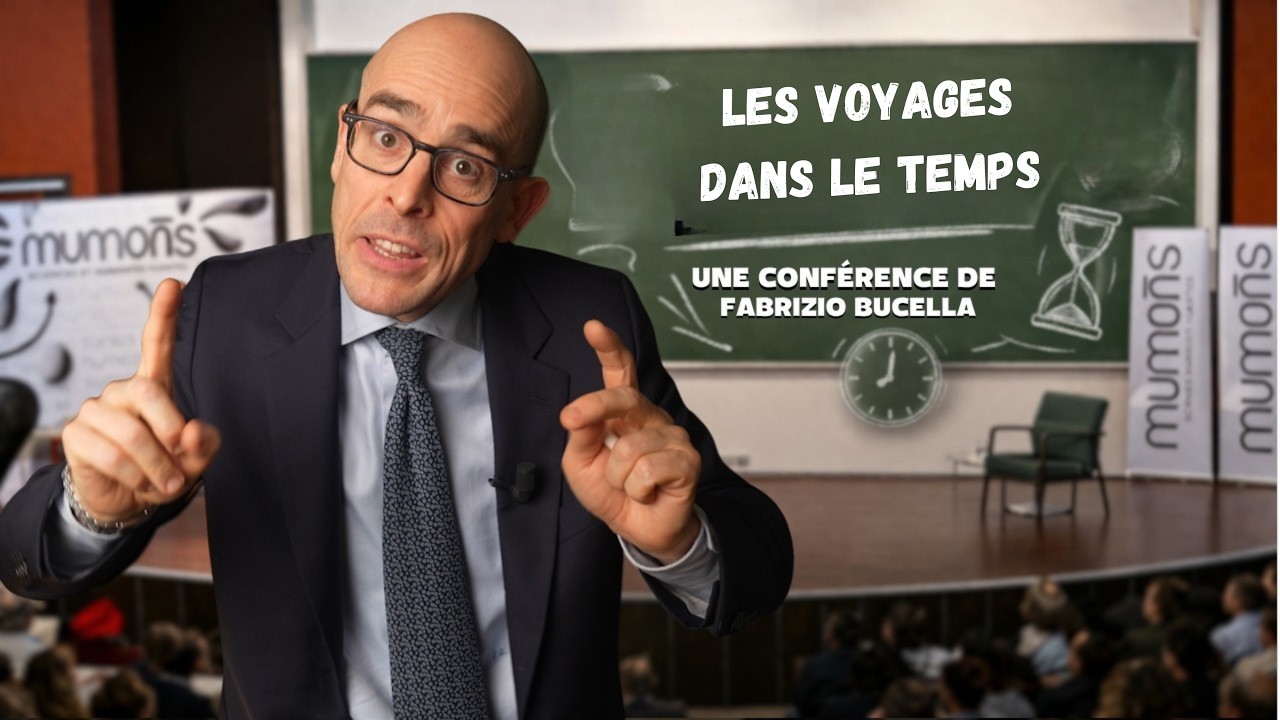
Les voyages dans le temps. Salukes #sience #physique #profbucella
Keywords
Summary
236 words
Critical Evaluation
The lecture provides a comprehensive and accessible overview of the twin paradox and time travel, grounded in established physics. Bucella demonstrates a strong command of the subject, having recalculated the physics himself, which adds credibility. The explanations are clear, using intuitive examples like the train and the twin scenario. The discussion of time travel covers key paradoxes and proposed resolutions, including the Novikov self-consistency principle and the chronological protection conjecture. However, the lecture lacks citations to external sources, relying solely on the speaker’s authority. While the content is accurate, the lack of references may limit its utility for further verification. The presentation is engaging and well-structured, with a logical flow from relativity to time travel. The inclusion of thought experiments and paradoxes makes it intellectually stimulating. The speaker’s enthusiasm is evident, and he effectively communicates complex ideas to a general audience. The main weakness is the absence of references to primary literature, which would enhance the scientific rigor. Additionally, the lecture does not delve into the mathematical details, which may be a limitation for those seeking a deeper understanding. Overall, this is a high-quality popular science lecture that successfully conveys the core concepts and open questions in the physics of time travel.
202 words
Title / Content Match
The title accurately reflects the content, which covers the twin paradox and time travel.
Quality & Reliability
8/10
The speaker is a professor who claims to have recalculated all the physics himself, and the content is based on established theories (special relativity, Novikov self-consistency principle, chronological protection conjecture). The presentation is rigorous, with clear explanations and references to scientific concepts. However, no external sources are cited in the video, and the speaker's authority is not independently verified.
Chapters
- Introduction
- Plan et relativité restreinte
- Principe de relativité Galilée
- Principe de relativité Einstein
- Expérience de l'avion
- Le paradoxe des jumeaux
- Simultanéité
- Les voyages dans le temps
- Le paradoxe du grand-père
- Le paradoxe de la question d'examen
- Le paradoxe de la boule de billard
- Conjecture de cohérence de Novikov
- Second principe de la thermodynamique
- Conjecture de protection chronologique
- La fête de Stephen Hawking
- L'expérience de la petite machine
- La théorie des histoires cohérentes
Contribution & Novelties
The lecture offers a clear and engaging synthesis of the twin paradox and time travel, emphasizing the conceptual challenges and proposed solutions. It stands out for its pedagogical approach, using relatable examples and paradoxes to illustrate abstract concepts.
Pour aller plus loin :
- Special relativity — Foundational theory behind the twin paradox.
- Twin paradox — Detailed explanation and resolution of the paradox.
- Novikov self-consistency principle — Principle that prevents time travel paradoxes.
- Chronology protection conjecture — Hawking’s conjecture on the impossibility of time travel.
84 words
Radar Profile
The radar profile shows high scores in quantity and quality of information, with a slightly lower technical level, indicating a well-balanced presentation that is both informative and accessible.