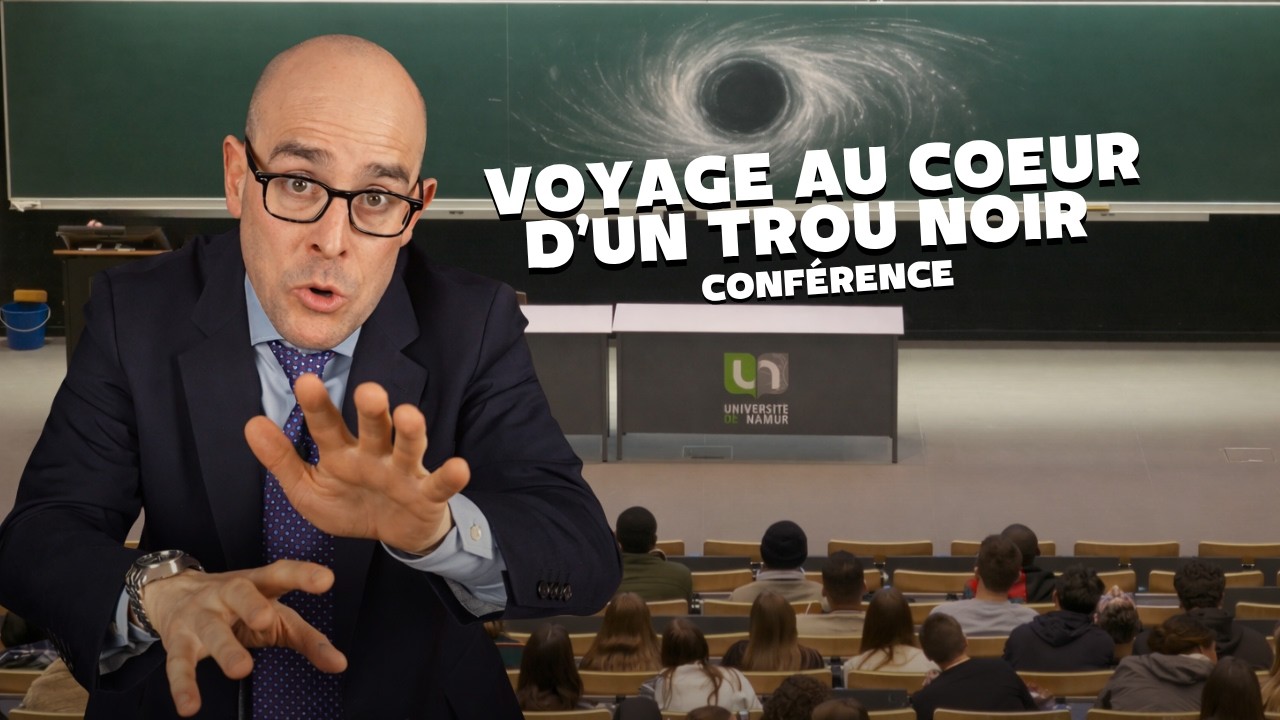
Voyage au Coeur d'un trou noir : Conférence à l’Université de Namur
Keywords
Summary
143 words
Critical Evaluation
The lecture excels in clarity and pedagogical effectiveness. Bucella’s use of a simple apple to demonstrate the concept of a black hole is a brilliant pedagogical tool, making an abstract idea tangible. He carefully explains the Schwarzschild radius and the escape velocity, ensuring that even without mathematical background, the audience grasps the fundamental principle. The discussion of infinities and the limits of general relativity is particularly valuable, as it highlights the ongoing quest for a quantum theory of gravity. The content is scientifically accurate, based on well-established physics, and avoids speculative theories, which enhances its reliability. The lecture’s structure, progressing from basic concepts to more complex implications, is logical and engaging. The only minor weakness is the lack of visual aids, but Bucella’s dynamic delivery compensates for this. The title accurately reflects the content, and the lecture fulfills its promise of a ‘voyage’ into black holes. Overall, this is an excellent example of high-quality science communication that respects the audience’s intelligence.
161 words
Title / Content Match
The title accurately reflects the content: a journey into black holes, both conceptually and metaphorically, as promised.
Quality & Reliability
9/10
The lecture is delivered by a university professor, based on established physics (general relativity), with clear explanations and no apparent misinformation. The content is consistent with current scientific understanding, though it does not delve into speculative theories.
Key Moments
Markers derived by PSI from the transcript: the creator did not define chapters.
- Introduction: the concept of a journey into a black hole, both metaphorical and physical.
- Demonstration with an apple: compressing Earth's mass into a small sphere creates a black hole.
- Explanation of the Schwarzschild radius and the event horizon.
- Discussion of infinities: black holes predict the end of general relativity.
- Formation of stellar black holes and the role of gravity.
- The fate of an explorer: tidal forces and spaghettification.
- Connections to the Big Bang and the end of the universe.
- Conclusion: the limits of current physics and the need for quantum gravity.
Cited Sources
- Black hole simulator — Interactive simulator mentioned in the description for exploring black holes.
Concurring Sources
- General relativity — The theory that predicts black holes.
Contribution & Novelties
The lecture provides a clear, rigorous introduction to black holes without oversimplification, using a unique pedagogical approach. It emphasizes the conceptual paradox that black holes are both predicted by and signal the breakdown of general relativity.
Pour aller plus loin :
- Schwarzschild radius — The concept of the radius at which an object becomes a black hole.
- Event horizon — The boundary beyond which nothing can escape.
- Spaghettification — The tidal stretching of objects near a black hole.
- Quantum gravity — The theoretical framework needed to resolve the infinities at singularities.
91 words
Radar Profile
The radar profile shows high scores in information quantity, quality, and reliability, with a slightly lower technical level, indicating a well-balanced lecture that is both informative and accessible.
💬 Très positif. Sur les 30 commentaires analysés, les spectateurs expriment un enthousiasme unanime, saluant la clarté des explications et la passion du professeur, sans aucune critique négative.