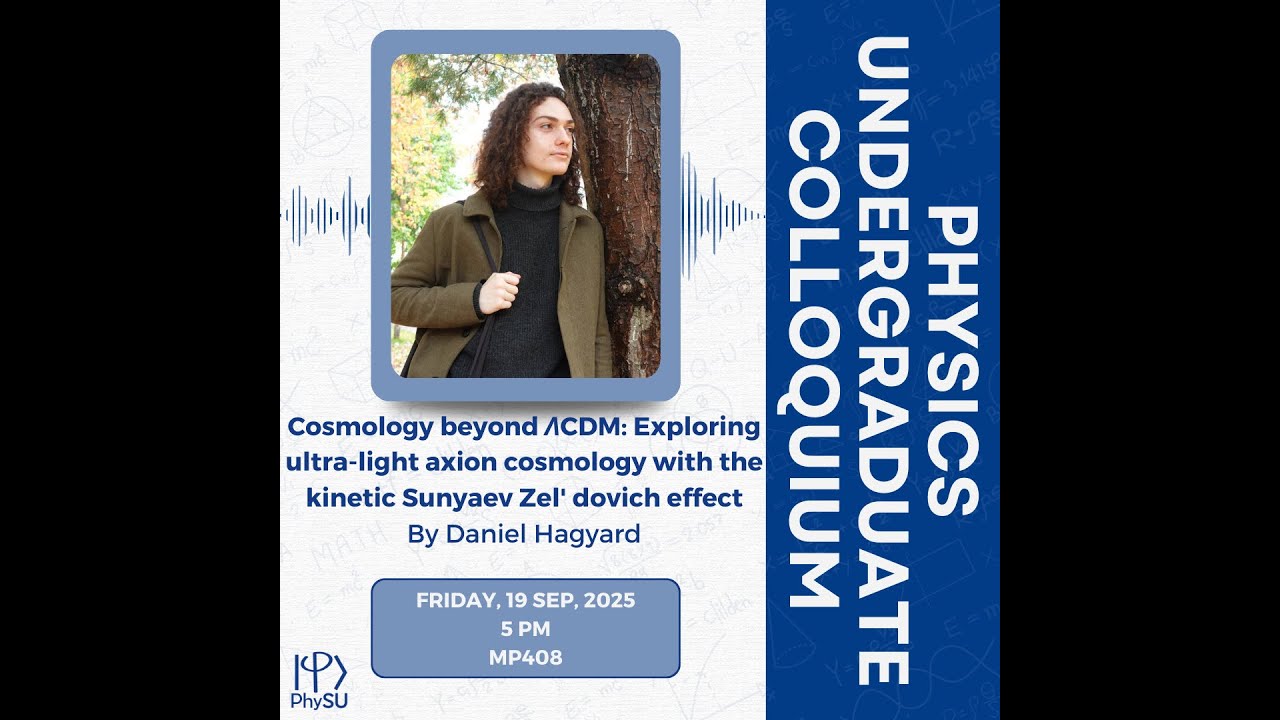
PhySU Colloquium - Exploring Cosmology Behind Lambda CDM: Ultralight Axion Cosmology and KSV effect
Keywords
Summary
196 words
Critical Evaluation
Value of the Information & Strength of the Argument
The presentation provides a clear and accessible introduction to advanced cosmology topics, effectively motivating the need for ultralight axions and explaining the kSZ effect. The argumentation is logically structured, building from basic concepts to the research application. However, the depth is limited by the undergraduate level, and some explanations are simplified. The speaker acknowledges uncertainties and invites questions, which adds to the credibility. The value lies in its educational merit and the presentation of a current research topic.
Scientific Rigor, Source Quality, Title Accuracy
The scientific rigor is moderate: the speaker accurately describes standard cosmological concepts and cites his research mentorship, but no specific sources are mentioned in the video. The title accurately reflects the content, focusing on ultralight axion cosmology and the kSZ effect. The presentation is based on the speaker’s own summer research, which adds authenticity but also limits the breadth of sources. No external references are provided in the description, only a link to sign up for future colloquia.
171 words
Title / Content Match
The title accurately reflects the content, which focuses on ultralight axion cosmology and the kinetic Sunyaev-Zel'dovich effect as a probe.
Quality & Reliability
7/10
The presentation is based on the speaker's summer research under a professor at the Dunlap Institute, and it accurately describes standard cosmological concepts (Lambda CDM, BAO, power spectrum). However, it is an undergraduate colloquium, so depth and rigor are limited, and no external sources are cited in the video.
Key Moments
Markers derived by PSI from the transcript: the creator did not define chapters.
- Introduction and overview of the presentation
- Motivation: Lambda CDM and the need for new physics
- Introduction to ultralight axions and the axiverse
- Explanation of the kinetic Sunyaev-Zel'dovich effect
- CMB temperature anisotropies and baryon acoustic oscillations
- Matter power spectrum and transfer functions
- Discussion of research methodology and results
- Q&A session and further discussion
Cited Sources
- Sign-up form for PhySU colloquia — Mentioned in the video description for students to sign up to present.
Concurring Sources
- Ultralight axions as dark matter candidates — General reference on axions and their role in cosmology.
- Kinetic Sunyaev-Zel'dovich effect — Provides background on the kSZ effect mentioned in the video.
Contribution & Novelties
The presentation offers an undergraduate-level overview of ultralight axion cosmology and the kinetic Sunyaev-Zel’dovich effect, based on the speaker’s summer research. It provides a pedagogical introduction to complex topics, making them accessible to a broader audience. The novelty lies in the synthesis of these concepts and the presentation of ongoing research.
Pour aller plus loin :
- Ultralight axion — Provides background on axions and their ultralight variants.
- Kinetic Sunyaev–Zel’dovich effect — Explains the kSZ effect in detail.
- Lambda-CDM model — Overview of the standard cosmological model.
86 words
Radar Profile
The radar profile shows a balanced presentation with moderate scores across all dimensions, indicating a solid but not exceptional scientific communication. The highest scores are in information quantity and quality, reflecting the comprehensive coverage of the topic, while the technical level is slightly lower, consistent with an undergraduate audience.