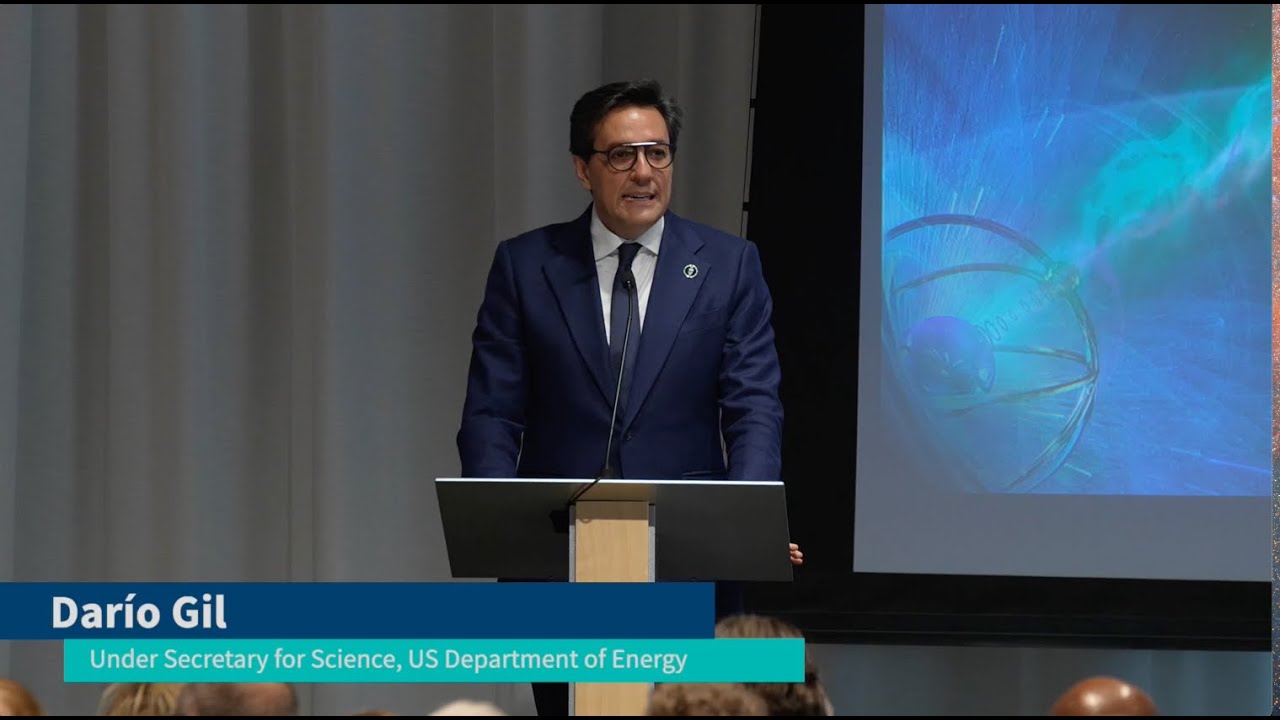
2025 Chicago Quantum Summit: Darío Gil, US Department of Energy
Keywords
Summary
158 words
Critical Evaluation
Value of the Information & Strength of the Argument
The talk provides valuable insights into the US government’s strategic priorities for quantum technology, including specific funding amounts and timelines. The argumentation is coherent, drawing on historical successes like the Exascale Computing Project to justify ambitious goals. However, it is primarily a policy statement rather than a technical presentation, and some claims, such as the attribution of the 2024 Nobel Prize in Physics, are factually incorrect (the prize was awarded to Hopfield and Hinton for machine learning, not to Martinis, Devoret, and Clarke). The speaker’s authority and the institutional backing lend weight to the message, but the lack of technical depth limits its scientific value.
Scientific Rigor, Source Quality, Title Accuracy
The talk is a policy speech, not a scientific presentation, so it does not cite specific sources. The title accurately reflects the content. The speaker’s position as DOE Undersecretary for Science lends authority, but the speech is not peer-reviewed. The description provides links to the Chicago Quantum Exchange and the summit, which are relevant but not sources for the scientific claims. The factual error regarding the Nobel Prize undermines the overall rigor.
192 words
Title / Content Match
The title accurately reflects the content: a keynote address by Darío Gil at the 2025 Chicago Quantum Summit.
Quality & Reliability
8/10
High-level official statement from the US DOE Undersecretary for Science, with concrete funding figures and policy commitments. However, it is a policy speech rather than a peer-reviewed scientific presentation, and some claims (e.g., Nobel Prize attribution) are factually inaccurate.
Key Moments
Markers derived by PSI from the transcript: the creator did not define chapters.
- Introduction of Darío Gil by the host.
- Gil begins his keynote, emphasizing the revolution in computing.
- Gil announces the goal of a fault-tolerant quantum computer by 2028.
- Gil discusses the DOE's history of user facilities and the Exascale Computing Initiative.
- Gil mentions the 2024 Nobel Prize in Physics (incorrectly attributing it to Martinis, Devoret, and Clarke).
- Gil announces the renewal of the five national QIS research centers with up to $625 million.
- Gil outlines the goals for the second phase of the quantum centers.
- Gil emphasizes the need for public-private partnerships and workforce development.
- Gil discusses the importance of supply chains and infrastructure.
- Gil concludes and opens the floor for questions.
Cited Sources
- Chicago Quantum Exchange — The organization hosting the summit.
- 2025 Chicago Quantum Summit — The event where this talk was given.
Concurring Sources
- DOE Office of Science — The DOE Office of Science oversees the quantum research centers and user facilities mentioned in the talk.
Dissenting Sources
- Nobel Prize in Physics 2024 — The talk incorrectly attributes the 2024 Nobel Prize in Physics to Martinis, Devoret, and Clarke, but it was actually awarded to John Hopfield and Geoffrey Hinton for foundational discoveries in machine learning.
Contribution & Novelties
This talk provides an authoritative overview of the US DOE’s strategic plans for quantum technology, including specific funding commitments and timelines. It highlights the convergence of AI, HPC, and quantum computing as a new scientific instrument, and sets a concrete goal of a fault-tolerant quantum computer by 2028. The announcement of the renewal of the five national QIS research centers with $625 million is a significant policy update.
Pour aller plus loin :
- National Quantum Initiative Act — Background on the 2018 legislation that established the quantum research centers.
- Exascale computing — Context on the DOE’s Exascale Computing Initiative, which serves as a model for the quantum effort.
- Quantum error correction — Key technical challenge addressed in the talk, relevant to achieving fault-tolerant quantum computers.
125 words
Radar Profile
The radar profile shows high scores in quantity of information and reliability, reflecting the speaker's authoritative position and the detailed policy announcements. The technical level is moderate, as the talk is aimed at a general scientific audience. The overall quality is strong, but the factual error regarding the Nobel Prize slightly reduces the reliability score.
💬 No comments were provided for analysis.