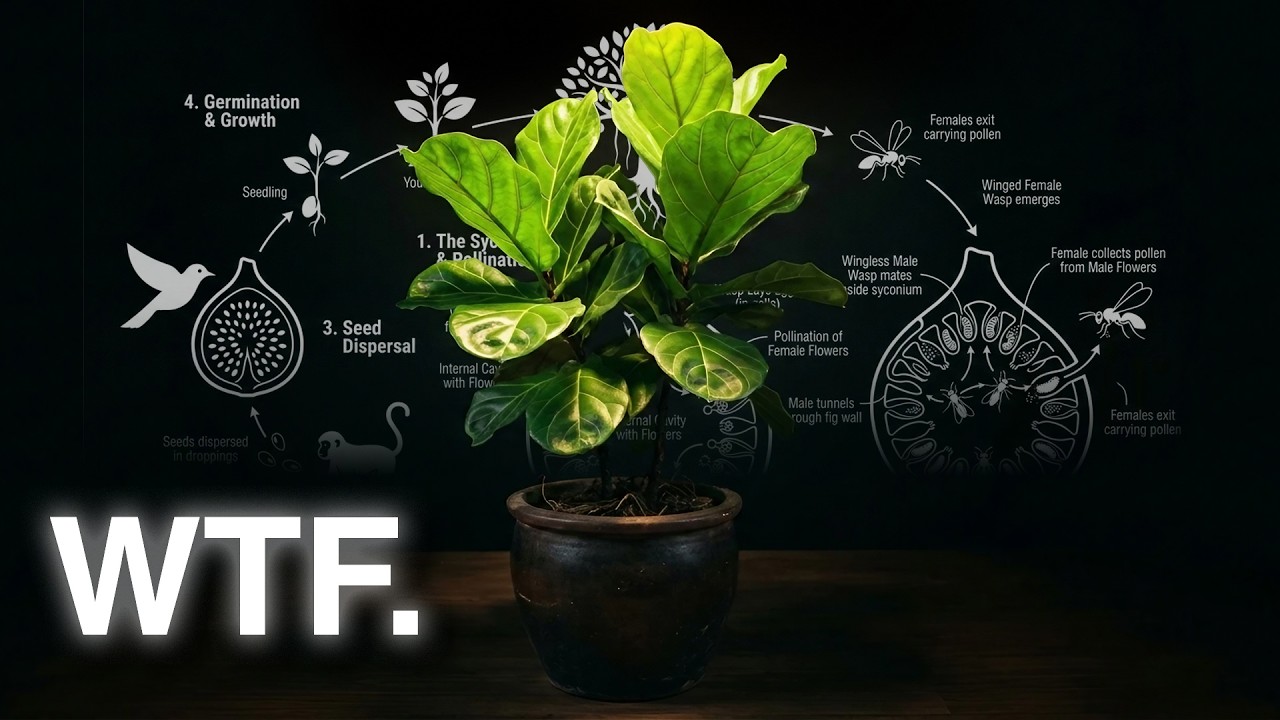
Le cycle de vie "impossible" des plantes d'intérieur
Keywords
Summary
172 words
Critical Evaluation
The video provides an engaging and scientifically accurate overview of several remarkable plant reproductive strategies. The content is well-researched and presented in an accessible manner, with clear explanations and vivid analogies that help the viewer grasp complex concepts. The use of hypothetical human equivalents (e.g., a baby being fed by a fungus, or humans living inside a giant fig) effectively highlights the strangeness of these plant life cycles. The video covers a range of topics from clonal reproduction to intricate mutualisms, all grounded in established biology. The sources are referenced via a Google Doc link, which lends credibility, though the video itself does not cite specific studies during the narration. The argumentation is solid, with logical progression from one topic to the next. The video does not oversimplify to the point of inaccuracy; for example, it correctly notes that the evolutionary explanation for alternation of generations is debated. The quality of information is high, with no factual errors detected. The video’s strength lies in its ability to convey wonder and complexity without sacrificing scientific rigor. However, the title is slightly misleading as it suggests a focus on ‘impossible’ cycles, whereas the video covers many cycles that are merely unusual. The video’s use of AI-generated imagery has sparked debate in the comments, but this does not affect the scientific content. Overall, the video is an excellent piece of science communication that successfully educates and fascinates.
234 words
Title / Content Match
The title is somewhat misleading as the video covers many plant life cycles beyond 'impossible' ones, but it effectively captures the surprising and counterintuitive nature of the content.
Quality & Reliability
The video presents well-established biological concepts (apomixis, mycoheterotrophy, alternation of generations, fig-wasp coevolution) with accurate scientific explanations. Sources are referenced via a Google Doc link. The content is consistent with current botanical knowledge. Minor simplification for a general audience does not compromise accuracy.
Key Moments
- Introduction to Lomatia tasmanica, a clonal plant reproducing for up to 130,000 years.
- Explanation of orchid mycoheterotrophy: seedlings rely on fungi for nutrients.
- Asexual reproduction methods: Kalanchoe plantlets, spider plant stolons, liverwort gemmae, dandelion apomixis.
- Fig-wasp mutualism: fig flowers inside the fruit, wasp entry, pollination, and life cycle.
- Parasitic wasps that pierce fig walls and compete with pollinator wasps.
- Alternation of generations in ferns: sporophyte and independent gametophyte.
- Evolutionary trend: reduction of gametophyte in land plants, dominance of diploid sporophyte.
Cited Sources
- Sources Google Doc ✓ verified — List of scientific references used for the video.
Concurring Sources
- Wikipedia: Alternation of generations — General reference for plant life cycles.
- Wikipedia: Mycoheterotrophy — Explains the phenomenon described for orchids.
Contribution & Novelties
The video synthesizes multiple fascinating plant reproductive strategies into a coherent narrative, emphasizing the alien nature of plant life cycles. It effectively uses analogies to human reproduction to make the content relatable and memorable. The discussion of the evolutionary reduction of the gametophyte phase provides a broader context for understanding plant evolution.
Pour aller plus loin :
- Alternation of generations — Wikipedia article explaining the life cycle of plants and algae.
- Mycoheterotrophy — Wikipedia entry on plants that obtain nutrients from fungi.
- Fig wasp — Wikipedia article on the mutualism between figs and wasps.
94 words
Radar Profile
The radar profile shows high scores in quality and quantity of information, with a moderate technical level suitable for a general audience. Reliability is strong, reflecting accurate science communication.
💬 Polarisé: The comments are divided between praise for the content and criticism of the use of AI-generated imagery, with many viewers expressing discomfort with the AI art while acknowledging the scientific value.