Une nouvelle théorie ƎꓕNⱯSꓤƎꓥNƎꓤ des individus
Keywords
Summary
133 words
Critical Evaluation
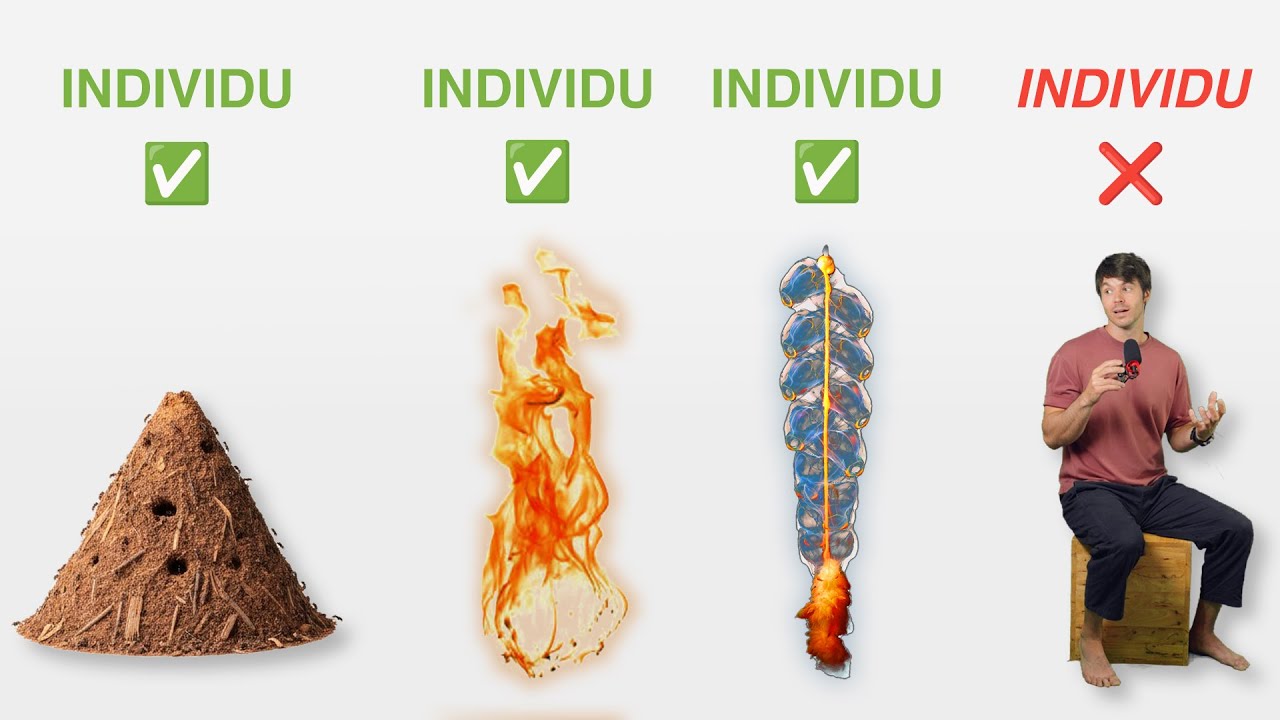
The video provides a compelling and well-structured argument against the conventional notion of individuality. It draws on a diverse range of biological examples, each clearly explained and illustrated, to demonstrate that the boundaries of an individual are not always clear-cut. The examples are scientifically accurate and well-chosen, covering colonial organisms, clonal species, and life-cycle stages. The presenter uses a conversational and humorous tone, which makes the content accessible without sacrificing rigor. The video references a source document (Google Doc) that likely contains citations, though the specific sources are not directly shown in the video itself. The argumentation is logical: it starts with intuitive definitions, then systematically presents counterexamples that challenge those definitions, and finally suggests that individuality is a spectrum or a matter of perspective. The video does not present original research but synthesizes existing knowledge in an engaging way. The quality of information is high, and the reasoning is sound. The title is clever and appropriate, though the reversed text may be confusing at first. The video’s main strength is its ability to make complex biological concepts accessible and thought-provoking. One minor weakness is that it does not delve deeply into the philosophical implications or alternative definitions (e.g., genetic, functional, evolutionary individuality), but this is acceptable given its scope. Overall, the video is an excellent piece of science communication that successfully challenges viewers’ assumptions.
225 words
Title / Content Match
The title is cleverly reversed (RENVERSANTE) and accurately reflects the video's theme of redefining individuality through surprising biological examples.
Quality & Reliability
The video presents well-documented biological examples (e.g., Synalpheus shrimp, Pyrosomes, siphonophores, Dictyostelium, ferns, Lomatia tasmanica) and references a source document. The reasoning is logical and based on established scientific concepts, though the presenter's style is informal and includes humor. The information is accurate and up-to-date.
Key Moments
- Introduction: intuitive definition of individual as spatially bounded.
- Example of Synalpheus shrimp colonies as superorganisms.
- Pyrosomes and Rhabdopleura: colonial tunicates and their structure.
- Siphonophores (e.g., Portuguese man o' war) with specialized zooids.
- Dictyostelium discoideum: slime mold aggregation and life cycle.
- Ferns and mosses: two-stage life cycle (sporophyte and gametophyte).
- Lomatia tasmanica: clonal tree colony as a single individual.
- Discussion: implications for defining individuality.
Cited Sources
- Sources document for the video ✓ verified — Referenced in the video description as the source of scientific references.
Concurring Sources
- Superorganism — Supports the concept of colonies as individuals.
Contribution & Novelties
The video’s original contribution lies in its accessible synthesis of multiple biological examples that collectively challenge the intuitive concept of individuality. It effectively communicates that individuality is not a binary property but a continuum, and that many organisms exist as ‘meta-individuals’ or superorganisms. This perspective is not new to biology but is presented in a way that is engaging and thought-provoking for a general audience.
Pour aller plus loin :
- Superorganism — Wikipedia article on superorganisms, covering eusocial insects and colonial organisms.
- Siphonophorae — Wikipedia page on siphonophores, detailing their colonial structure and specialization.
- Dictyostelium discoideum — Wikipedia article on the social amoeba, describing its aggregation and multicellular stage.
109 words
Radar Profile
The radar profile shows high scores in quantity and quality of information, reflecting the video's rich content and accuracy. The technical level is moderate, suitable for a general audience. The overall reliability is high, supported by referenced sources.
💬 Positif. Sur les 30 commentaires analysés, le public exprime un fort enthousiasme pour le sujet et la qualité de la vidéo, avec des discussions approfondies sur les implications philosophiques et biologiques.