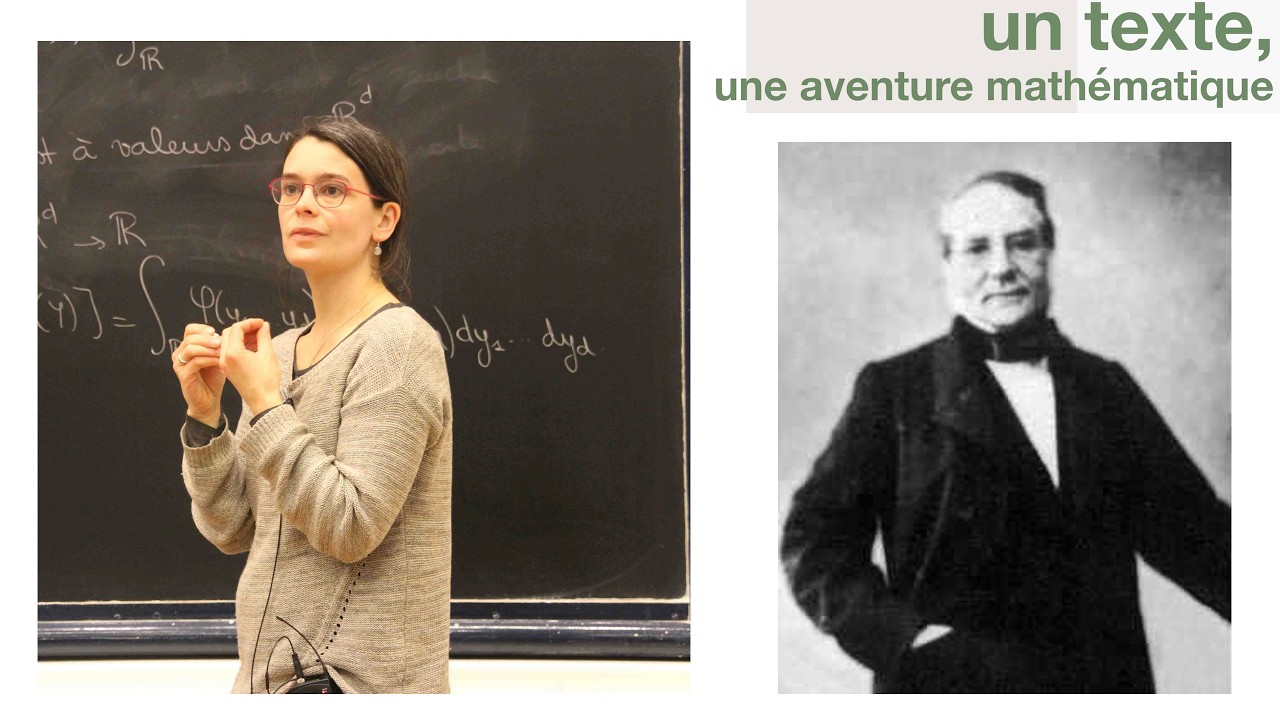
Bienaymé et l'extinction des familles
Keywords
Summary
147 words
Critical Evaluation
Value of the Information & Strength of the Argument
The lecture provides valuable insights into the historical development of probability theory and the contributions of a relatively unknown mathematician. The speaker effectively argues for Bienaymé’s importance by presenting his work in context and comparing it with later developments. The argumentation is solid, as she clearly explains the mathematical model and its implications, and supports her claims with historical evidence and references.
Scientific Rigor, Source Quality, Title Accuracy
The scientific rigor is high: the speaker is a professional mathematician, and she bases her presentation on historical documents and mathematical proofs. The sources cited include the original text by Bienaymé and the work of Heyde and Seneta. The title accurately reflects the content, and the lecture is well-structured. The description provides links to the SMF website for further information.
137 words
Title / Content Match
The title accurately reflects the content, which focuses on Bienaymé's work on the extinction of family names and the mathematical model he introduced.
Quality & Reliability
8/10
The conference is given by a professional mathematician (Sandrine Dallaporta) and is based on historical documents and mathematical results. The speaker is credible, and the content is well-structured. However, the video is a recording of a public lecture, not a peer-reviewed publication, and some historical details may be simplified.
Key Moments
Markers derived by PSI from the transcript: the creator did not define chapters.
- Introduction and welcome by the BnF and SMF representatives.
- Presentation of Sandrine Dallaporta's background and research.
- Biographical overview of Irénée-Jules Bienaymé, including his career and political context.
- Discussion of Bienaymé's contributions to least squares and the Bienaymé-Chebyshev inequality.
- Introduction to the problem of extinction of family names and Galton's question.
- Presentation of Bienaymé's 1845 note and its rediscovery by Heyde and Seneta.
- Formal definition of the Bienaymé-Galton-Watson process and the criticality theorem.
- Modern applications of branching processes in various fields.
- Conclusion and Q&A session.
Cited Sources
- SMF membership page — Mentioned as a way to support the SMF.
- Conference page on SMF website — Official page for the conference, providing details and possibly additional resources.
Concurring Sources
- Heyde, C.C. & Seneta, E. (1977). I.J. Bienaymé: Statistical Theory Anticipated. — The book by Heyde and Seneta is mentioned in the lecture as a source for Bienaymé's contributions.
Contribution & Novelties
The lecture sheds light on the often-overlooked contributions of Bienaymé, highlighting his priority in the discovery of the branching process. It provides a clear and accessible explanation of the mathematical model and its historical context, making it valuable for both students and enthusiasts of mathematics.
Pour aller plus loin :
- Bienaymé-Galton-Watson process — Provides a detailed mathematical treatment and historical background.
- Branching process — General overview of branching processes and their applications.
- Irénée-Jules Bienaymé — Biographical information and contributions.
- Chebyshev’s inequality — Related to Bienaymé’s work on probability bounds.
89 words
Radar Profile
The radar profile shows high scores in information quantity, quality, technical level, and reliability, indicating a well-rounded and informative lecture. The speaker's expertise and the historical depth contribute to a strong overall performance.
💬 No comments were provided for analysis.