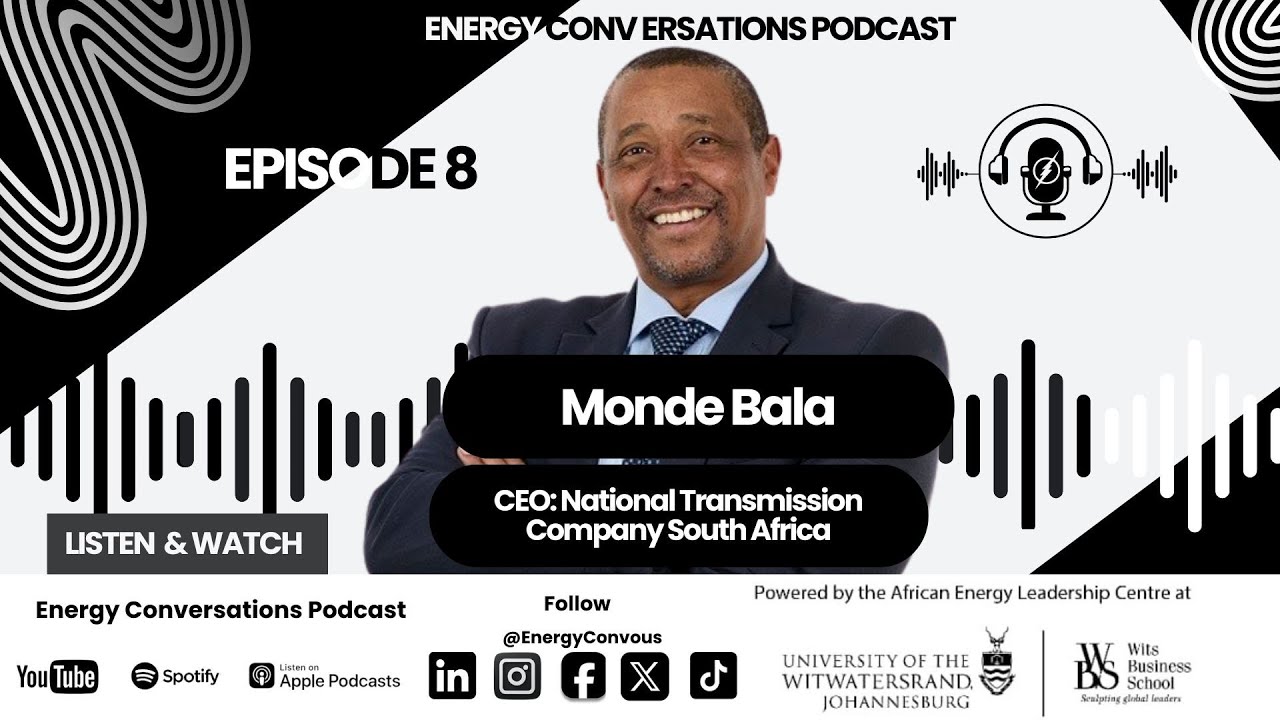
Building the Backbone: How NTCSA is Leading South Africa’s Energy Future
Keywords
Summary
203 words
Critical Evaluation
Value of the Information & Strength of the Argument
The value of the information is high for those interested in South Africa’s energy sector, as it provides firsthand insights from a key decision-maker. The argumentation is coherent and well-structured, with Bala clearly explaining the rationale behind the NTCSA’s strategies, such as the need for private investment and the importance of grid expansion for renewable integration. However, the discussion is largely promotional, lacking critical examination of potential obstacles or alternative viewpoints.
Scientific Rigor, Source Quality, Title Accuracy
The scientific rigor is moderate; the content is based on the expert’s professional experience and official plans, but no external sources are cited. The title accurately reflects the content. No comments were provided for analysis.
121 words
Title / Content Match
The title accurately reflects the content, which focuses on the NTCSA's role in South Africa's energy future.
Quality & Reliability
7/10
The content is an expert interview with the CEO of NTCSA, providing authoritative insights into South Africa's transmission grid expansion and energy transition. The information is current and directly from a key stakeholder, but it is largely promotional and lacks independent verification or critical analysis.
Key Moments
Markers derived by PSI from the transcript: the creator did not define chapters.
- Introduction to the episode and guest Monde Bala, CEO of NTCSA.
- Bala discusses the rapid changes in South Africa's energy landscape and the need for grid expansion.
- Discussion on the 14,000 km of new transmission lines planned and the challenges of execution.
- Bala explains the role of the Independent Transmission Programme (ITP) and private sector participation.
- Discussion on grid congestion in the Northern Cape and the need for spatial planning.
- Bala outlines the NTCSA's responsibilities as system operator and the importance of grid stability.
- Explanation of the market operator and central purchasing agency roles in the electricity market reform.
- Discussion on integrating renewable energy and the challenges of intermittency and grid inertia.
- Bala emphasizes the need to rebuild skills and supply chain capacity for the grid expansion.
Cited Sources
- Transmission Development Plan (TDP) — Mentioned as the plan outlining the 14,000 km of new transmission lines and 56 GW of new generation capacity.
- Independent Transmission Programme (ITP) — Discussed as a subset of the TDP to attract private investment for grid expansion.
- Electricity Regulation Amendment Act — Referenced as the legislative framework shaping the NTCSA's evolving role.
Concurring Sources
- South Africa's Integrated Resource Plan (IRP) — The IRP outlines the country's energy mix and generation capacity targets, aligning with the need for grid expansion.
Dissenting Sources
- Eskom's financial challenges — The video does not address the financial constraints and operational issues that may affect the NTCSA's ability to execute its plans.
Contribution & Novelties
The video provides an insider perspective on the NTCSA’s strategic priorities and the challenges of expanding South Africa’s transmission grid. It offers unique insights into the ITP and the need for private investment, as well as the operational role of the system operator. The discussion highlights the economic opportunities associated with the grid expansion, such as job creation and reindustrialization.
Pour aller plus loin :
- South Africa’s Just Energy Transition — Provides context on the broader energy transition in South Africa.
- Eskom — Background on the utility from which NTCSA was unbundled.
- Transmission system operator — Explains the role of system operators in maintaining grid stability.
106 words
Radar Profile
The radar profile shows high scores in information quantity and reliability, reflecting the expert's authoritative knowledge. The technical level is moderate, indicating the content is accessible to a general audience while still providing detailed insights. The overall balance suggests a valuable but not deeply technical discussion.