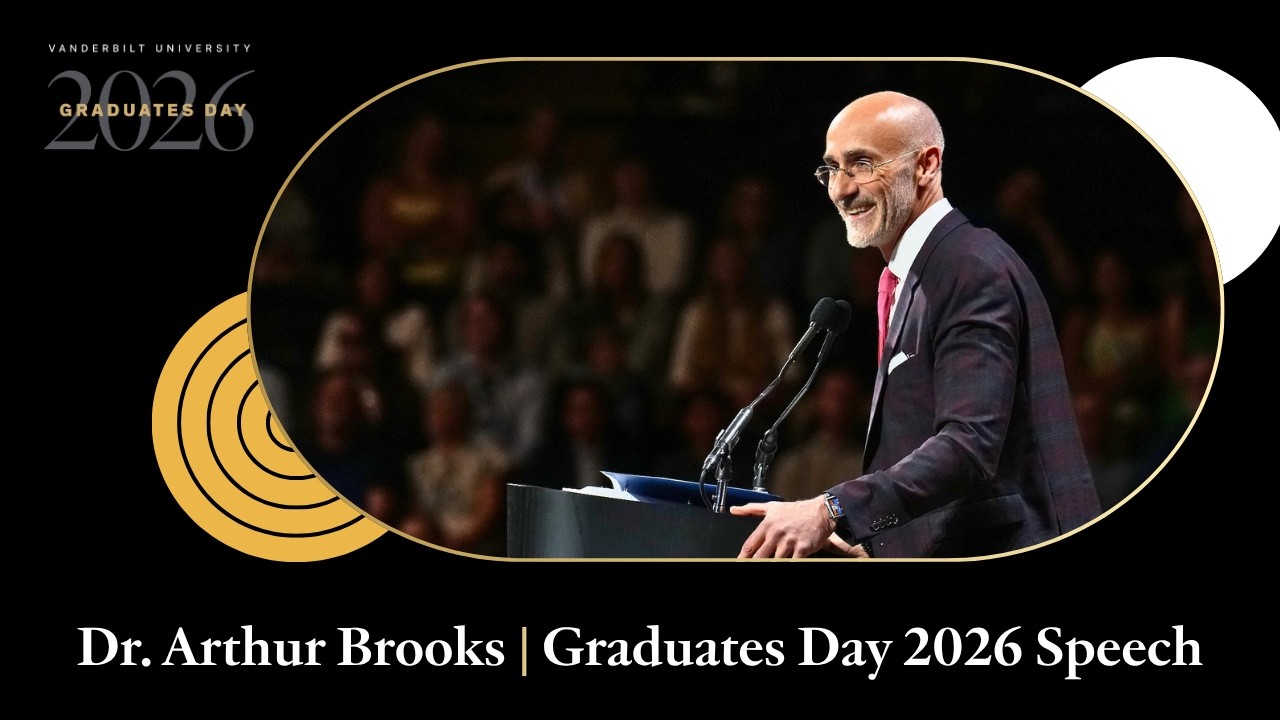
Arthur Brooks Graduates Day Speech 2026
Keywords
Summary
175 words
Critical Evaluation
Value of the Information & Strength of the Argument
The speech provides valuable insights into the science of happiness, drawing on research in psychology and neuroscience. Brooks effectively argues that meaning is found through right-brain activities such as love, service, and transcendence, and he supports his claims with references to specific studies and experts. The argumentation is persuasive and well-structured, using personal stories to illustrate his points. However, some claims are presented without detailed evidence, and the speech is more motivational than rigorously scientific.
Scientific Rigor, Source Quality, Title Accuracy
Brooks cites several researchers and studies, including Daniel Gilbert’s boredom experiments, James Booth’s work on language lateralization, Erin Calipari’s research on addiction, and Georgine Troseth’s studies on dialogic questions. These references lend credibility to his arguments. The title accurately reflects the content, and the speech aligns with the occasion. The description provides links to Vanderbilt’s social media, but no direct sources for the claims made.
155 words
Title / Content Match
The title accurately reflects the content: a commencement speech by Arthur Brooks at Vanderbilt University's Graduates Day 2026.
Quality & Reliability
8/10
The speech is based on established research in psychology and neuroscience, citing specific researchers (e.g., Daniel Gilbert, James Booth, Erin Calipari, Georgine Troseth) and presenting data on mental health trends. However, it is a motivational speech, not a peer-reviewed scientific presentation, and some claims are simplified or anecdotal.
Chapters
Cited Sources
- Vanderbilt University Social Media — Official social media hub for Vanderbilt University, mentioned in the video description.
- Vanderbilt University YouTube Channel — Official YouTube channel of Vanderbilt University, where the video is hosted.
- Vanderbilt University LinkedIn — Official LinkedIn page of Vanderbilt University, mentioned in the video description.
Concurring Sources
- Vanderbilt University — The university's official website, which may contain information about the event and Arthur Brooks' appointment.
Contribution & Novelties
The speech offers a compelling synthesis of happiness research and practical advice for graduates, emphasizing the importance of right-brain activities for finding meaning. It provides a framework for understanding the modern crisis of meaninglessness and offers actionable steps to counteract it.
Pour aller plus loin :
- Default Mode Network — The brain network associated with mind-wandering and self-reflection, central to Brooks’ argument about boredom.
- Hemispheric Lateralization — The concept that the two brain hemispheres have different functions, which Brooks uses to explain the need for both analytical and intuitive thinking.
- Daniel Gilbert’s research on happiness — A key psychologist cited by Brooks, known for his work on affective forecasting and happiness.
111 words
Radar Profile
The radar chart shows a balanced profile with high scores in information quality and reliability, moderate scores in information quantity and technical level. This indicates a well-argued, credible speech that is accessible to a general audience, with a strong emphasis on scientific backing.