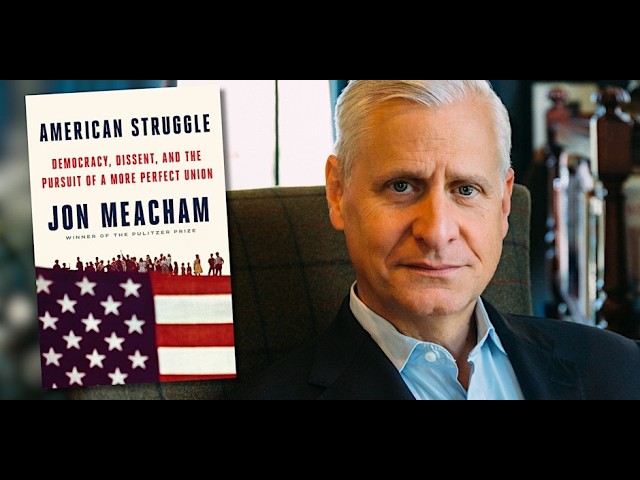
Jon Meacham discusses his latest book in conversation with John M. Seigenthaler
Keywords
Summary
155 words
Critical Evaluation
Value of the Information & Strength of the Argument
The value of the information lies in Meacham’s deep historical knowledge and his ability to connect past struggles to present challenges. He provides specific historical examples, such as the certification of the 1860 election by John Breckenridge, to illustrate the importance of constitutional norms. His argumentation is coherent and persuasive, though it is clearly partisan, advocating for a particular interpretation of current events. He uses rhetorical devices and personal anecdotes to engage the audience, but the lack of formal citations and the reliance on his own authority may limit the argument’s academic rigor.
Scientific Rigor, Source Quality, Title Accuracy
Meacham demonstrates scholarly rigor by referencing primary sources and historical figures, but he does not provide specific citations or footnotes. The sources he mentions, such as Frederick Douglass and the Federalist Papers, are credible, but the discussion is more conversational than academic. The title accurately reflects the content, as it is a book discussion. The conversation is well-structured, but the lack of formal sourcing and the presence of partisan commentary reduce the overall scientific rigor.
183 words
Title / Content Match
The title accurately describes the content: a conversation about Meacham's latest book.
Quality & Reliability
8/10
Discussion by a Pulitzer Prize-winning historian, grounded in historical sources and personal expertise, but with a clear political stance and no formal citations.
Key Moments
Markers derived by PSI from the transcript: the creator did not define chapters.
- Meacham jokes about the book's success and its ranking on the New York Times bestseller list.
- Meacham explains the motivation for the book, referencing Charlottesville and the January 6th attack.
- Discussion of the book's structure as an anthology of primary voices, including George H.W. Bush and Frederick Douglass.
- Meacham discusses the importance of the Declaration of Independence and the phrase 'all men are created equal'.
- Meacham talks about the founders' concerns about tyranny and the Constitution's checks and balances.
- Meacham argues that the current threat to constitutional order is grave, citing the norm of accepting election results.
- Meacham reads from a Foreign Affairs article by Steven Levitsky on competitive authoritarianism.
- Meacham discusses the need to make a historical case without mentioning the current president, and the importance of appealing to undecided voters.
- Meacham reflects on the impact of threats on historians and the importance of resisting intimidation.
Cited Sources
- Vanderbilt University social media directory — Mentioned in the video description as a resource for following Vanderbilt University.
- Vanderbilt University YouTube channel — Mentioned in the video description as a place to subscribe for more content.
- Vanderbilt University LinkedIn page — Mentioned in the video description as a social media link.
Concurring Sources
- The Federalist Papers — Meacham references Alexander Hamilton's Federalist No. 1, aligning with the argument that the Constitution was designed to check power.
- Frederick Douglass's writings — Meacham highlights Douglass as a key voice in the book, and his speeches align with the theme of striving for a more perfect union.
Dissenting Sources
- None — No discordant sources were mentioned in the video.
Contribution & Novelties
The video provides a unique perspective on American history as a tool for understanding current political crises. Meacham’s approach of using primary sources to illustrate recurring themes offers a valuable framework for analyzing contemporary issues. The discussion is particularly insightful in its emphasis on the fragility of democratic norms and the importance of historical precedent.
Pour aller plus loin :
- The Federalist Papers — Essential for understanding the Constitution’s design and the founders’ intentions.
- Frederick Douglass’s ‘What to the Slave Is the Fourth of July?’ — A powerful speech that illustrates the tension between American ideals and reality.
- Steven Levitsky and Daniel Ziblatt’s ‘How Democracies Die’ — A key work on the erosion of democratic norms, referenced in the video.
120 words
Radar Profile
The radar profile shows high scores in information quantity, quality, and reliability, with a moderate technical level. This indicates a content-rich discussion that is accessible to a general audience but lacks deep technical or methodological detail.