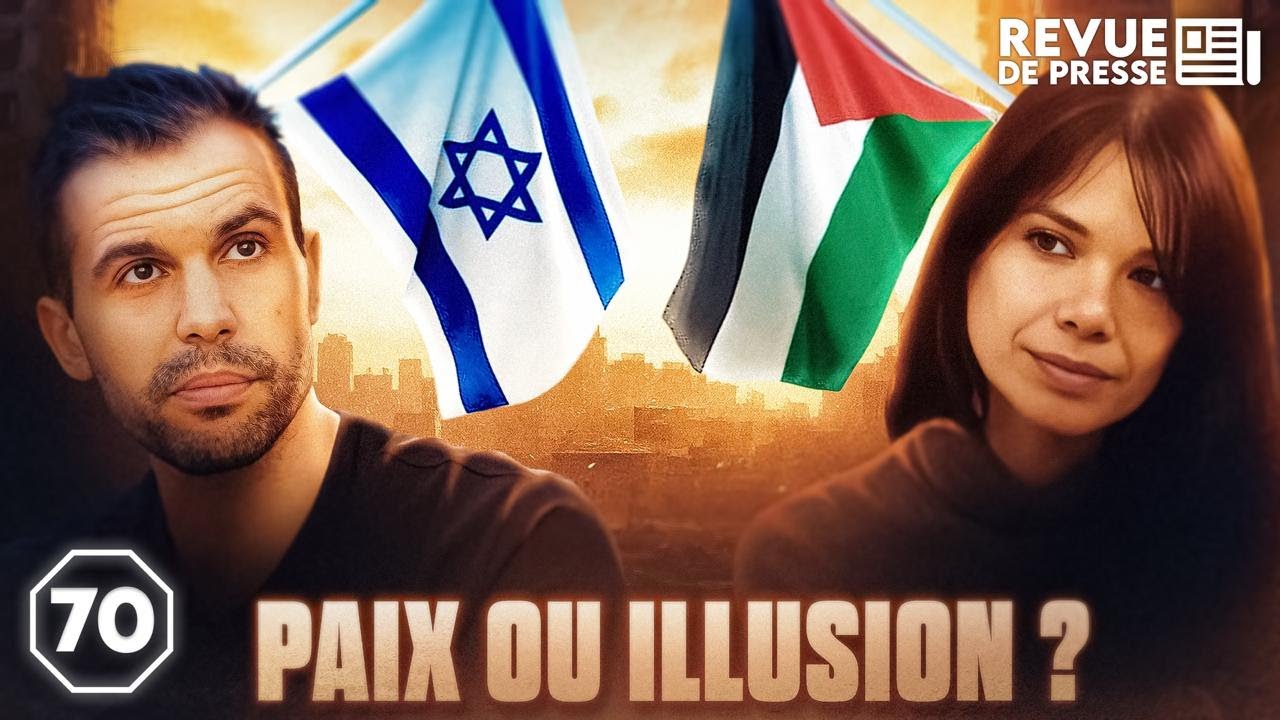
Israël–Hamas : ce cessez-le-feu peut-il vraiment tenir ? #Octogone70 11/10/2025
Israel–Hamas: can this ceasefire really hold? #Octogone70 11/10/2025
Keywords
Summary
134 words
Critical Evaluation
Value of the Information & Strength of the Argument
The video provides a comprehensive review of current geopolitical events, offering multiple angles and historical context. The hosts’ arguments are structured and they support claims with specific numbers and references to official reports. However, the discussion is heavily opinionated, particularly regarding the US role and Venezuelan politics, and lacks balanced representation of counterarguments. The hosts often rely on framing that aligns with a critical perspective on US imperialism, but they do present counterpoints when discussing internal Israeli politics. Overall, the value lies in its informative synthesis, while the argumentation is persuasive but one-sided.
Scientific Rigor, Source Quality, Title Accuracy
The sources mentioned include a UN inquiry report, news outlets like Haaretz and Times of Israel, and a French journalist’s video essay. No direct links are provided in the description, but the hosts cite these verbally. The title accurately reflects the central question about the ceasefire’s sustainability. However, the video does not offer formal citations or verification, and some claims are presented without sourcing. The adequacy between title and content is high, focusing on the key issue. The lack of rigorous source documentation lowers the scientific quality.
195 words
Title / Content Match
The title asks if the ceasefire can hold; the video directly addresses this, presenting arguments for both sides and expert skepticism, so the adequacy is good.
Quality & Reliability
7/10
The discussion cites specific figures (e.g., 67,194 deaths, 20 hostages) and references official documents (UN report), but relies heavily on personal interpretation and commentary without direct citations or verification.
Key Moments
Markers derived by PSI from the transcript: the creator did not define chapters.
- Introduction to Octogone 70 and reading of ceasefire agreement details.
- Discussion of skepticism about ceasefire durability and internal Israeli opposition.
- Analysis of UN genocide report and international pressure on Israel.
- Transition to Nobel Peace Prize awarded to María Corina Machado.
- Detailed account of Machado's role in the 2002 coup and her early political career.
- Discussion of Machado's political ideology, parallels to Pinochet and Thatcher, and critique of media portrayal.
Cited Sources
- Scanderia platform — Link to Scanderia's free platform from video description.
- Scanderia subscription — Link to subscribe to the channel.
Contribution & Novelties
The video provides a synthesis of recent geopolitical events, offering a critical perspective not commonly found in mainstream media. It draws connections between the ceasefire agreement, international pressure, and the Nobel Prize controversy, while also diving into the biography of María Corina Machado. This adds depth to public discussion of these topics. The original value lies in the hosts’ ability to present a cohesive narrative linking these issues, though it is not based on novel research.
Pour aller plus loin :
- 2002 Venezuelan coup d’état — Provides historical context for the episode’s discussion of Machado’s involvement.
- María Corina Machado — Biographical overview that complements the video’s critique of media portrayals.
- National Endowment for Democracy — Relevant to the funding of opposition groups like Súmate.
124 words
Radar Profile
The radar likely shows high scores for information quantity and quality, moderate for technical level, and lower for factual reliability due to reliance on opinion. This suggests a well-informed but not fully rigorous analysis.
💬 Out of 30 comments analyzed, the sentiment is predominantly positive, with viewers appreciating the geopolitical expertise and the broad range of topics covered.