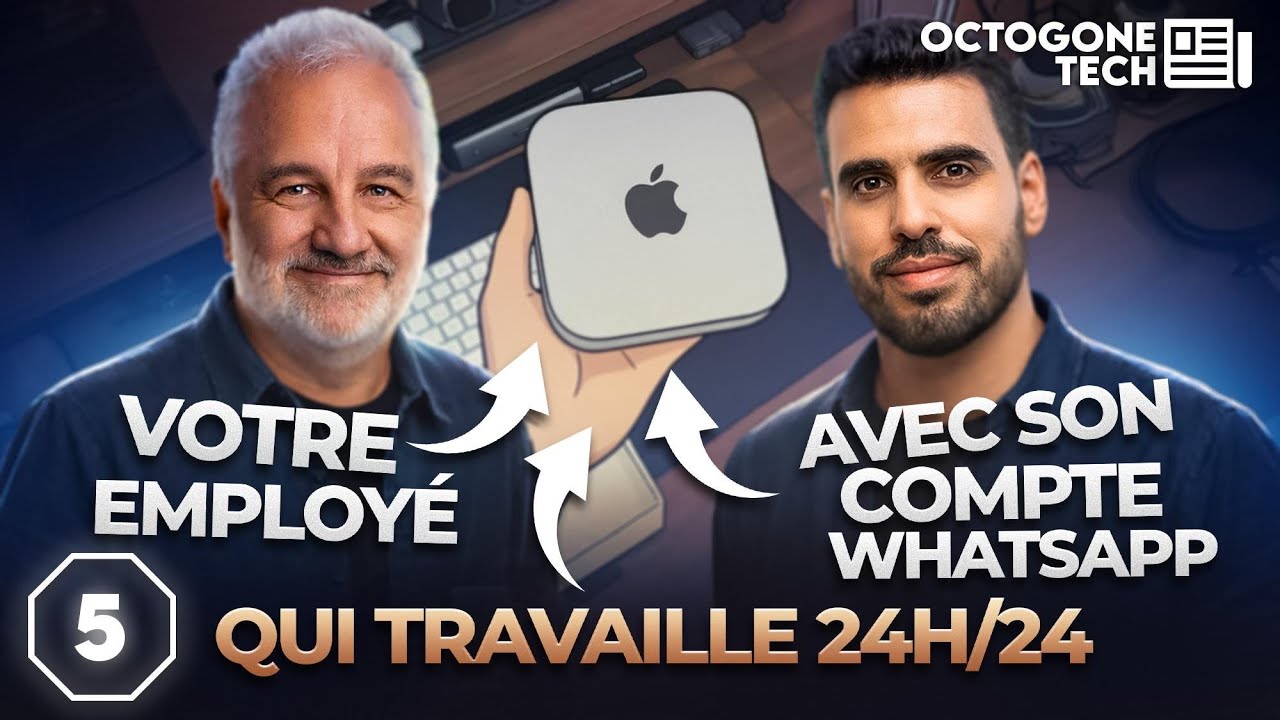
Clawdbot sur Mac Mini : L'Employé Numérique Qui Ne Dort Jamais ! Octogone Tech avec Philippe Anel
Keywords
Summary
152 words
Critical Evaluation
Value of the Information & Strength of the Argument
The video offers substantial value by connecting diverse news items—vibe coding, large-scale AI-generated code, local agent deployment, and governance implications—into a coherent narrative about the shifting software economy. The argumentation is generally lively and well-structured, with Idriss providing analogies (e.g., 1920s radio/aviation) and Philippe contributing technical depth on agent orchestration and adversarial approaches. However, some claims are presented without direct evidence or sources, and the discussion occasionally digresses (e.g., carbonara). The strength of argumentation lies in the practical examples and the credibility of the guest, but lacks systematic citation.
Scientific Rigor, Source Quality, Title Accuracy
The scientific rigor is moderate: the hosts reference several external sources (Linus Torvalds’ statements, Cursor’s blog post, Linux Tech Tips) but do not provide hyperlinks or verifiable data for most claims. The information appears plausible and aligns with trends known in the AI community, but it is presented in an informal talk show format rather than a peer-reviewed analysis. The title accurately highlights Clawdbot on Mac Mini but the content covers a wider scope, making the title partially representative. Regarding viewer comments: among the 30 provided, the sentiment is predominantly positive, with many thanking for clarity and expressing interest in the topics, alongside a few comments from older viewers feeling overwhelmed and several promotional mentions of a third-party tool (Pneumatic Workflow).
225 words
Title / Content Match
Title highlights Clawdbot on Mac Mini, a core topic, but the episode covers many other subjects (vibe coding, Cursor, OpenAI, agents), so the match is partial.
Quality & Reliability
6/10
Informative discussion with credible guest, but many claims are not sourced; promotional segments and digressions reduce rigour.
Key Moments
Markers derived by PSI from the transcript: the creator did not define chapters.
- Introduction on the 2020s, analogy with radio and aviation.
- Discussion on vibe coding and Linus Torvalds' endorsement.
- Cursor's project to build a web browser in one weekend using AI.
- Explanation of adversarial multi-agent architectures to avoid errors.
- Focus on Clawdbot on Mac Mini as a persistent digital employee.
Cited Sources
- Scanderia Formation Live - Business plan LaTeX — Promotion of upcoming masterclass mentioned in the video.
- Cursor Blog — Referenced as the blog post describing their methodology for building a web browser with AI in a weekend.
Contribution & Novelties
This episode provides an original synthesis of recent developments in AI agents and local deployment, notably giving visibility to Clawdbot and the idea of a Mac Mini as a persistent autonomous employee. It also introduces the notion of using real-time strategy game interfaces for managing agents, an emerging idea in agent orchestration. The discussion on adversarial multi-agent systems and the commoditization of software adds a distinctive perspective.
Pour aller plus loin :
- Vibe coding - Wikipedia — Background on the practice and its origins.
- Intelligent agent - Wikipedia — Defines agentic AI concepts and capabilities.
- Adversarial machine learning - Wikipedia — Relates to the adversarial agent architecture discussed.
108 words
Radar Profile
The profile shows a content rich in information (8/10) but with moderate reliability (6/10) and a technical level suitable for a general audience (6/10). This reflects a news-oriented talk show that covers a wide range of topics but requires cross-verification of claims.
💬 positif — Sur les 30 commentaires analysés, le climat est majoritairement positif : nombreux remerciements pour la clarté, intérêt pour les sujets abordés, et demandes récurrentes de réinviter Philippe Anel. Quelques commentaires expriment la difficulté à suivre pour un public non technique, et on note des mentions répétées d'outils tiers (Pneumatic Workflow) qui semblent promotionnelles.