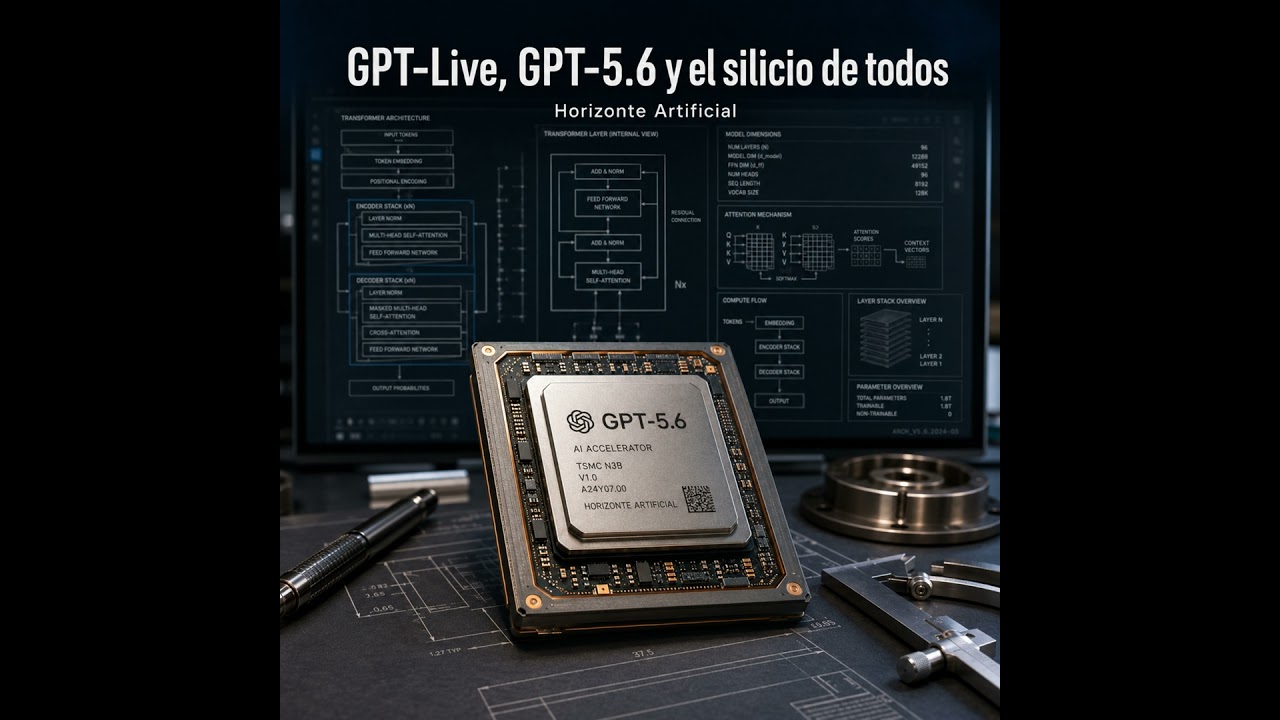
79. GPT-Live, GPT-5.6 y el silicio de todos
Keywords
Summary
142 words
Critical Evaluation
Value of the Information & Strength of the Argument
The video provides a timely overview of recent AI industry developments, but the information is presented as a casual conversation rather than a structured analysis. The hosts offer personal opinions and anecdotes, which adds a relatable perspective but lacks depth. The argumentation is often based on speculation and hearsay, with limited critical evaluation of the claims. For instance, the discussion on GPT-5.6’s efficiency is based on unverified numbers, and the analysis of open-source vs. frontier models is superficial. The value lies in the aggregation of news, but the lack of rigorous analysis reduces its overall worth.
Scientific Rigor, Source Quality, Title Accuracy
The video does not cite specific sources for most claims, relying on general knowledge and personal experience. The hosts mention reports from Reuters and analyses from ‘Lansang’ but do not provide direct references. The title accurately reflects the main topics, but the content is more of a news roundup than a deep dive. The lack of citations and the conversational tone undermine the scientific rigor. The hosts acknowledge uncertainty about some details, which is honest but also highlights the lack of verification. Overall, the video is more of an opinion piece than a factual report.
206 words
Title / Content Match
The title accurately reflects the main topics: GPT-Live, GPT-5.6, and the silicon race, though the 'silicio de todos' is only partially covered.
Quality & Reliability
5/10
The video is a conversational news review with personal anecdotes and opinions, lacking in-depth technical analysis or verifiable data. Claims about model capabilities and government oversight are presented without direct sources, and the discussion is often speculative.
Key Moments
Markers derived by PSI from the transcript: the creator did not define chapters.
- Introduction and discussion of Meta's MuseSpark 1.1 launch.
- Overview of OpenAI's GPT-Live voice model with full-duplex architecture.
- Discussion of GPT-5.6 release and US government oversight.
- Anthropic's plans to develop its own AI chip with Samsung.
- Mistral AI's upcoming open-weight model and European sovereignty.
- Analysis of open-source vs. frontier models market dynamics.
- xAI's Grok 4.5 launch and the shift to efficiency.
- Personal experiences with GLM 5.2 and other models.
- Discussion of Anthropic's 'pizarrón' visualization of reasoning.
Cited Sources
- Telegram channel — Mentioned as a way to join the community.
Concurring Sources
- Reuters report on Anthropic's chip plans — Mentioned in the video as a source for Anthropic's chip development.
Contribution & Novelties
The video offers a snapshot of the AI landscape in July 2026, highlighting the competitive dynamics among major labs. Its original contribution is the emphasis on efficiency as the new battleground, illustrated by GPT-5.6’s token efficiency and Grok 4.5’s pricing. The discussion on government oversight of frontier models is also notable. However, the analysis is not deep, and the hosts often rely on speculation.
Pour aller plus loin :
- Mixture of Experts — Relevant to Mistral’s ‘fat but sparse’ model description.
- Full-duplex communication — Relevant to GPT-Live’s architecture.
- AI accelerator — Relevant to the custom silicon race.
- Open-source AI — Relevant to the open-source vs. frontier debate.
107 words
Radar Profile
The radar profile shows moderate scores across all dimensions, with a slight peak in information quantity. This indicates a video that covers many topics but lacks depth and technical rigor, typical of a casual news discussion.
💬 No comments were provided for analysis.