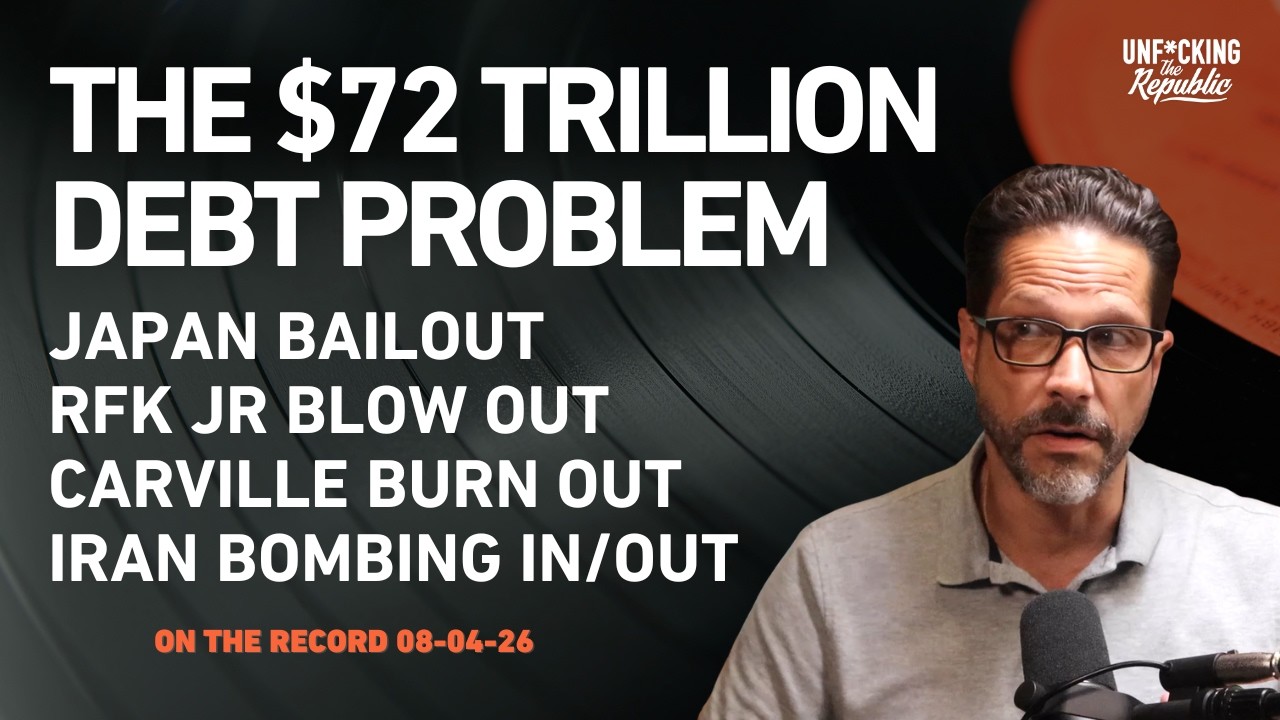
The Yen Bailout, RFK Jr. Fail, and the $72 Trillion Debt
Keywords
Summary
126 words
Critical Evaluation
Value of the Information & Strength of the Argument
The video offers valuable insights into the structure of US debt, breaking down household, corporate, and government components. The argument that fiscal dominance is already constraining the Fed’s influence is well-articulated and supported by references to economists like Steve Keen and Ann Pettifor. The host’s explanation of the yen intervention and its connection to US debt is informative. However, the argumentation is sometimes one-sided, blending economic analysis with political opinions, which may reduce its objectivity. The use of analogies and examples helps make complex concepts accessible, but the lack of counterarguments weakens the overall persuasiveness.
Scientific Rigor, Source Quality, Title Accuracy
The video cites several credible sources, including Bloomberg, Jacobin, The American Prospect, and Forever Wars, which are listed in the description. The analysis of the $72 trillion debt figure is not fully sourced, but it is a reasonable aggregation of known data. The title accurately reflects the content, though it sensationalizes the ‘RFK Jr. Fail’ aspect. The host’s political bias is evident, but he does not misrepresent facts. The video’s scientific rigor is moderate: it uses economic concepts correctly but simplifies some complexities. The adequacy between title and content is good, with the main debt segment being the core.
209 words
Title / Content Match
The title accurately reflects the main topics covered: the yen bailout, RFK Jr.'s interview, and the $72 trillion debt analysis.
Quality & Reliability
7/10
The video provides a coherent and well-structured analysis of US debt, referencing credible sources such as Bloomberg, Jacobin, and The American Prospect. However, it mixes factual reporting with strong opinion and political commentary, and some claims (e.g., the $72 trillion figure) are presented without full methodological transparency.
Chapters
Cited Sources
- Bloomberg: Yen Bailout — Referenced in the COTW segment about the US helping Japan intervene to support the yen.
- KLTW: Abdul El-Sayed on MSNBC — Referenced in the KLTW segment showing Abdul El-Sayed's interview.
- COTW: Foreign holders of US Debt — Referenced in the COTW segment about foreign holders of US debt.
- Jacobin: Health Care Searchlight Institute ACA — Referenced in the Headlines segment.
- The American Prospect: AI Bailout Could Be Baked Into Bubble — Referenced in the Headlines segment.
- Forever Wars: The Markets Matter for War You Don't — Referenced in the Headlines segment.
Concurring Sources
- Steve Keen's work on debt and financial instability — The video references Keen's arguments about household debt being the most dangerous variable.
- Ann Pettifor's analysis of debt and the global economy — The video references Pettifor's work on debt and financial crises.
Dissenting Sources
- Mainstream economic view on US debt sustainability — The IMF and many mainstream economists argue that US debt is sustainable given its reserve currency status and low interest rates, contrasting with the video's more alarmist view.
External References
Contribution & Novelties
The video provides a clear and accessible breakdown of the US debt stack, emphasizing the often-overlooked household and corporate debt components. It introduces the concept of fiscal dominance in a practical context, explaining why traditional monetary policy may be losing effectiveness. The discussion of the yen intervention and its link to US debt is a timely and unique angle. The host’s perspective, while opinionated, offers a critical view of mainstream economic narratives.
Pour aller plus loin :
- Fiscal dominance - Wikipedia — A key concept discussed in the video, explaining how government debt can influence monetary policy.
- Hyman Minsky - Wikipedia — The economist whose ‘financial instability hypothesis’ underpins the analysis of debt cycles.
- Private credit - Wikipedia — The rapidly growing but opaque sector highlighted as a risk in the corporate debt market.
134 words
Radar Profile
The radar profile shows high scores in quantity of information and fiabilité, reflecting the video's data-rich and well-sourced content. The lower score in niveau technique indicates that while the analysis is sophisticated, it is presented in an accessible manner. The overall balance suggests a reliable but opinionated source.
💬 Très positif. Sur les 30 commentaires analysés, la grande majorité exprime une forte appréciation du contenu, louant la qualité des analyses et la clarté des explications, avec un soutien marqué à l'animateur et à l'équipe.