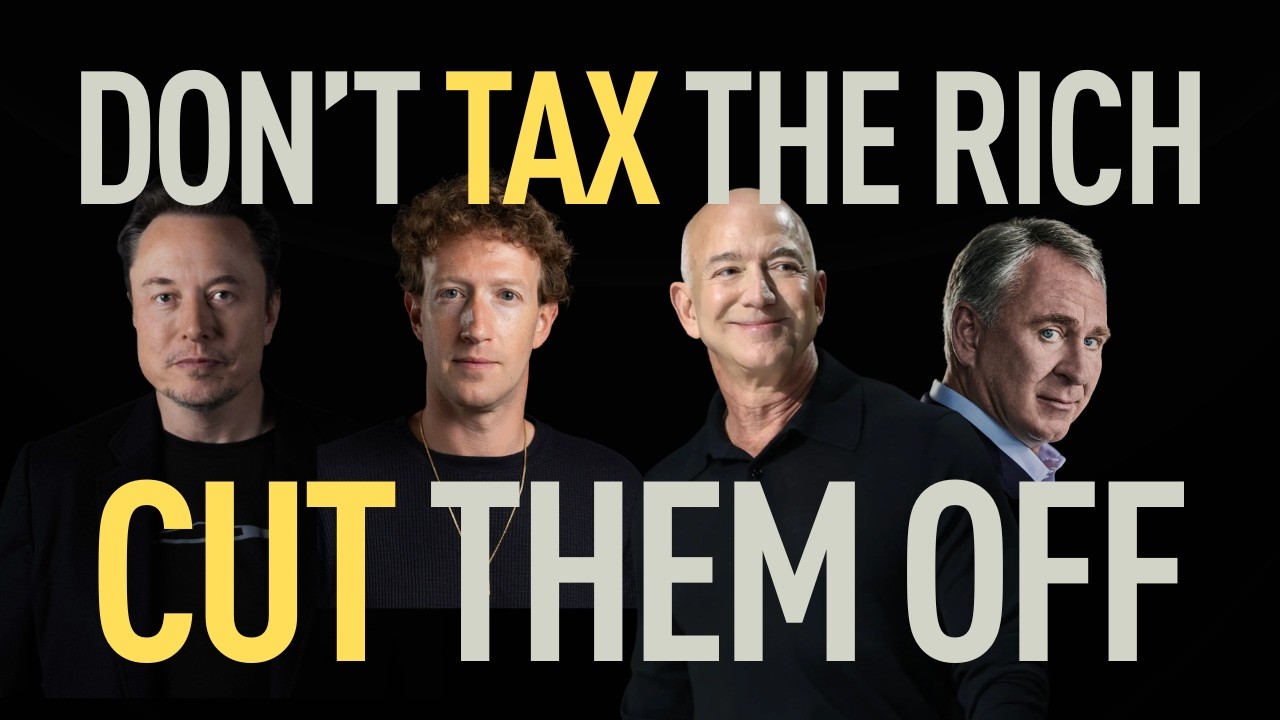
Why Taxing Billionaires Won't Save Us
Keywords
Summary
171 words
Critical Evaluation
Value of the Information & Strength of the Argument
The video provides a substantive argument with a clear thesis, supported by specific data points and references to studies from institutions like the New York Fed, CBO, and Tax Policy Center. The argument is logically structured, moving from the problem of billionaire wealth to the root cause in corporate tax policy. However, the presentation is heavily opinionated and uses rhetorical language, which may undermine its perceived objectivity. The host selectively uses data to support his points and does not engage with counterarguments in depth, which weakens the overall argumentative rigor.
Scientific Rigor, Source Quality, Title Accuracy
The video cites several credible sources, including government reports (CBO, Federal Reserve) and think tanks (Tax Policy Center, CBPP), which are listed in the description. The sources are relevant and support the claims made. However, the video also includes promotional links and partisan references (DSA platform), which may bias the presentation. The title accurately reflects the content, and the video stays on topic throughout. The argument is well-researched but presented from a clear ideological perspective, which may affect its perceived neutrality.
186 words
Title / Content Match
The title accurately reflects the central thesis: that focusing on taxing billionaires is misguided and that corporate taxation is the real solution.
Quality & Reliability
6/10
The video presents a coherent argument with references to credible sources (CBO, NY Fed, Tax Policy Center, CBPP), but it is explicitly opinion-driven and partisan, with rhetorical language and selective use of data. The argument is well-structured but lacks balanced counterpoints.
Key Moments
Markers derived by PSI from the transcript: the creator did not define chapters.
- Introduction: thesis that taxing billionaires is the wrong focus.
- Discussion of economic inequality and corporate earnings.
- Explanation of offshore tax havens and the $4 trillion hidden.
- Analysis of the 2017 Tax Cuts and Jobs Act and its impact on corporate taxes.
- Discussion of tariff refunds and how corporations benefit.
- Proposal for a higher corporate minimum tax and eliminating loopholes.
- Counterarguments against corporate tax increases and rebuttals.
- Call to action: shift focus to corporate tax reform and political engagement.
Cited Sources
- Why Corporations Must Pay More — Referenced as providing in-depth analysis on corporate taxation.
- Who Is Paying for the 2025 U.S. Tariffs? — Cited for evidence that tariffs are borne by American firms and consumers.
- Demand Economic Democracy — Linked as the platform of the party the host supports.
- What is the TCJA repatriation tax and how does it work? — Referenced for details on the repatriation tax.
- Monthly Budget Review — Cited for data on corporate income tax revenue decline.
- The 2025 Trump Tax Cuts: Who Benefits? — Referenced for distributional analysis of tax cuts.
- Companies are getting tariff refunds of up to $2 billion from the Trump administration — Cited for examples of corporate tariff refunds.
- US Corporations Repatriation of Offshore Profits — Referenced for data on repatriation after TCJA.
- Tax Cuts and Jobs Act of 2017 (TCJA) — Referenced for legal details of the TCJA.
- Companies got tariff refunds. Where's your cut? — Cited for the issue of tariff refunds not reaching consumers.
- Warren pushes giant corporations to give billions in tariff refunds back to consumers — Referenced for Senator Warren's efforts.
- Tariff revenue exceeded corporate taxes as 2025 ended — Cited for the statistic that tariff revenue exceeded corporate taxes.
- Updated Tax Evasion Figures — Referenced for their own prior work on tax evasion.
Concurring Sources
- Who Is Paying for the 2025 U.S. Tariffs? — Supports the claim that tariffs are borne by domestic firms and consumers.
- Monthly Budget Review — Confirms the decline in corporate income tax revenue.
- The 2025 Trump Tax Cuts: Who Benefits? — Provides data on the distribution of tax cuts, supporting the argument that the wealthy benefit disproportionately.
Dissenting Sources
- Tax Policy Center — While the video cites the Tax Policy Center for some data, the center's overall analysis often emphasizes the benefits of tax cuts for economic growth, which contrasts with the video's critical stance.
External References
Contribution & Novelties
The video offers a distinctive perspective by arguing that the focus on taxing billionaires is a distraction from more systemic corporate tax reform. It synthesizes recent data on tariff refunds and corporate tax avoidance to support this thesis, providing a coherent narrative that connects historical tax policy to current issues. The proposal for a 40-45% corporate minimum tax and the emphasis on preventing the creation of billionaires rather than taxing them after the fact is a novel framing.
Pour aller plus loin :
- Tax Cuts and Jobs Act — Provides background on the 2017 tax law.
- Corporate tax in the United States — Overview of corporate taxation.
- Wealth tax — Discusses the concept of wealth taxes.
- Stock buyback — Explains stock buybacks and their controversy.
- Powell Memorandum — Context for the referenced memo.
133 words
Radar Profile
The radar profile shows high scores in quantity and quality of information, indicating a well-researched video with substantial data. The technical level is moderate, making it accessible to a general audience. The overall reliability is moderate due to the opinionated nature and potential bias.
💬 No comments were provided for analysis.