Moving Markets: Mobility, Memory, and Urban Transformation in London and Hong Kong
Keywords
Summary
216 words
Critical Evaluation
Value of the Information & Strength of the Argument
The lecture provides valuable insights into the socio-cultural significance of street markets, connecting them to broader themes of migration, urban governance, and heritage. Marinelli’s argument is well-structured, using comparative examples from London and Hong Kong to illustrate his points. He effectively employs theoretical frameworks (e.g., Lefebvre’s ‘right to the city’) and empirical evidence from his research projects. However, the argumentation could be strengthened by more systematic data presentation and direct comparison between the two cities. The reliance on case studies and personal research adds depth but also limits generalizability.
Scientific Rigor, Source Quality, Title Accuracy
The lecture demonstrates scientific rigor through references to academic works (e.g., Josephine Smart, Tang Wing Shing) and archival materials. The speaker acknowledges funding sources and presents original research. The title accurately reflects the content, focusing on mobility, memory, and urban transformation. However, the lecture is not a peer-reviewed publication, and some claims lack specific citations in the transcript. The use of visual aids and maps enhances credibility, but the audience is not given detailed source lists.
180 words
Title / Content Match
The title accurately reflects the content, which compares street markets in London and Hong Kong through the lens of mobility, memory, and urban transformation.
Quality & Reliability
8/10
The lecture is based on two research projects, one funded by the Lincoln Institute for Land Policy and the other by UCL Grand Challenges, indicating a solid academic foundation. The speaker cites specific scholars (e.g., Josephine Smart, Tang Wing Shing) and uses archival materials and case studies. However, the presentation is a lecture, not a peer-reviewed publication, and some claims (e.g., about the number of hawkers) are not fully referenced in the transcript.
Key Moments
Markers derived by PSI from the transcript: the creator did not define chapters.
- Introduction by Professor Kate McLean, welcoming attendees and marking UCL's 200th anniversary.
- Kate McLean introduces Professor Maurizio Marinelli, highlighting his background and research interests.
- Marinelli begins his lecture, framing street markets as 'laboratories of mobilities' and introducing his two research projects.
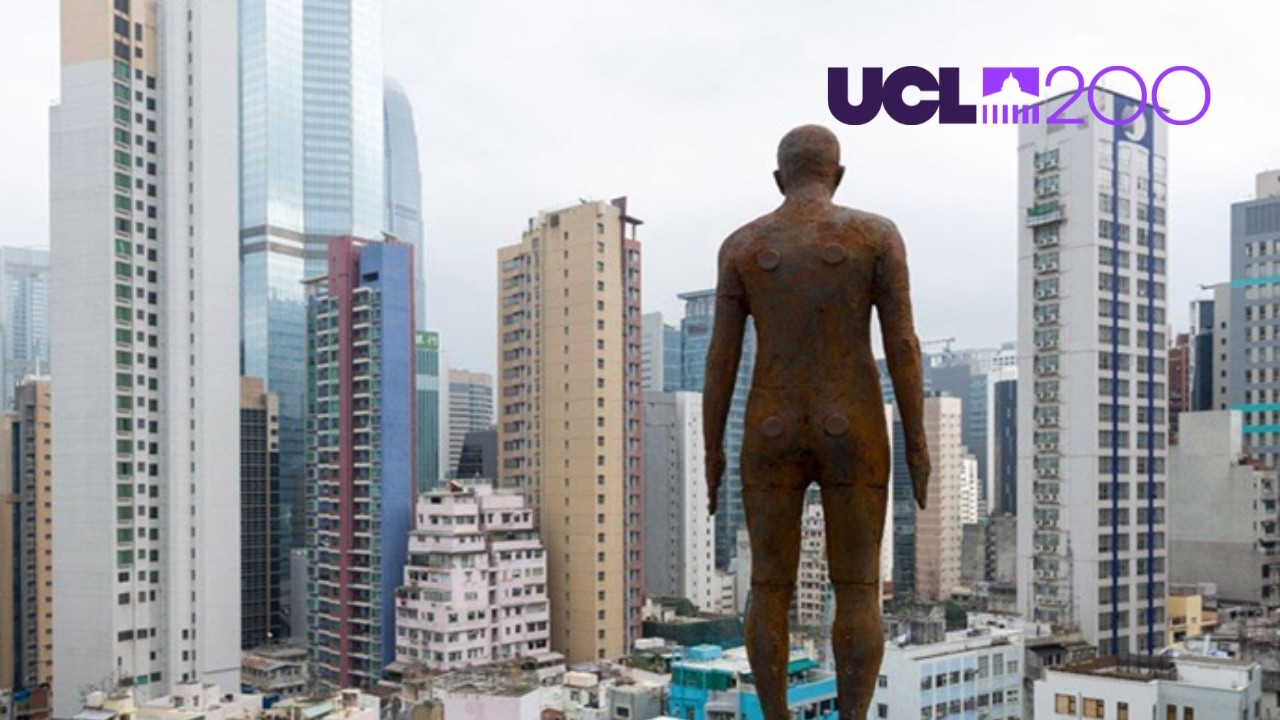
- Discussion of the verticality vs. horizontality of cities, using Anthony Gormley's 'Event Horizon' as an example.
- Exploration of street markets as living heritage and their role in migrant-led public cultures.
- Case study of Brick Lane and Brixton Market in London, illustrating successive waves of migration.
- Introduction to Hong Kong's street hawking history, including government policies since the 1970s.
- Detailed analysis of Graham Street Market, including the Urban Renewal Authority's redevelopment plans and community resistance.
- Discussion of the 'right to the city' and the importance of preserving street markets as heritage.
- Conclusion and Q&A session begins.
Cited Sources
- Lincoln Institute for Land Policy — Funding source for the Hong Kong street markets research project.
- UCL Grand Challenges — Funding source for the London food markets research project.
- Event Horizon by Antony Gormley — Art installation in Hong Kong referenced to illustrate the human dimension of the city.
- Echoes of the Rainbow (2010) — Film set in Wing Lee Street, Hong Kong, used to discuss local identity and heritage.
- 10 Years (2015) — Film with a segment called 'Local Egg' exploring Hong Kong's local identity.
- The Street (1950 documentary) — Documentary on London street markets mentioned as an example of market history.
- The Street by Zed Nelson — Documentary focusing on Hoxton Street, Hackney, and gentrification.
- Stalls Stories — Oral history project on Church Street market in London.
Concurring Sources
- Josephine Smart, 'The Political Economy of Street Hawkers in Hong Kong' (1989) — Cited as an earlier work on street hawkers in Hong Kong, supporting the lecture's historical analysis.
- Tang Wing Shing, 'Urban Redevelopment in Hong Kong' — Cited for the argument that land redevelopment in Hong Kong is hegemonic and profit-driven.
Dissenting Sources
- No discordant sources explicitly mentioned — The lecture does not present opposing viewpoints, but it implicitly challenges top-down urban renewal policies.
Contribution & Novelties
The lecture offers a comparative perspective on street markets in London and Hong Kong, emphasizing the concept of ‘mobility’ as a lens to understand urban transformation. It contributes to the literature on urban heritage and the ‘right to the city’ by highlighting the role of street markets as living heritage and sites of resistance to top-down redevelopment. The integration of two research projects provides a novel framework for analyzing markets as spaces of social and cultural exchange.
Pour aller plus loin :
- Right to the City — Concept by Henri Lefebvre, central to the lecture’s argument.
- Gentrification — Key process discussed in relation to market redevelopment.
- Street food — Related to the informal economy and urban culture.
- Urban renewal — Policies affecting street markets in both cities.
- Migration studies — Relevant to the mobility aspect of the lecture.
138 words
Radar Profile
The radar profile shows high scores in quantity and quality of information, reflecting the lecture's rich content and academic grounding. The technical level is moderate, suitable for a general academic audience. Overall reliability is high due to the speaker's expertise and funded research, though the lecture format limits peer review.
💬 No comments were provided for analysis.