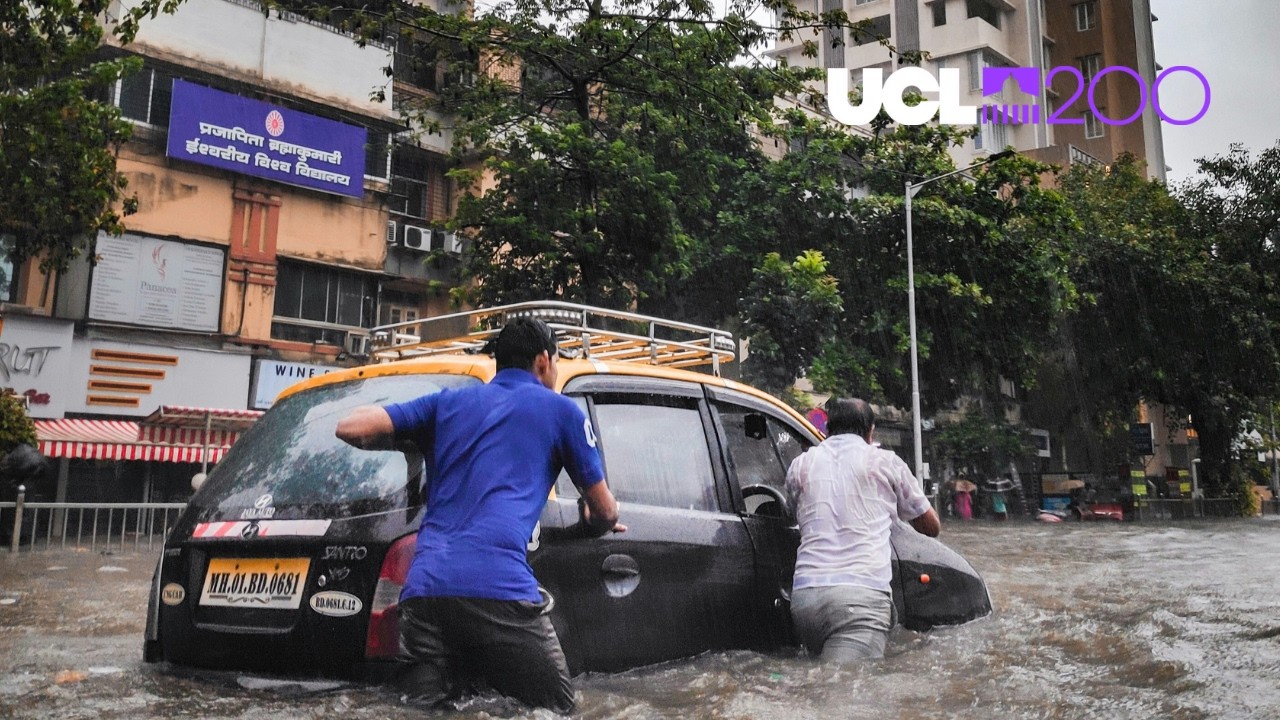
Lunch Hour Lecture | What happens to construction in cities after a flood?
Keywords
Summary
163 words
Critical Evaluation
Value of the Information & Strength of the Argument
The lecture provides valuable insights into the counterintuitive response of urban development to floods. The argumentation is solid, based on a rigorous econometric framework (difference-in-differences) and a rich dataset. The speaker clearly explains the methodology and the causal interpretation of the results. The use of an event study graph and a case study (Malaga) enhances the clarity of the findings. The discussion of the non-linearity of flood damage and the potential impact of climate change adds depth. The presentation is well-structured and accessible, while maintaining scientific rigor.
Scientific Rigor, Source Quality, Title Accuracy
The research is based on publicly available data sources, including the Spanish cadastre, Copernicus rainfall data, and EU flood plain maps. The methodology is standard in economics and the results are presented with appropriate caveats. The speaker is an academic at UCL, which lends credibility. The title accurately reflects the content. The lecture does not cite specific external sources beyond the data, but the research appears to be original and replicable.
173 words
Title / Content Match
The title accurately reflects the content, which focuses on the impact of floods on construction in cities.
Quality & Reliability
8/10
The lecture presents original research based on comprehensive public data (all buildings in Spain, flood records, rainfall data) and uses a robust econometric method (difference-in-differences). The speaker is an academic at UCL, and the study is replicable with publicly available data and code. However, the lecture is a presentation and not a peer-reviewed publication, and some details of the methodology are simplified.
Key Moments
Markers derived by PSI from the transcript: the creator did not define chapters.
- Introduction by Max Gunneberg Menard and UCL bicentenary film.
- Rodrigo Martinez Maza introduces the topic: floods as costliest natural disasters and the puzzle of economic growth in flood-prone areas.
- Literature review: recovery after shocks, risk perception, and the gap in within-city analysis.
- Data description: universe of buildings in Spain, flood records, rainfall data, flood plain maps.
- Methodology: difference-in-differences approach comparing similar cities hit at different times.
- Results: floods lead to 7.8% more construction 10 years after, cities become more compact and taller.
- Case study of Malaga: interactive exercise on where new construction occurs after a flood.
- Discussion of heterogeneous responses by flood intensity and implications for climate change.
- Policy implications and conclusion.
Cited Sources
- Copernicus Climate Data Store — Rainfall data used in the study.
- EU Floods Directive — Flood plain maps used in the study.
Concurring Sources
- Copernicus Climate Data Store — Rainfall data used in the study.
- EU Floods Directive — Flood plain maps used in the study.
Contribution & Novelties
The research provides novel evidence on the within-city response of construction to floods, showing that cities become denser and taller after a flood, contrary to the expectation of moving to safer areas. This challenges the assumption that risk perceptions lead to spatial reallocation. The use of granular building data and a causal identification strategy adds robustness. The findings have implications for urban planning and climate adaptation.
Pour aller plus loin :
- Difference-in-differences — The econometric method used in the study.
- Flood risk management — Context for policy implications.
- Urban sprawl — Related concept of urban form.
96 words
Radar Profile
The radar profile shows high scores in information quantity, quality, and reliability, with a slightly lower technical level, indicating a well-balanced presentation accessible to a broad audience while maintaining scientific depth.