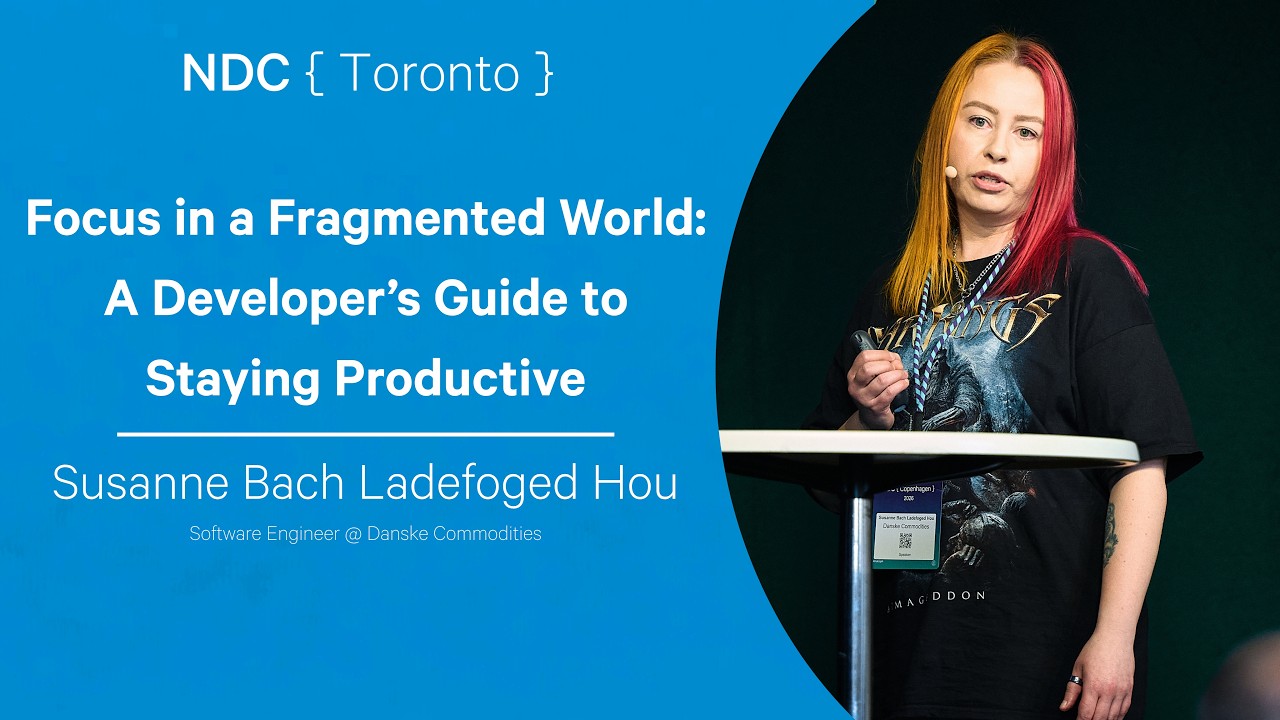
Focus in a Fragmented World: A Developer’s Guide to Staying Productive
Keywords
Summary
134 words
Critical Evaluation
Value of the Information & Strength of the Argument
The talk provides valuable, actionable advice based on the speaker’s extensive personal experience, which adds authenticity and practical relevance. The strategies are presented with clear explanations and relatable examples, making them easy to understand and apply. The argumentation is coherent, though it relies heavily on anecdotal evidence rather than scientific studies. The speaker acknowledges her lack of formal expertise, which tempers the authority of the claims. The discussion of AI’s cognitive load and the concept of ‘AI burnout’ is particularly insightful and timely, offering a fresh perspective on a common challenge. Overall, the value lies in the practical applicability of the techniques, even if the scientific backing is limited.
Scientific Rigor, Source Quality, Title Accuracy
The talk is not rigorously scientific; it is a personal narrative with references to general neuroscience concepts (e.g., prefrontal cortex, amygdala) but without citing specific studies. The speaker is transparent about her non-expert status, which is honest but reduces the scientific credibility. The title accurately reflects the content, focusing on productivity in a distracting world. The description provides links to NDC conferences, which are not directly related to the content but serve as organizational references. No external sources are cited within the talk itself, limiting the ability to verify claims. The talk’s strength lies in its practical wisdom rather than academic rigor.
226 words
Title / Content Match
The title accurately reflects the content: the talk addresses productivity and focus challenges in a distracting environment, with practical strategies for developers.
Quality & Reliability
7/10
The talk is based on personal experience and practical strategies rather than peer-reviewed research. The speaker is transparent about her lack of formal expertise in psychology or neuroscience, which limits the scientific rigor. However, the content is grounded in widely recognized concepts (e.g., attention residue, cognitive load) and offers actionable advice.
Key Moments
Markers derived by PSI from the transcript: the creator did not define chapters.
- Introduction: speaker's background and ADHD diagnosis.
- Discussion of the attention crisis and changes in the world.
- Neuroscience basics: brain regions involved in focus and stress.
- Impact of interruptions and context switching on productivity.
- AI and cognitive load: the hidden cost of AI tools.
- Time blocking and deep work strategies.
- Ramp in/ramp out technique for smooth transitions.
- Energy management: the traffic light method.
- Optimizing physical work environment and reducing clutter.
- Browser tab management and rules for closing tabs.
- Getting started: 'eat the frog' and snowball method.
Cited Sources
- NDC Conferences — Organizer of the talk and related conferences.
- NDC Toronto — Specific conference where the talk was recorded.
Concurring Sources
- Attention residue — Supports the claim that interruptions have a cognitive cost.
- Cognitive load theory — Relevant to the discussion of AI's impact on mental effort.
Contribution & Novelties
The talk offers a personal, battle-tested perspective on productivity, particularly for developers with ADHD. It synthesizes common strategies into a cohesive framework, emphasizing the protection of attention as a key resource. The discussion of AI-induced cognitive load and ‘AI burnout’ is a novel contribution, addressing a contemporary issue not widely covered in productivity talks.
Pour aller plus loin :
- Attention residue — Concept explaining the cognitive cost of task switching.
- Executive functions — Cognitive processes involved in planning and impulse control.
- Pomodoro Technique — A time management method that can complement the strategies discussed.
94 words
Radar Profile
The radar profile shows high scores in information quantity and quality, reflecting the talk's rich practical content. The technical level is moderate, as it avoids deep scientific jargon. Reliability is moderate due to the anecdotal nature, but the overall balance indicates a useful, practical resource.