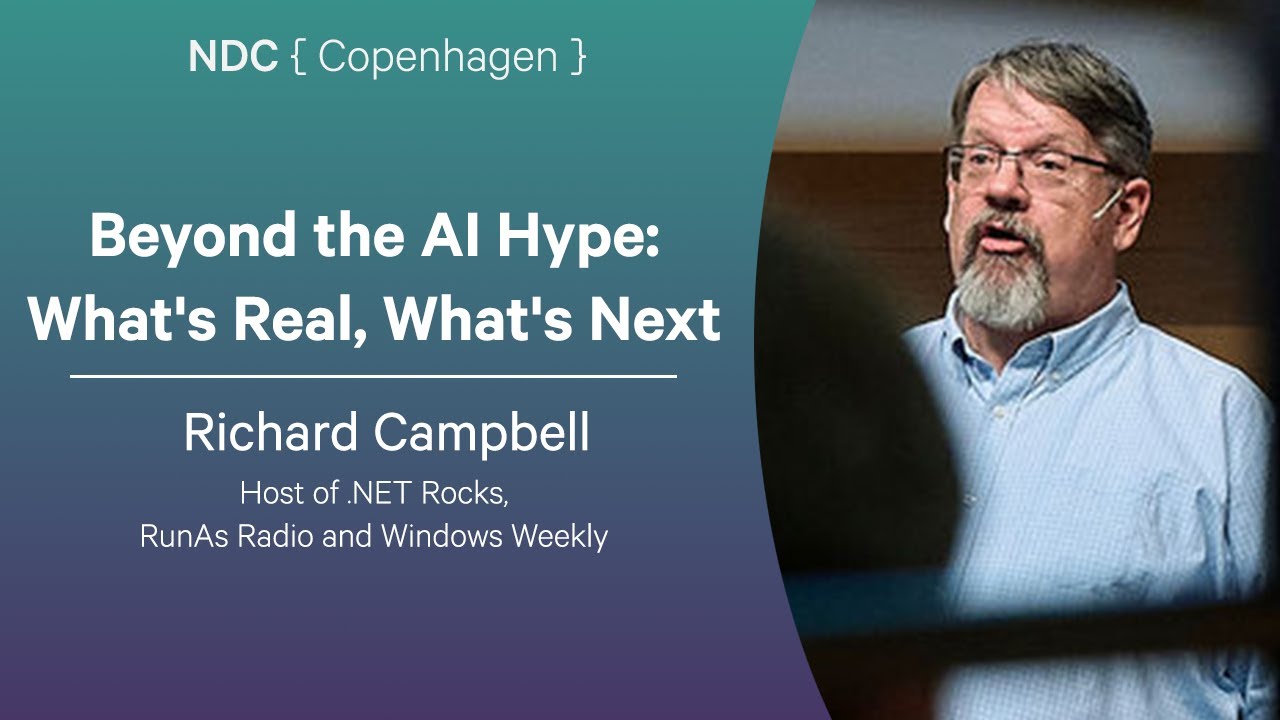
Beyond the AI Hype: What's Real, What's Next - Richard Campbell - NDC Copenhagen 2025
Keywords
Summary
155 words
Critical Evaluation
Value of the Information & Strength of the Argument
The talk provides valuable insights into the AI hype cycle, drawing on historical parallels and personal anecdotes. Campbell’s argument is well-structured, moving from the origins of AI to the current state, and he effectively uses the Gartner Hype Cycle to frame the discussion. He offers a balanced perspective, acknowledging both the genuine advancements and the overhyped expectations. However, the argumentation relies heavily on personal opinions and anecdotes rather than empirical data or citations, which weakens its scientific rigor. The talk is more of a narrative than a rigorous analysis, but it is engaging and thought-provoking.
Scientific Rigor, Source Quality, Title Accuracy
The talk lacks explicit citations or references to specific sources, which limits its scientific rigor. Campbell mentions historical events and figures, but does not provide verifiable references. The title accurately reflects the content, focusing on the hype and future of AI. The description provides links to NDC conferences, but these are not directly related to the content. Overall, the talk is informative but not heavily sourced, making it more of an expert opinion than a scholarly presentation.
187 words
Title / Content Match
The title accurately reflects the content, which examines the AI hype cycle, current realities, and future directions.
Quality & Reliability
7/10
The talk is an expert opinion with historical narrative and personal insights, but lacks citations or references to specific sources, and some claims are anecdotal.
Key Moments
Markers derived by PSI from the transcript: the creator did not define chapters.
- Introduction: Richard Campbell introduces himself and his podcasts, and sets the stage for the talk.
- Origins of AI: Marvin Minsky and the Dartmouth conference, and the term 'artificial intelligence' as a marketing term.
- Early AI: ELIZA chatbot and the concept of pareidolia.
- AI in popular culture: 2001: A Space Odyssey and the trope of AI as a threat.
- Neural networks and the ImageNet competition: Hinton's deep learning breakthrough.
- The founding of OpenAI and the involvement of Elon Musk and Sam Altman.
- Microsoft's investment in OpenAI and the scaling laws paper.
- GPT-3 and the launch of GitHub Copilot.
- ChatGPT's launch and its rapid adoption.
- Microsoft's response: Bing integration and the proliferation of copilots.
Cited Sources
- NDC Conferences — Mentioned as the organizer of the conference.
- NDC Copenhagen — Mentioned as the specific conference event.
Concurring Sources
- Gartner Hype Cycle — The concept used to describe the AI hype cycle.
Dissenting Sources
- No specific discordant sources — The talk does not directly contradict any specific sources, but its anecdotal nature may conflict with more rigorous analyses.
Contribution & Novelties
The talk offers a unique perspective on the AI hype cycle, combining historical context with personal anecdotes and industry insights. It provides a clear framework for understanding the current state of AI and its potential future trajectory.
Pour aller plus loin :
- Gartner Hype Cycle — The framework used to analyze the AI hype cycle.
- ImageNet — The dataset and competition that spurred deep learning advancements.
- Scaling Laws for Neural Language Models — The paper by Kaplan et al. that influenced the scaling approach.
84 words
Radar Profile
The radar profile shows high scores in quantity of information and moderate scores in quality and technical level, indicating a talk that is informative but not deeply technical. The low reliability score suggests a need for more citations and verifiable sources.
💬 No comments were provided for analysis.