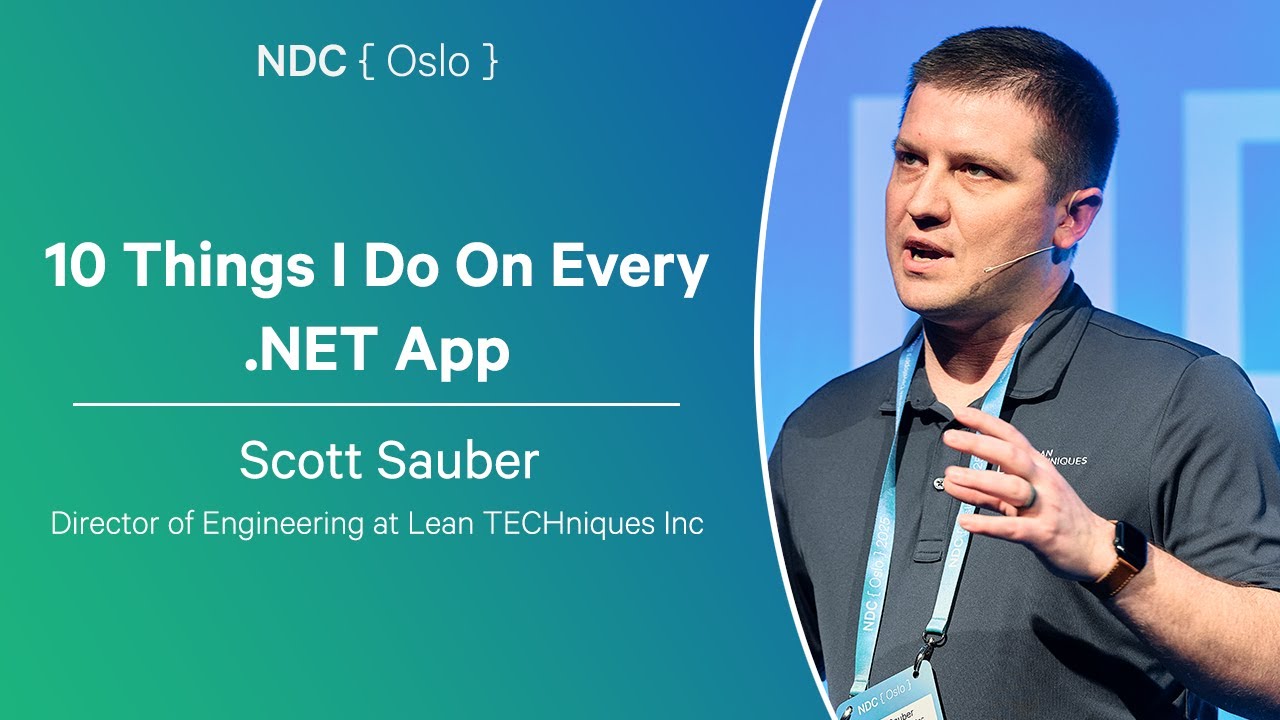
10 Things I Do On Every .NET App - Scott Sauber - NDC Oslo 2025
Keywords
Summary
179 words
Critical Evaluation
Value of the Information & Strength of the Argument
The talk provides high practical value, offering actionable advice that developers can implement immediately. Each tip is grounded in real-world experience, with clear explanations of the problems they solve. The argumentation is solid, as Sauber acknowledges trade-offs and context-dependence, avoiding dogmatic ‘best practices’ language. He supports his points with analogies (e.g., soap storage) and references to industry figures, enhancing persuasiveness. However, some recommendations are subjective and may not apply universally, but he explicitly invites listeners to adapt them to their own contexts.
Scientific Rigor, Source Quality, Title Accuracy
The talk demonstrates scientific rigor in its systematic approach to common .NET issues. Sauber cites his own blog posts and references the tweet by Guillermo Rauch, but he does not provide external academic sources, which is typical for conference talks. The quality of sources is adequate for the format, relying on established industry practices. The title accurately reflects the content, as he indeed covers 10 distinct topics. The talk is well-structured, with clear transitions between topics, and the speaker’s expertise is evident.
179 words
Title / Content Match
The title accurately reflects the content: the speaker presents 10 distinct practices he applies to .NET applications, each covered in a lightning-talk format.
Quality & Reliability
8/10
The talk is based on the speaker's extensive professional experience as a software consultant and Microsoft MVP, offering practical, field-tested advice. While it is opinion-based rather than peer-reviewed, the recommendations align with widely accepted software engineering principles and are presented with clear reasoning. The speaker acknowledges context-dependence, enhancing credibility.
Key Moments
Markers derived by PSI from the transcript: the creator did not define chapters.
- Introduction and framing: the talk is a series of lightning talks on maintainability.
- Tip 1: Feature folders - grouping by feature instead of technical responsibility.
- Tip 2: Treat warnings as errors to keep the codebase clean.
- Tip 3: Logging best practices - structured logging, log levels, and logs vs metrics vs audits.
- Tip 4: Global authorization fallback policy for secure-by-default.
- Tip 5: Validation - critique of data annotations and suggestion of FluentValidation.
- Tip 6: Automated testing - importance and strategies.
- Tip 7: Code flow - using analyzers and formatting tools.
- Tip 8: Microservices - when to use and pitfalls.
- Tip 9: Security by default - additional practices.
- Tip 10: Conclusion and final takeaways.
Cited Sources
- NDC Conferences — Official conference website, mentioned in the video description.
- NDC Oslo — Official conference website for NDC Oslo, mentioned in the video description.
Concurring Sources
- Feature folders — Supports the concept of grouping by feature.
- Structured logging — Supports the recommendation for structured logging.
- ASP.NET Core authorization — Supports the fallback policy approach.
Dissenting Sources
- Data annotations — The speaker criticizes data annotations, but Microsoft's documentation presents them as a standard approach, though it acknowledges limitations.
External References
Contribution & Novelties
The talk offers a consolidated set of practical, experience-based recommendations for .NET developers, emphasizing maintainability and security. Its originality lies in the concise, lightning-talk format that covers a broad range of topics, making it a valuable resource for developers seeking quick improvements. The speaker’s emphasis on context-dependence and avoiding dogmatic practices adds nuance.
Pour aller plus loin :
- Feature folders — Related concept of organizing code by features.
- Structured logging — Overview of structured logging principles.
- ASP.NET Core authorization — Official documentation on authorization policies.
- FluentValidation — Popular validation library for .NET.
- Serilog — Official site of the logging library mentioned.
101 words
Radar Profile
The radar profile shows high scores in quantity and quality of information, indicating a content-rich talk. The technical level is also high, suitable for experienced developers. The overall reliability is strong due to the speaker's expertise, though it is opinion-based.