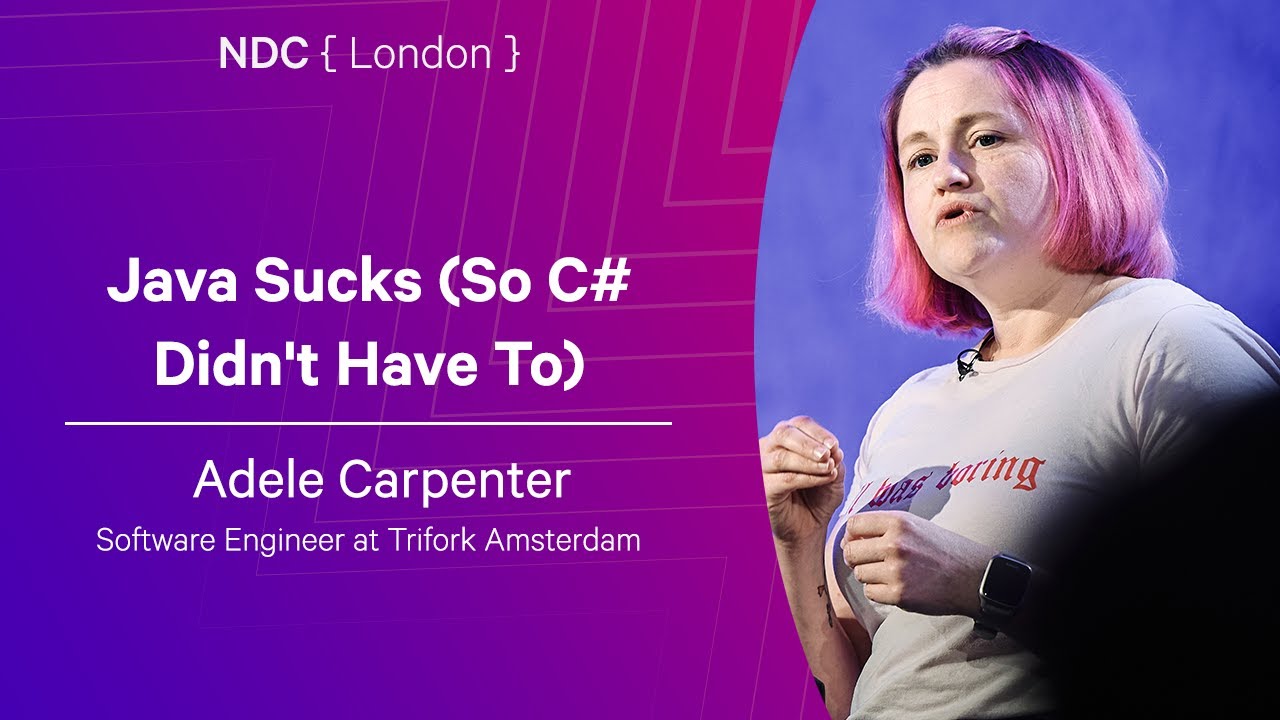
Java Sucks (So C# Didn't Have To) - Adele Carpenter - NDC London 2026
Keywords
Summary
181 words
Critical Evaluation
Value of the Information & Strength of the Argument
The talk provides valuable insights into the historical and technical reasons behind Java’s design choices, particularly type erasure, and compares them with C#’s approach. Carpenter’s argumentation is well-structured, using concrete examples and anecdotes to illustrate points. She acknowledges trade-offs and presents a balanced view, avoiding pure bias. The discussion of Xerox PARC’s influence adds depth. However, some arguments rely on personal experience and may not be universally applicable.
Scientific Rigor, Source Quality, Title Accuracy
Carpenter cites historical facts and quotes from key figures like James Gosling and Brian Goetz, but does not provide formal citations. The talk is based on her expertise and public knowledge. The title is catchy but slightly misleading as the talk is more of a comparison than a pure critique. The content aligns with the title in that it discusses Java’s flaws, but it also highlights its merits.
151 words
Title / Content Match
The title is provocative and slightly misleading; the talk is more of a balanced comparison and love letter to Java rather than a pure critique. It does discuss Java's flaws but also its strengths.
Quality & Reliability
7/10
The talk is an expert opinion by a software engineer with practical experience in Java and C#. It provides historical context and technical explanations, but relies on personal anecdotes and subjective comparisons rather than empirical data. The information is generally accurate and well-reasoned, but not peer-reviewed.
Key Moments
Markers derived by PSI from the transcript: the creator did not define chapters.
- Introduction and audience interaction about C# and Java developers.
- Mention of Mads Torgersen and the dinner conversation about reified generics.
- Overview of Java's history and design goals from the 1990s.
- Discussion of Xerox PARC languages and their influence on Java.
- Explanation of type erasure and its implications.
- Comparison of Java and C# generics with code examples.
- Historical context of generics in Java and the JCP process.
- Discussion of other design decisions like checked exceptions.
- Analysis of Java's evolution and future directions.
- Conclusion and call for unity among developers.
Cited Sources
- NDC Conferences — Conference organizer and event information.
- NDC London — Specific conference event page.
Concurring Sources
- Java Language Specification — Official specification for Java, relevant to generics and type erasure.
- C# Language Specification — Official specification for C#, relevant to generics and reified types.
Dissenting Sources
- Java Generics FAQ — Provides detailed explanations of Java generics and type erasure, potentially offering different perspectives on the trade-offs.
External References
Contribution & Novelties
The talk offers a fresh perspective on the Java vs C# debate by focusing on historical context and design trade-offs. It provides a nuanced explanation of type erasure, often misunderstood, and highlights the influence of Xerox PARC. The speaker’s personal anecdotes add authenticity.
Pour aller plus loin :
- Type erasure (Wikipedia) — Provides a general overview of type erasure in programming languages.
- Java Community Process — Official site for the JCP, relevant to the discussion of Java’s evolution.
- Reified generics (Wikipedia) — Explains the concept of reification in type systems.
90 words
Radar Profile
The radar profile shows high scores in information quantity and technical level, indicating a content-rich talk with moderate technical depth. The quality and reliability scores are slightly lower, reflecting the subjective nature of the presentation.