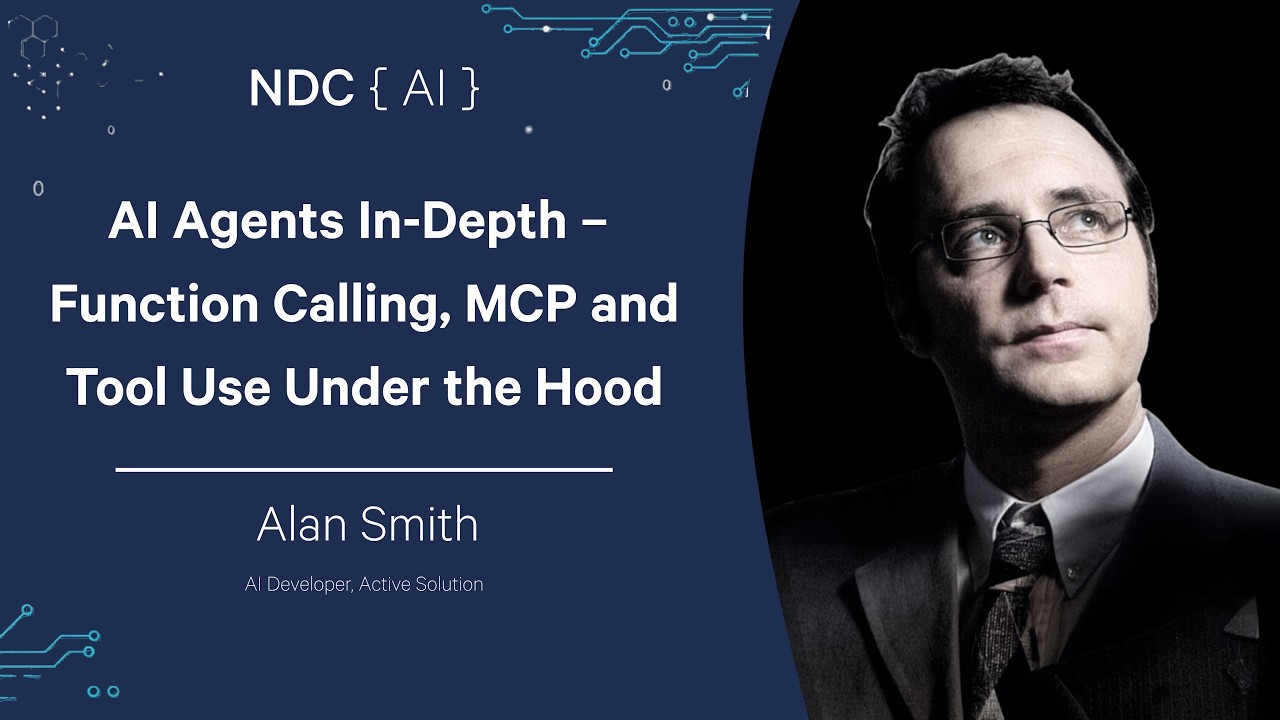
AI Agents In-Depth – Function Calling, MCP and Tool Use Under the Hood - Alan Smith - NDC AI 2026
Keywords
Summary
176 words
Critical Evaluation
Value of the Information & Strength of the Argument
The talk provides valuable insights into the practical implementation of AI agents, with a focus on function calling and tool use. The argumentation is solid, based on live demonstrations and clear explanations of the underlying concepts. The speaker effectively illustrates how models infer tool usage, the role of system prompts, and the importance of tool definitions. He also addresses common pitfalls such as non-deterministic behavior and the need for careful prompt engineering. The value lies in the practical, hands-on approach, making complex concepts accessible to developers.
Scientific Rigor, Source Quality, Title Accuracy
The talk demonstrates scientific rigor through its structured explanation and live demos. However, it lacks formal citations or references to academic sources, relying instead on practical experience and official documentation. The title accurately reflects the content, which is a technical tutorial on AI agents. The speaker’s credibility is enhanced by his 30 years of coding experience and MVP status. The content is well-organized and technically accurate, but the absence of external references limits its scholarly depth.
177 words
Title / Content Match
The title accurately reflects the content, which covers function calling, MCP, and tool use in AI agents.
Quality & Reliability
8/10
The talk is a technical tutorial by an experienced developer (MVP) with live demos and clear explanations. The content is accurate and well-structured, but it lacks formal citations and peer-reviewed sources, relying on practical experience and official documentation.
Key Moments
Markers derived by PSI from the transcript: the creator did not define chapters.
- Introduction to the session and overview of topics: function calling, MCP, and tool use.
- Explanation of how LLMs work and the concept of tool calling.
- Demo of function calling with GPT-4o in Postman, showing JSON requests and responses.
- Discussion on model fine-tuning for function calling and user approval flows.
- Comparison of frameworks: LangChain, Semantic Kernel, and Agent Framework.
- Demo of a pizza ordering agent, showing tool inference and multi-language support.
- Demo of a vibe coding assistant that creates a website using file tools.
- Explanation of agentic RAG and how search services are used as tools.
- Demo of agentic RAG with Wikipedia, comparing internal knowledge vs. external search.
- Conclusion and summary of key takeaways.
Cited Sources
- NDC AI Conference — The talk was recorded at NDC AI in Oslo, Norway.
- NDC Conferences — Information about upcoming NDC conferences.
Concurring Sources
- OpenAI Function Calling Documentation — Official documentation on function calling, which aligns with the talk's content.
- Model Context Protocol (MCP) Official Site — Official site for MCP, a protocol mentioned in the talk.
Contribution & Novelties
The talk provides a practical, in-depth look at the mechanics of function calling and tool use in AI agents, demystifying the process with live demos. It offers valuable insights for developers, particularly in understanding how models infer tool usage and the importance of tool definitions. The session also highlights the evolution from naive RAG to agentic RAG, showcasing improved query rewriting and routing.
Pour aller plus loin :
- Function calling in OpenAI — Official documentation on function calling.
- Model Context Protocol (MCP) — Official site for MCP, a protocol for tool integration.
- Agent Framework — Microsoft’s Agent Framework documentation.
- Retrieval-Augmented Generation (RAG) — Wikipedia article on RAG.
107 words
Radar Profile
The radar profile shows high scores in information quantity and quality, reflecting the talk's depth and practical value. The technical level is also high, indicating a detailed technical tutorial. The overall reliability is strong, though the lack of formal citations slightly reduces the score.