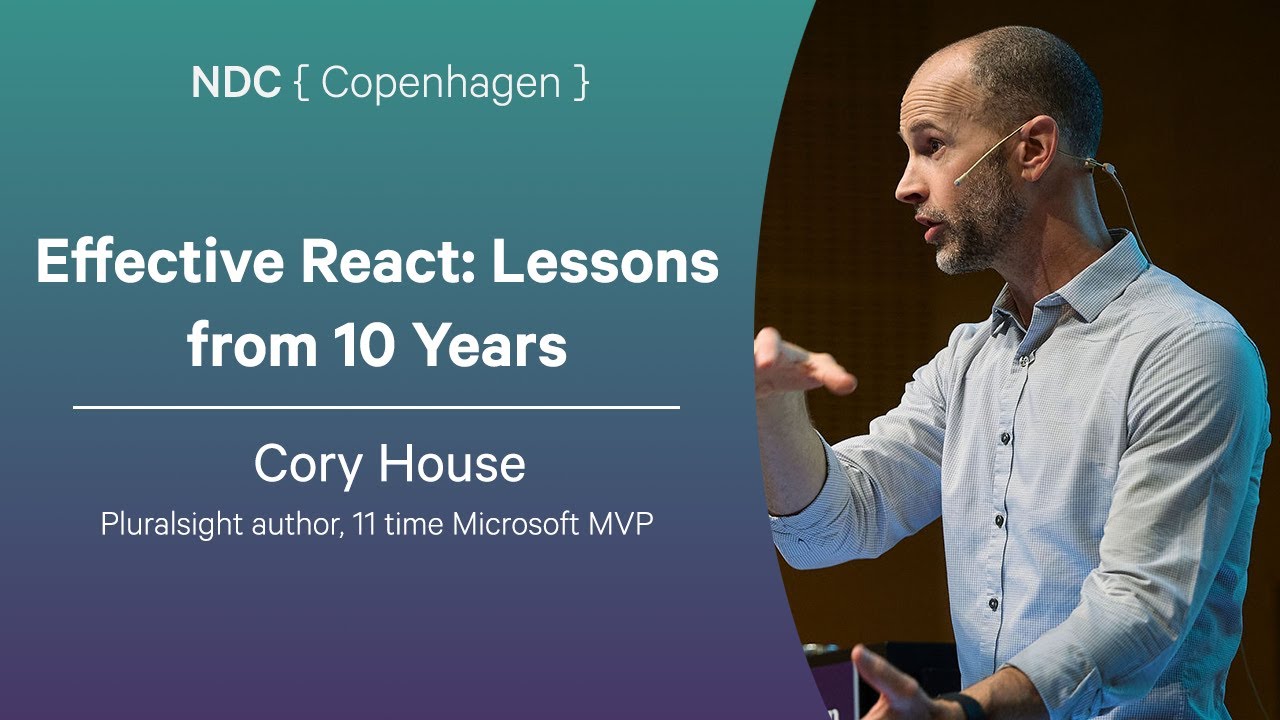
Effective React: Lessons from 10 Years - Cory House - NDC Copenhagen 2025
Keywords
Summary
216 words
Critical Evaluation
Value of the Information & Strength of the Argument
The talk provides high practical value for React developers, offering concrete patterns and library recommendations that can immediately improve code quality and developer experience. The argumentation is based on the speaker’s extensive real-world experience, which lends credibility. He uses clear examples and before/after comparisons to illustrate the benefits of abstractions like React Query and Zod. However, the talk is largely anecdotal and lacks formal evidence or comparative studies. Some claims, such as the prevalence of TypeScript or the effectiveness of certain patterns, are based on personal observation rather than systematic data. The speaker also acknowledges the controversy around React Server Components but does not delve deeply into technical trade-offs, instead focusing on the political and adoption aspects. Overall, the argumentation is persuasive for practitioners but not rigorously scientific.
Scientific Rigor, Source Quality, Title Accuracy
The speaker does not cite specific sources or research, but he references well-known libraries and tools (React Query, Zod, TanStack Query) and mentions his own experience with clients. The talk is not a formal scientific presentation but a practitioner’s perspective. The title accurately reflects the content, which is a rapid-fire session of lessons learned. The talk is well-structured and the claims are generally consistent with current React best practices. However, the lack of citations and reliance on anecdotal evidence limits its scientific rigor. The speaker does mention that he has audited many React codebases, which adds some authority, but he does not provide data or references to support his claims. The talk is more of an expert opinion than a rigorous review.
265 words
Title / Content Match
The title accurately reflects the content: a rapid-fire session sharing lessons learned from 10 years of working with React teams.
Quality & Reliability
8/10
The speaker is an experienced independent React consultant with 10 years of hands-on experience across many teams. He provides practical, actionable advice, but the talk is largely anecdotal and based on personal experience rather than formal research. Claims are generally consistent with current best practices in the React community.
Key Moments
Markers derived by PSI from the transcript: the creator did not define chapters.
- Introduction: Cory House introduces himself and his background with React since its open-sourcing.
- Evolution of data fetching: from class components with componentDidMount to hooks and the pitfalls of useEffect.
- Custom hook 'useFetch' to simplify data fetching and reduce boilerplate.
- Introduction of React Query (TanStack Query) and its benefits: caching, retries, automatic refetching.
- Importance of error boundaries and using 'throwOnError' in TanStack Query to simplify error handling.
- Runtime data validation with Zod: why TypeScript types don't exist at runtime and how Zod helps.
- Case study: a client's $3 million React app built by an inexperienced agency, salvaged with refactoring and Zod.
- Using Suspense for data fetching: stable in Next.js, but less adopted elsewhere.
- React Server Components: controversy, political aspects, and adoption challenges.
- Final thoughts and Q&A: practical advice for React teams.
Cited Sources
- NDC Conferences — Conference website where the talk was recorded.
- NDC Copenhagen — Specific conference event page.
Concurring Sources
- React Query documentation — Confirms the features and benefits of React Query mentioned in the talk.
- Zod documentation — Confirms the usage and benefits of Zod for runtime validation.
Contribution & Novelties
The talk synthesizes 10 years of React experience into actionable lessons, emphasizing the evolution of data fetching and state management. It highlights the importance of using robust libraries like TanStack Query and Zod to avoid common pitfalls. The speaker’s unique perspective as an independent consultant who has audited many codebases adds practical weight. The talk also addresses the controversial adoption of React Server Components, providing a balanced view of the political and technical factors.
Pour aller plus loin :
- React Query (TanStack Query) — Official documentation and guides for data fetching and caching.
- Zod — Official site for runtime schema validation with TypeScript.
- React Error Boundaries — React documentation on error boundaries and how to use them.
- React Server Components — React blog post discussing the future of server components.
130 words
Radar Profile
The radar profile shows high scores in information quantity, quality, and technical level, with a slightly lower but still strong reliability score. This indicates a talk that is rich in practical content and technically sound, though based on anecdotal evidence rather than formal research.
💬 Sur les 0 commentaires analysés, aucune tendance n'est disponible.