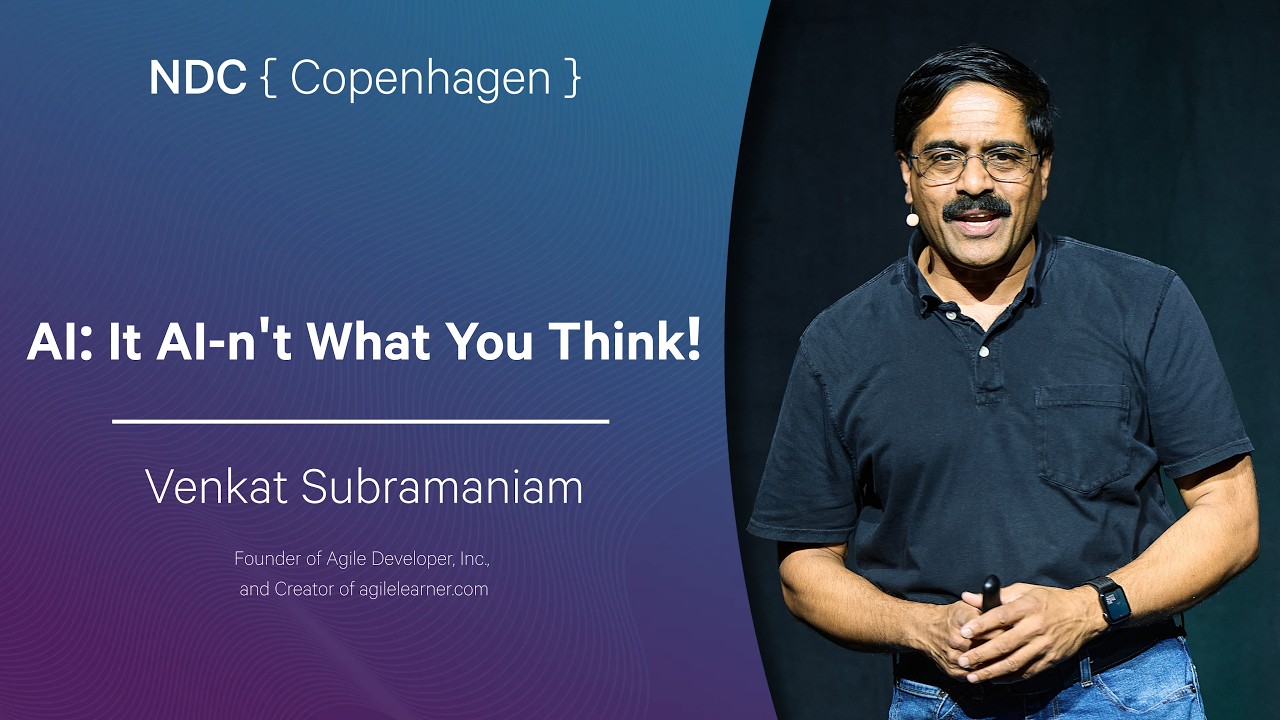
AI: It AI-n't What You Think! - Venkat Subramaniam - NDC Copenhagen 2026
Keywords
Summary
139 words
Critical Evaluation
Value of the Information & Strength of the Argument
The talk offers valuable insights into the nature of AI, emphasizing that it is an inference engine rather than true intelligence. The speaker’s argumentation is coherent and persuasive, using historical analogies and personal experiences to illustrate points. He effectively debunks the hype around AI while acknowledging its practical benefits. The discussion on responsibility for AI outputs is particularly relevant. However, the argumentation is anecdotal and lacks rigorous evidence, making it more of an opinion piece than a scientific analysis.
Scientific Rigor, Source Quality, Title Accuracy
The talk does not cite specific scientific sources, but it references historical events and figures like Alan Turing and John McCarthy. The speaker’s credibility as a software expert adds weight to his opinions. The title is catchy and accurately reflects the content’s focus on misconceptions about AI. The talk is well-structured and engaging, but it lacks formal citations and empirical data, which limits its scientific rigor. No comments were provided for analysis.
166 words
Title / Content Match
The title cleverly plays on the acronym, and the content aligns well, discussing misconceptions and the nature of AI.
Quality & Reliability
7/10
The talk provides a balanced, experience-based perspective on AI, drawing on historical analogies and practical examples. While it lacks formal citations and empirical data, the speaker's expertise and the coherent argumentation lend credibility. The content is opinion-oriented rather than rigorously scientific.
Key Moments
Markers derived by PSI from the transcript: the creator did not define chapters.
- Introduction with quotes from Gandhi, FDR, and Aristotle.
- Discussion of Clarke's laws and the importance of pushing boundaries.
- Historical analogy of horse-drawn carriages to automobiles, illustrating slow adoption.
- Example of AI generating false information about the speaker, redefining AI as 'alternative information'.
- Air Canada chatbot case, highlighting legal responsibility for AI outputs.
- AI's strength in identifying code issues, with an example of C++ expression.
- AI as 'accelerated inference' and its limitations in code generation.
- Conclusion: opportunities for both experienced and young professionals.
Cited Sources
- NDC Conferences — Conference organizer and source of the talk.
- NDC Copenhagen — Specific conference where the talk was recorded.
Concurring Sources
- NDC Conferences — The talk is part of NDC's conference series, which is a reputable source for software development content.
Contribution & Novelties
The talk provides a refreshing perspective on AI, emphasizing its nature as an inference engine rather than true intelligence. It offers practical advice for software developers on using AI responsibly. The historical analogies are compelling and help contextualize the current AI revolution.
Pour aller plus loin :
- Turing test — Foundational concept in AI, referenced in the talk.
- Clarke’s three laws — The laws discussed in the talk.
- Air Canada chatbot case — The legal case mentioned, though the specific ruling is not detailed on Wikipedia.
86 words
Radar Profile
The radar profile shows a balanced talk with moderate scores across all dimensions. The quantity of information is good, but the technical depth is moderate, making it accessible to a broad audience. The reliability is moderate due to the lack of formal citations, but the speaker's expertise adds credibility.