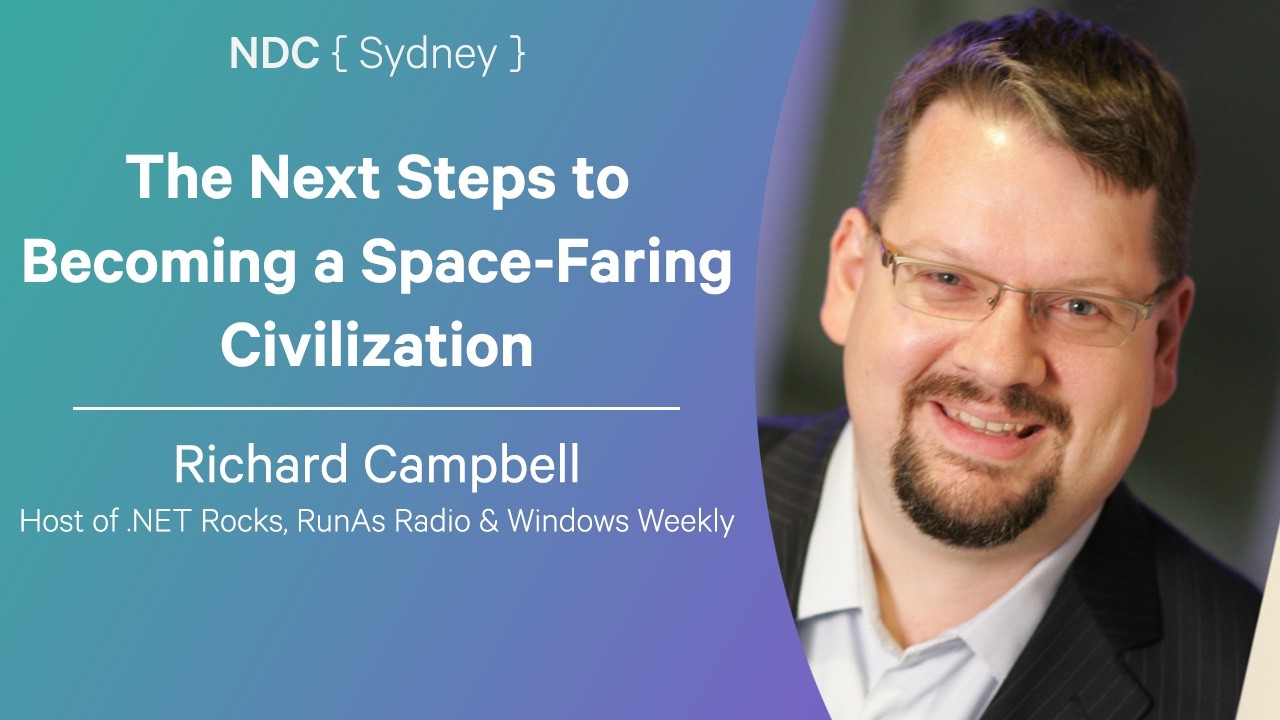
The Next Steps to Becoming a Space-Faring Civilization - Richard Campbell - NDC Sydney 2026
Keywords
Summary
154 words
Critical Evaluation
Value of the Information & Strength of the Argument
The talk provides valuable insights into the current state and near-term future of space exploration, backed by specific examples and data. Campbell’s argumentation is solid, as he supports his points with real missions and cost figures. He effectively argues that the lowering cost of access to space is a game-changer, and he presents a balanced view of the challenges and opportunities. However, some claims are speculative, such as the potential for asteroid mining, and he occasionally relies on personal anecdotes rather than rigorous evidence.
Scientific Rigor, Source Quality, Title Accuracy
The talk demonstrates a good level of scientific rigor, as Campbell references real missions and technologies. However, he does not provide formal citations, and some information is based on his personal interpretation. The title accurately reflects the content, and the talk is well-structured. The speaker’s credibility is enhanced by his experience and the fact that he was invited to speak at NASA. The talk is not purely technical but is accessible to a general audience, which is appropriate for a conference talk.
181 words
Title / Content Match
The title accurately reflects the content, which discusses the technological and logistical steps needed for humanity to become a space-faring civilization.
Quality & Reliability
8/10
The talk is based on well-known space missions and publicly available data, but it includes personal opinions and some speculative elements. The speaker demonstrates deep knowledge and references real missions (DART, Artemis, Starship) without providing formal citations.
Key Moments
Markers derived by PSI from the transcript: the creator did not define chapters.
- Introduction and background on the speaker's podcasts and interest in space.
- Discussion of planetary defense and the DART mission's success in altering an asteroid's orbit.
- Explanation of the cost of access to space and the impact of reusable rockets.
- Overview of current space stations and the future of commercial space stations.
- Discussion of the Artemis program and the recent Artemis 2 mission.
- Reflection on the importance of scientific exploration on the Moon, using Jack Schmitt as an example.
- Analysis of the challenges with the SLS rocket and the need for a more powerful upper stage.
- Discussion of the future of lunar exploration and the potential for international cooperation.
- Conclusion and summary of the key points.
Cited Sources
- NDC Conferences — Conference organizer and host of the talk.
- NDC Sydney — Event page for the conference where the talk was recorded.
Concurring Sources
- NASA - DART Mission — Official NASA page on the DART mission.
- NASA - Artemis Program — Official NASA page on the Artemis program.
Contribution & Novelties
The talk provides a comprehensive overview of the current state of space exploration and the technological advancements that are making a space-faring civilization more feasible. It emphasizes the economic factors and the role of commercial entities in driving progress. The speaker’s perspective as a technology enthusiast and podcaster adds a unique angle, making the topic accessible to a broader audience.
Pour aller plus loin :
- DART mission — Overview of the Double Asteroid Redirection Test.
- Artemis program — NASA’s lunar exploration program.
- SpaceX Starship — Details on the fully reusable spacecraft.
- International Space Station — Information on the ISS and its future.
102 words
Radar Profile
The radar profile shows high scores in quantity and quality of information, with a moderate technical level. The reliability is also high, reflecting the speaker's expertise and use of real-world examples. The overall balance suggests a well-informed and credible talk.