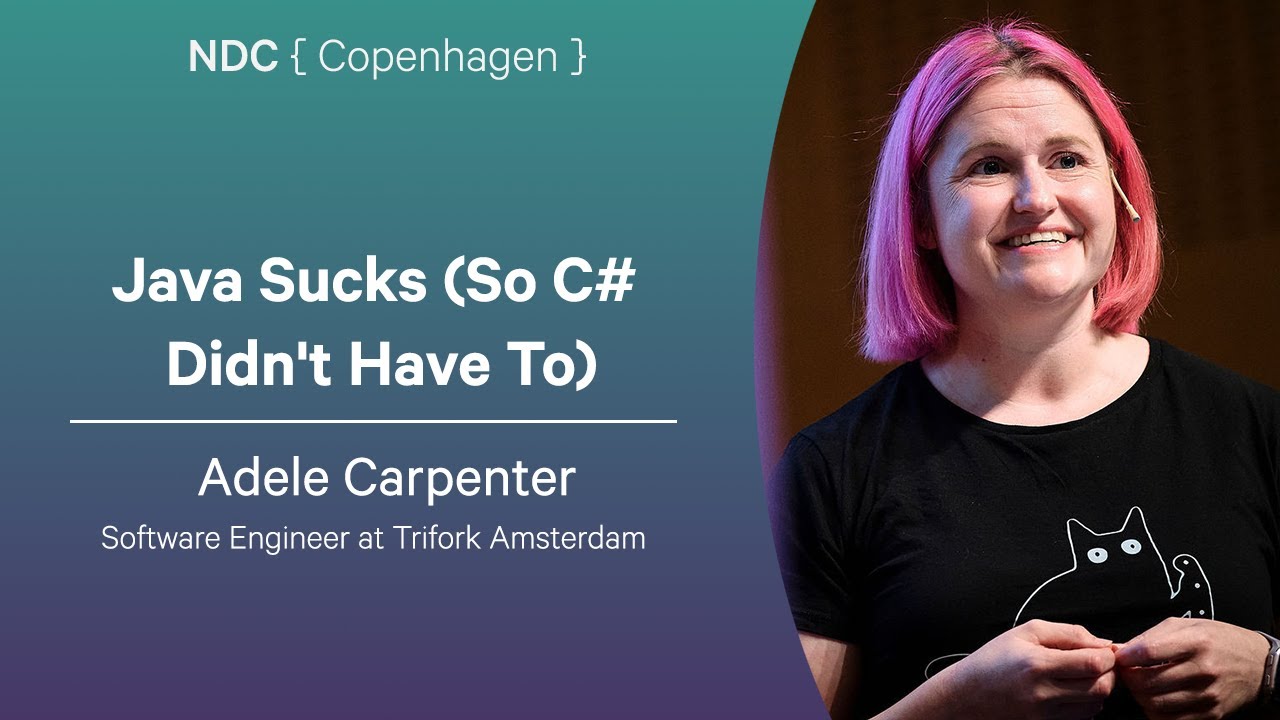
Java Sucks (So C# Didn't Have To) - Adele Carpenter - NDC Copenhagen 2025
Keywords
Summary
150 words
Critical Evaluation
Value of the Information & Strength of the Argument
The talk provides valuable insights into the historical and technical reasons behind Java’s design choices, such as type erasure and the lack of reified generics. Carpenter’s argumentation is well-structured, using concrete examples and anecdotes to illustrate her points. She effectively explains complex concepts like type erasure and generics in an accessible manner. The comparison with C# is balanced, acknowledging both languages’ strengths and weaknesses. The talk is opinionated but grounded in factual history and technical details, making it a valuable resource for developers interested in language design.
Scientific Rigor, Source Quality, Title Accuracy
Carpenter demonstrates scientific rigor by referencing historical events, quotes from key figures like James Gosling and Bill Joy, and specific JSRs (Java Specification Requests). She cites the Java Community Process and mentions the influence of languages like Smalltalk, Mesa, and Cedar. The talk is based on her experience and publicly available information, but it lacks formal citations or references to academic papers. The title is catchy but slightly misleading, as the talk is more of a balanced comparison than a critique. Overall, the content is well-researched and credible for an expert opinion.
194 words
Title / Content Match
The title is provocative and attention-grabbing, but the content is a balanced comparison and a love letter to Java, not a one-sided bashing. It matches the talk's theme of comparing Java and C#.
Quality & Reliability
8/10
The talk is an expert opinion by a software engineer with practical experience in Java and C#. It provides historical context and technical explanations, but it is not peer-reviewed and contains subjective opinions. The speaker is transparent about her background and the talk's purpose.
Key Moments
Markers derived by PSI from the transcript: the creator did not define chapters.
- Introduction and personal story about emergency appendectomy.
- Overview of Java's origins and the Green Team.
- Explanation of Java's design goals and influences from Xerox PARC languages.
- Discussion on type erasure and reified generics.
- Historical context of generics in Java and the JCP.
- Comparison of Java and C# features and design philosophies.
- Modern Java evolution and future directions.
- Conclusion and call for unity between Java and C# developers.
Cited Sources
- NDC Conferences — Conference organizer and talk host.
- NDC Copenhagen — Conference website for the event where the talk was given.
Concurring Sources
- Java Language Specification — Official specification for Java, which includes details on generics and type erasure.
- C# Language Specification — Official specification for C#, which includes reified generics.
Dissenting Sources
- Java Generics: What are the advantages of reified generics? — Some developers argue that type erasure is not a significant drawback and that reified generics would complicate the language.
Contribution & Novelties
The talk provides a unique perspective on Java’s design decisions, particularly the trade-offs made for backward compatibility and the impact on developer experience. It offers a balanced comparison with C#, highlighting how C# benefited from Java’s early mistakes. The personal anecdotes and humor make it engaging, while the technical depth is suitable for experienced developers.
Pour aller plus loin :
- Java Community Process — Official site for the JCP, which is central to Java’s evolution.
- JSR 14: Add Generic Types To The Java Programming Language — The specification for generics in Java, explaining type erasure.
- Reified generics — Wikipedia article on reification, which includes generics.
- Type erasure — Wikipedia article on type erasure, a key concept discussed in the talk.
120 words
Radar Profile
The radar chart shows a balanced profile with high scores in information quantity and quality, moderate technical level, and good reliability. The talk is informative and well-argued, but not extremely technical or highly rigorous in terms of formal citations.
💬 Sur les 0 commentaires analysés, aucune tendance n'est disponible.