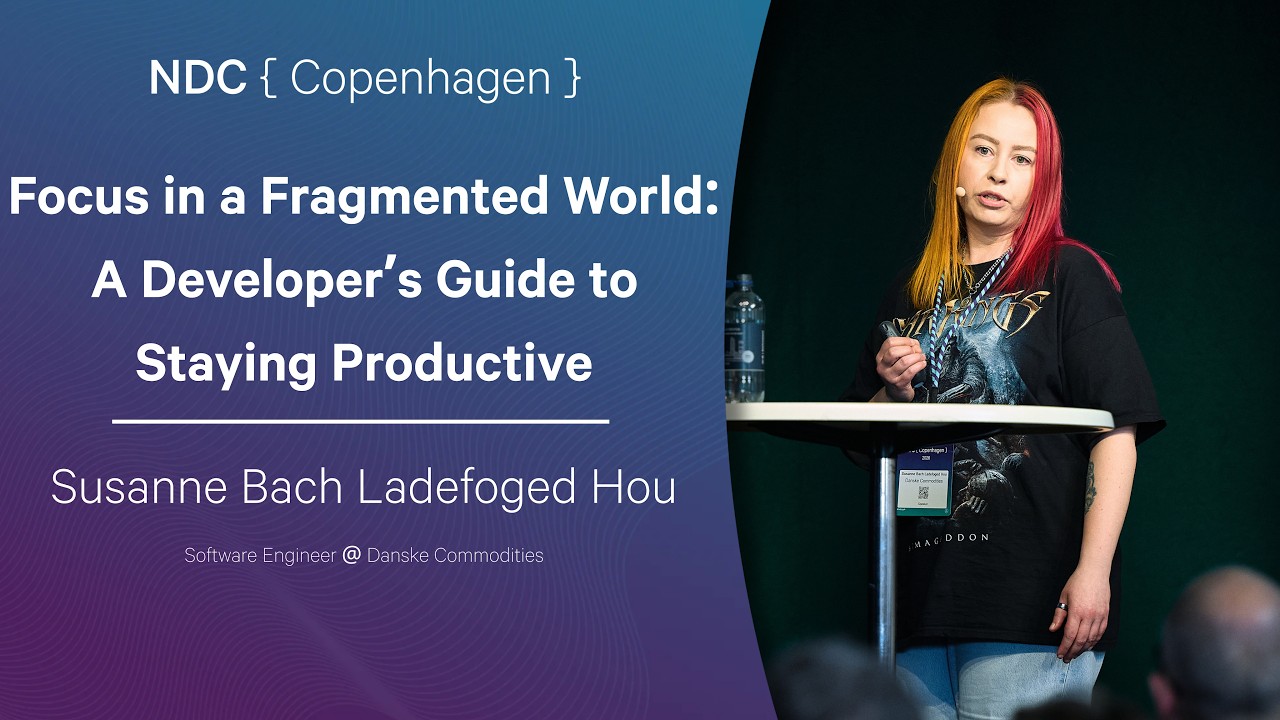
Focus in a Fragmented World: A Developer’s Guide to Staying Productive
Keywords
Summary
160 words
Critical Evaluation
Value of the Information & Strength of the Argument
The talk provides valuable, actionable advice grounded in the speaker’s extensive personal experience, making it highly relatable for developers facing similar struggles. The argumentation is coherent and well-structured, moving from explaining the neurological basis of attention to offering concrete strategies. While not scientifically rigorous, the speaker’s transparency about her non-expert status and her emphasis on practical, tested methods lend credibility. The techniques are presented as a toolbox, allowing attendees to pick what works for them, which is a pragmatic approach. The inclusion of personal anecdotes, such as using a website blocker and the 5-minute timer, makes the advice tangible and convincing.
Scientific Rigor, Source Quality, Title Accuracy
The talk lacks formal citations or references to scientific literature, which limits its scientific rigor. However, the speaker clearly states she is not a psychologist or neurologist, and her advice is based on personal trial and error. The simplified explanation of brain systems is accurate but not deeply detailed. The title accurately reflects the content, focusing on practical productivity for developers. The description provides links to NDC conferences but no additional sources. The talk’s strength lies in its practical applicability rather than academic depth.
200 words
Title / Content Match
The title accurately reflects the content, focusing on practical productivity techniques for developers in a distracting environment.
Quality & Reliability
7/10
The talk is based on personal experience and practical strategies rather than peer-reviewed research. It provides a simplified overview of neuroscience concepts but lacks citations. The speaker is transparent about her non-expert status, which enhances credibility but limits scientific rigor.
Key Moments
Markers derived by PSI from the transcript: the creator did not define chapters.
- Introduction: speaker introduces herself, her background, and the talk's purpose.
- Explanation of why focus is harder today: increased complexity and information overload.
- Overview of brain systems involved in attention: prefrontal cortex, anterior cingulate cortex, striatum, amygdala.
- Discussion of the cost of interruptions and context switching on productivity.
- Impact of AI on productivity and the risk of AI burnout.
- Time management techniques: blocking focused time, batching code reviews, ramp-in and ramp-out.
- Energy management: the traffic light method for categorizing tasks and balancing energy.
- Optimizing physical work environment: reducing visual clutter and creating a dedicated workspace.
- Managing browser tabs with tab groups to reduce cognitive load.
- Strategies for starting large tasks: eat the frog, snowball method, and the 5-minute timer.
- Dealing with procrastination: making distractions harder and making work more enjoyable.
- Meetings as a challenge and strategies for staying engaged.
- Task tracking and taking attention back from smartphones.
Cited Sources
- NDC Conferences — Mentioned as the organizer of the conference where the talk was recorded.
- NDC Copenhagen — Specific conference event page.
Concurring Sources
- NDC Conferences — The conference platform where the talk was presented, aligning with the speaker's context.
Contribution & Novelties
The talk offers a unique perspective by combining personal experience with ADHD with practical productivity techniques tailored for developers. It provides a comprehensive toolbox of strategies that are immediately applicable, emphasizing sustainability and balance. The speaker’s candid sharing of her own struggles and solutions adds authenticity and relatability.
Pour aller plus loin :
- ADHD and Executive Function — Provides background on cognitive processes relevant to focus and task management.
- Pomodoro Technique — A time management method that complements the speaker’s suggestions for breaking work into intervals.
- Flow (psychology) — Understanding the state of deep focus and how to achieve it.
100 words
Radar Profile
The radar profile shows high scores in quantity and quality of information, reflecting the talk's rich practical content. The technical level is moderate, suitable for a general developer audience. The overall reliability is slightly lower due to the lack of formal citations, but the speaker's experience adds credibility.
💬 No comments were provided for analysis.