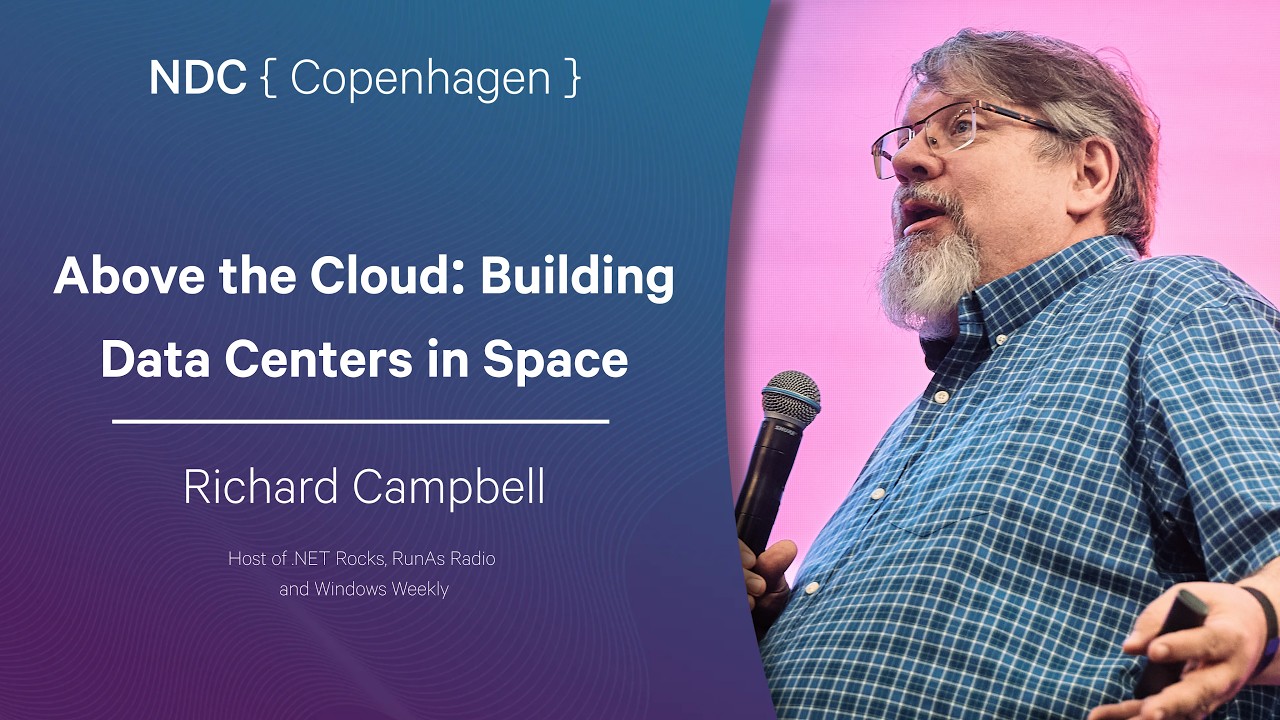
Above the Cloud: Building Data Centers in Space - Richard Campbell - NDC Copenhagen 2026
Keywords
Summary
131 words
Critical Evaluation
Value of the Information & Strength of the Argument
The talk provides valuable insights by quantifying the challenges of space-based data centers, moving beyond hype. The argumentation is solid, based on publicly available specifications and orbital mechanics. Campbell walks through each subsystem, providing concrete numbers and comparisons, making the case that while the concept is not impossible, it is impractical for most workloads. He emphasizes the latency and cooling issues, which are often overlooked. The analysis is grounded and avoids sensationalism.
Scientific Rigor, Source Quality, Title Accuracy
The talk demonstrates scientific rigor by using specific data points (e.g., NVL72 power draw, solar panel efficiency, Starlink capabilities) and referencing real systems. The sources are primarily public specifications and his own calculations, which are transparent. The title accurately reflects the content. The talk is an expert opinion rather than a peer-reviewed study, but it is well-reasoned and based on verifiable data.
149 words
Title / Content Match
The title accurately reflects the content, which explores the feasibility of space-based data centers.
Quality & Reliability
8/10
The talk is grounded in engineering analysis, with detailed calculations and references to real systems (Starlink, ISS, Nvidia NVL72). The speaker is experienced and transparent about assumptions. However, it is an opinion piece based on public data, not peer-reviewed research.
Key Moments
Markers derived by PSI from the transcript: the creator did not define chapters.
- Introduction and background on the speaker's space-related talks.
- Discussion of Star Cloud's H100 satellite launch and their ambitious plans.
- Explanation of different orbits and their latency implications.
- Introduction of the Nvidia NVL72 as the computational unit for analysis.
- Breakdown of satellite bus components: structure, command, attitude control.
- Power requirements: 135 kW, solar panel area calculation.
- Cooling challenges: heat radiation in vacuum, ammonia system.
- Communication: laser links, latency, and reliance on Starlink.
- Battery vs. sun-synchronous orbit trade-offs.
- Overall mass and size estimates, comparison to existing satellites.
Cited Sources
- NDC Conferences — Conference organizer and host of the talk.
- NDC Copenhagen — Specific conference where the talk was recorded.
Concurring Sources
- Star Cloud — Startup mentioned in the talk that launched an H100 into space.
Dissenting Sources
- SpaceX Starship — While not directly contradicting, the talk implies Starship's delays affect the timeline for space data centers.
External References
Contribution & Novelties
The talk provides a comprehensive, numbers-driven analysis of space-based data centers, filling a gap in public discourse. It breaks down the engineering requirements in a way that is accessible yet detailed. The ‘Pour aller plus loin’ section offers further exploration.
Pour aller plus loin :
- Sun-synchronous orbit — Relevant to the discussion of avoiding batteries.
- Nvidia NVL72 — The specific compute unit analyzed.
- Starlink laser communication — The technology for inter-satellite links.
72 words
Radar Profile
The radar profile shows high scores in information quantity, quality, and technical level, with a slightly lower but still strong reliability score. This indicates a technically dense and informative talk that is well-grounded, though not peer-reviewed.
💬 Très positif. Sur les 30 commentaires analysés, les spectateurs expriment une admiration marquée pour la clarté et la rigueur de l'analyse, saluant la capacité de Richard Campbell à vulgariser des sujets complexes sans perdre en précision.