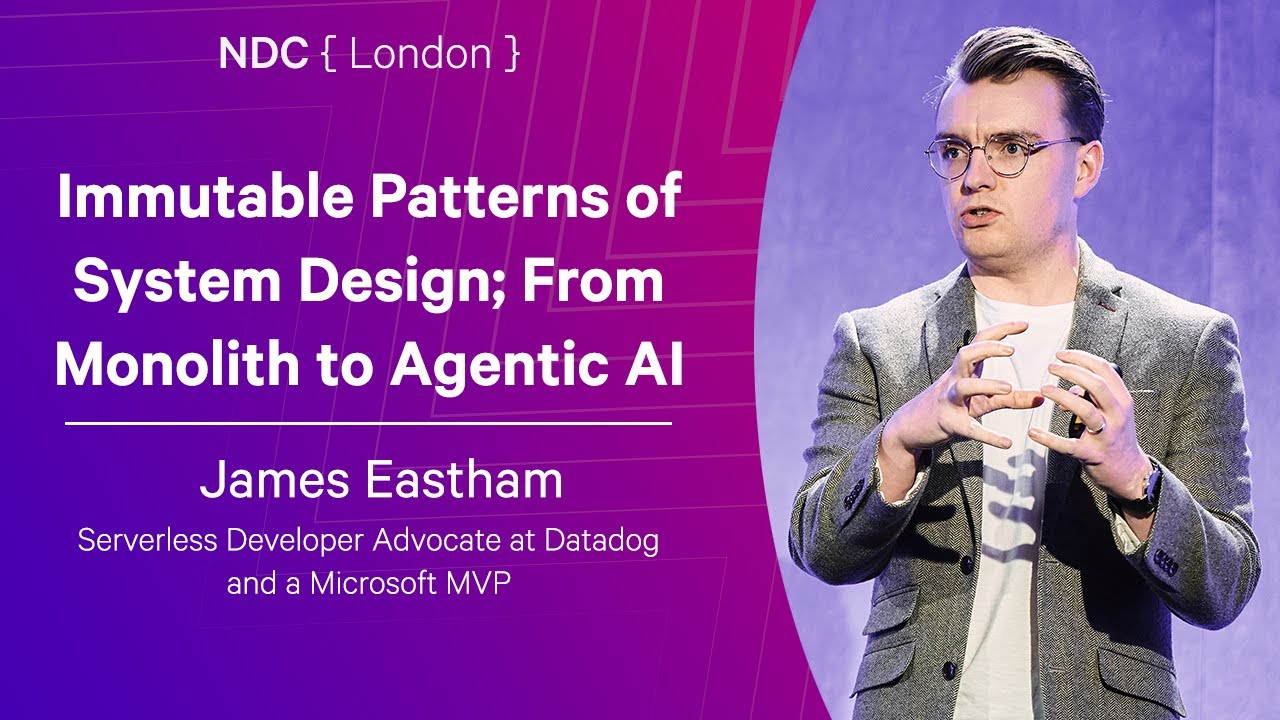
Immutable Patterns of System Design; From Monolith to Agentic AI - James Eastham - NDC London 2026
Keywords
Summary
168 words
Critical Evaluation
Value of the Information & Strength of the Argument
The talk offers valuable insights into timeless software design principles, supported by references to established authorities like Ashby, Fowler, and Helland. The argumentation is coherent and practical, using the narrative of Jane to illustrate real-world challenges and solutions. The speaker effectively argues that despite technological changes, core patterns like evolvability and encapsulation remain crucial. He provides concrete examples, such as migrating from serverless to Kubernetes, to demonstrate the benefits of these patterns. The emphasis on event-driven architecture and the robustness principle adds depth to the discussion. Overall, the value lies in its actionable heuristics for system design, though it could benefit from more empirical evidence or case studies.
Scientific Rigor, Source Quality, Title Accuracy
The talk demonstrates scientific rigor by referencing well-known concepts and authors, such as Ashby’s law, Barry O’Reilly’s books, Martin Fowler’s work on event-driven architecture, and Pat Helland’s article. The sources are credible within the software engineering community. The title accurately reflects the content, focusing on immutable patterns that apply across different architectural styles. The talk is well-structured and the speaker’s expertise is evident. However, the sources are not formally cited with URLs, and the talk is primarily based on the speaker’s experience and interpretation of these concepts. The adequacy between title and content is high, as the talk indeed covers patterns that are consistent from monoliths to agentic AI.
232 words
Title / Content Match
The title accurately reflects the content: the talk discusses immutable patterns of system design that apply across various architectural styles, from monoliths to agentic AI.
Quality & Reliability
8/10
The talk is based on established principles and patterns (e.g., Ashby's law, ports and adapters, event-driven architecture) and references credible sources like Martin Fowler and Pat Helland. The speaker is an experienced practitioner (Microsoft MVP, developer advocate) and provides practical, actionable advice. However, the talk is largely opinion and experience-based, with limited empirical evidence or citations to specific studies.
Key Moments
Markers derived by PSI from the transcript: the creator did not define chapters.
- Introduction: The speaker introduces the concept of immutable patterns and the story of Jane.
- Discussion on the inevitability of change and the first pattern: evolvability.
- Explanation of Ashby's law of requisite variety and its application to software systems.
- Introduction to Barry O'Reilly's concepts of naive architecture, stressors, and attractors.
- Deep dive into ports and adapters (hexagonal architecture) and its benefits for evolvability.
- Discussion on event-driven architecture and how it enables system evolution.
- The second pattern: encapsulation, illustrated with the kitchen analogy and Pat Helland's article.
- Practical techniques: domain storytelling and event storming for understanding data flow.
- Postel's law (robustness principle) for designing resilient service interactions.
- Conclusion: Recap of the five immutable patterns and their importance in modern system design.
Cited Sources
- NDC Conferences — Conference organizer; the talk was given at NDC London.
- NDC London — Specific conference event where the talk was recorded.
Concurring Sources
- Martin Fowler's article on Event-Driven Architecture — Referenced in the talk as a source for the definition of event-driven architecture.
- Pat Helland's article 'Data on the Inside vs. Data on the Outside' — Referenced in the talk to discuss data encapsulation.
Contribution & Novelties
The talk provides a synthesis of well-known patterns and principles into a coherent framework of ‘immutable patterns’ that remain relevant across technological shifts. It emphasizes the importance of evolvability and encapsulation, and offers practical advice for applying these patterns in modern systems, including agentic AI. The speaker’s narrative approach makes the concepts accessible and memorable.
Pour aller plus loin :
- Ashby’s law of requisite variety — Foundational concept for understanding system adaptability.
- Hexagonal architecture (Ports and Adapters) — Detailed explanation of the pattern discussed.
- Event-driven architecture — Overview of the architectural style and its benefits.
- Domain storytelling — Technique for modeling business processes.
- Event storming — Collaborative workshop technique for domain modeling.
112 words
Radar Profile
The radar profile shows high scores in information quantity and quality, indicating a content-rich talk with valuable insights. The technical level is moderately high, suitable for experienced developers. The overall reliability is strong, supported by references to established concepts and authors.
💬 Sur les 0 commentaires analysés, aucune tendance n'est disponible.