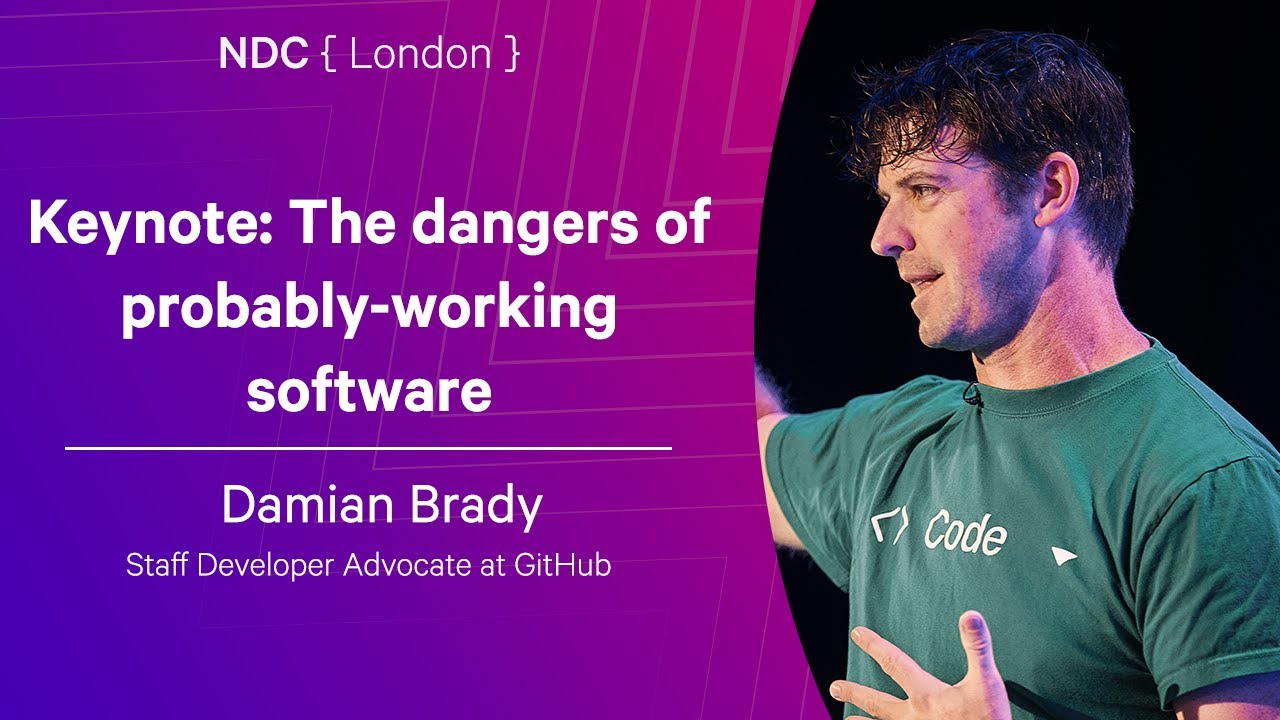
Keynote: The dangers of probably-working software - Damian Brady - NDC London 2026
Keywords
Summary
198 words
Critical Evaluation
Value of the Information & Strength of the Argument
The talk provides valuable insights into the challenges of software reliability in the age of AI. Brady’s argument is well-structured, using personal stories and concrete examples to illustrate the dangers of ‘probably-working software.’ He effectively builds a case that understanding code is crucial, but acknowledges that complete understanding is impossible due to the complexity of modern software stacks. The argument is persuasive, though it relies heavily on anecdotal evidence rather than systematic research. He offers practical advice: trust the ecosystem but verify critical components, and use AI judiciously based on risk.
Scientific Rigor, Source Quality, Title Accuracy
Brady demonstrates scientific rigor by referencing real incidents (e.g., a .NET compiler bug from 2015, the CrowdStrike outage) and well-known concepts (Huffman coding, dependency trees). He recommends ‘Code: The Hidden Language of Computer Hardware and Software’ by Charles Petzold, a reputable source. The title accurately reflects the content. The talk is well-researched and the speaker is credible, though it is not a formal study. The audience’s engagement suggests the content resonated, but no comments were provided for analysis.
184 words
Title / Content Match
The title accurately reflects the central theme: the risks of relying on software that appears to work but is not fully understood, especially in the context of AI-generated code.
Quality & Reliability
8/10
The talk is based on the speaker's extensive experience in software development and developer relations. It references real incidents (e.g., .NET compiler bug, CrowdStrike) and concepts (Huffman coding, dependency trees) that are verifiable. The speaker is credible and the content is well-structured, though it is primarily anecdotal and opinion-based rather than presenting new empirical research.
Key Moments
Markers derived by PSI from the transcript: the creator did not define chapters.
- Introduction: Damian Brady introduces himself and his background in software development and developer relations.
- Story about implementing Huffman coding from Wikipedia without full understanding, leading to a production bug.
- Explanation of Huffman coding and the problem of padding bits causing decoding errors.
- Discussion of modern development with AI tools: using GitHub Copilot to generate compression code without understanding it.
- Example of a .NET code snippet that outputs zero, except under specific compiler conditions, illustrating hidden complexity.
- Introduction of MSIL and the layers of abstraction between source code and machine code.
- The toaster project: building a toaster from scratch to demonstrate reliance on existing infrastructure.
- Dependency tree of a simple Express.js app: 123 dependencies, highlighting reliance on others' code.
- Argument that software development is an exercise in trust, and we must trust the ecosystem.
- Example of an AI agent that bricked a machine due to unintended actions, illustrating risks of AI-generated code.
Cited Sources
- NDC Conferences — Mentioned as the organizer of the conference.
- NDC London — Mentioned as the specific conference event.
Concurring Sources
- GitHub Copilot — Mentioned as an example of AI coding tool.
Contribution & Novelties
The talk offers a fresh perspective on the risks of AI-generated code by framing it within the broader context of software trust and understanding. It highlights that ‘probably-working software’ is not a new problem but is exacerbated by AI’s opacity. The speaker provides practical guidance on when to trust AI-generated code based on risk assessment.
Pour aller plus loin :
- Huffman coding — Background on the compression algorithm discussed.
- CrowdStrike incident — Example of a software failure due to a faulty update.
- Code: The Hidden Language of Computer Hardware and Software — Recommended book for understanding computer systems from the ground up.
102 words
Radar Profile
The radar profile shows high scores in quality of information and reliability, reflecting the speaker's expertise and credible examples. The quantity of information is moderate, as the talk focuses on a few key points. The technical level is moderate, accessible to a broad developer audience. Overall, the talk is well-balanced, with strengths in credibility and relevance.