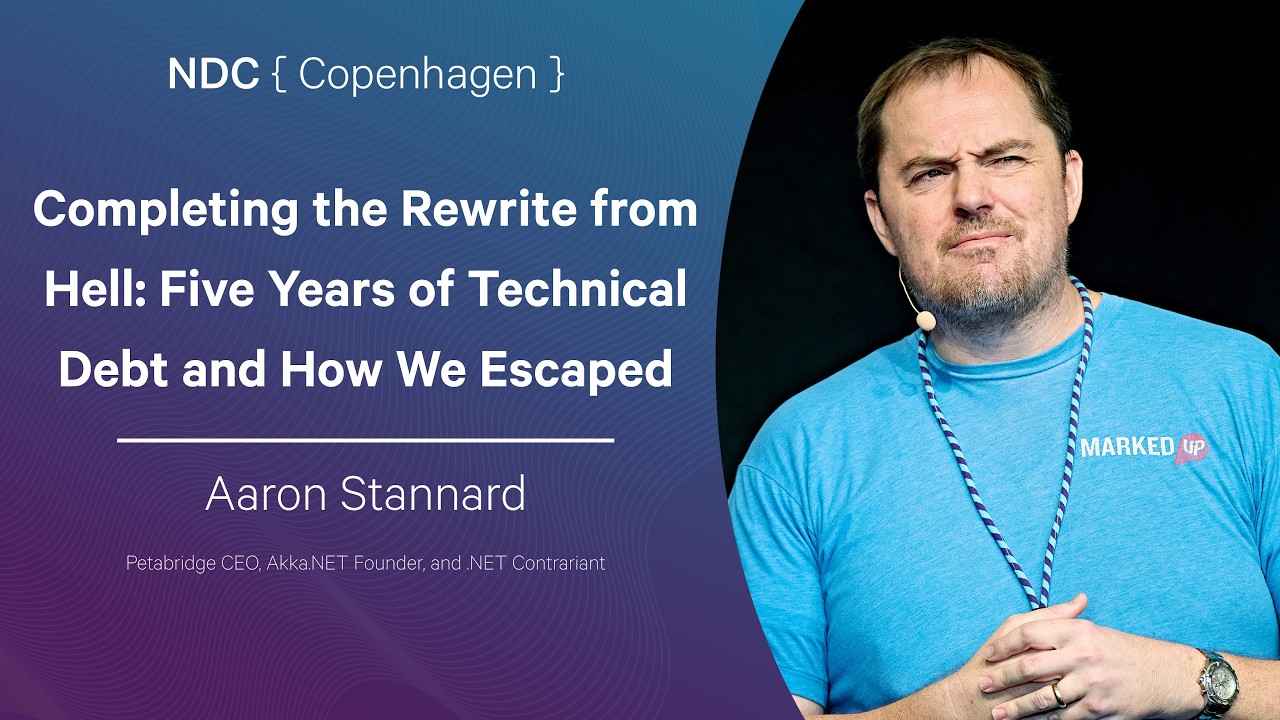
Completing the Rewrite from Hell: Five Years of Technical Debt and How We Escaped - Aaron Stannard
Keywords
Summary
157 words
Critical Evaluation
Value of the Information & Strength of the Argument
The talk provides valuable insights into the consequences of poor architectural decisions and the challenges of managing technical debt. Stannard’s argumentation is compelling, supported by concrete examples and personal experience. He effectively illustrates the pitfalls of over-engineering, the importance of architecture reviews, and the benefits of strategic refactoring over full rewrites. The narrative is well-structured and persuasive, offering practical lessons for both technical and managerial audiences.
Scientific Rigor, Source Quality, Title Accuracy
The talk is based on the speaker’s personal experience, which lends authenticity but limits generalizability. No external sources are cited, but the speaker references specific technologies and patterns (e.g., actor model, generic repository) that are well-known in the software engineering community. The title accurately reflects the content, and the talk’s structure is clear and logical. The lack of external references is a minor weakness, but the depth of personal insight compensates.
152 words
Title / Content Match
The title accurately reflects the content: a detailed account of a five-year technical debt crisis and the eventual successful rewrite.
Quality & Reliability
8/10
The talk is a first-hand account of a technical and managerial failure, with concrete examples and lessons learned. The speaker is a recognized expert in distributed systems and .NET, and the narrative is coherent and detailed. However, it is anecdotal and lacks external verification or data.
Key Moments
Markers derived by PSI from the transcript: the creator did not define chapters.
- Introduction: Aaron Stannard sets the stage, describing the talk as about his biggest professional embarrassment.
- Background on Petabridge and the business model, emphasizing high standards and the importance of quality.
- The origin of SDK Bin: the need for a fulfillment system for Phobos, and the initial ambitious vision.
- Early development: the team, the timeline, and the impact of COVID-19 on priorities.
- The fatal architectural decisions: generic repository pattern, microservices, and the choice of Postgres over SQL Azure.
- The discovery of the front-end problem and the panic build using Razor Pages.
- The launch disaster: payment failures, security bugs, and performance issues.
- The ongoing firefighting and the impact on sales and company finances.
- The decision to abandon a full rewrite and pivot to strategic refactoring.
- Using AI to accelerate the refactoring process and the final successful outcome.
Cited Sources
- NDC Conferences — The talk was recorded at NDC Copenhagen, and this is the main conference website.
- NDC Copenhagen — The specific conference where the talk was given.
Concurring Sources
- Technical Debt — The concept of technical debt is central to the talk, and this source provides a general overview.
- Actor Model — The speaker recommends the actor model as a solution to the architectural problems, and this source explains the pattern.
Contribution & Novelties
The talk offers a candid, first-hand account of a five-year technical debt crisis, providing valuable lessons on the dangers of over-engineering, the importance of architecture reviews, and the benefits of strategic refactoring over full rewrites. It also highlights the potential of AI in code modernization, a relatively new area. The speaker’s dual perspective as CEO and developer adds depth to the analysis.
Pour aller plus loin :
- Technical debt — Foundational concept for understanding the talk’s core theme.
- Actor model — The architectural pattern the speaker advocates for, relevant to the discussion of scalable systems.
- Strangler fig pattern — A common strategy for incremental refactoring, directly related to the talk’s approach.
- Generic repository pattern — The anti-pattern criticized in the talk, useful for understanding the initial mistakes.
127 words
Radar Profile
The radar profile shows high scores in information quantity and quality, reflecting the detailed and insightful content. The technical level is moderate, suitable for a broad technical audience. The reliability score is slightly lower due to the anecdotal nature, but overall the talk is well-regarded.
💬 Sur les 0 commentaires analysés, aucune tendance n'est disponible.