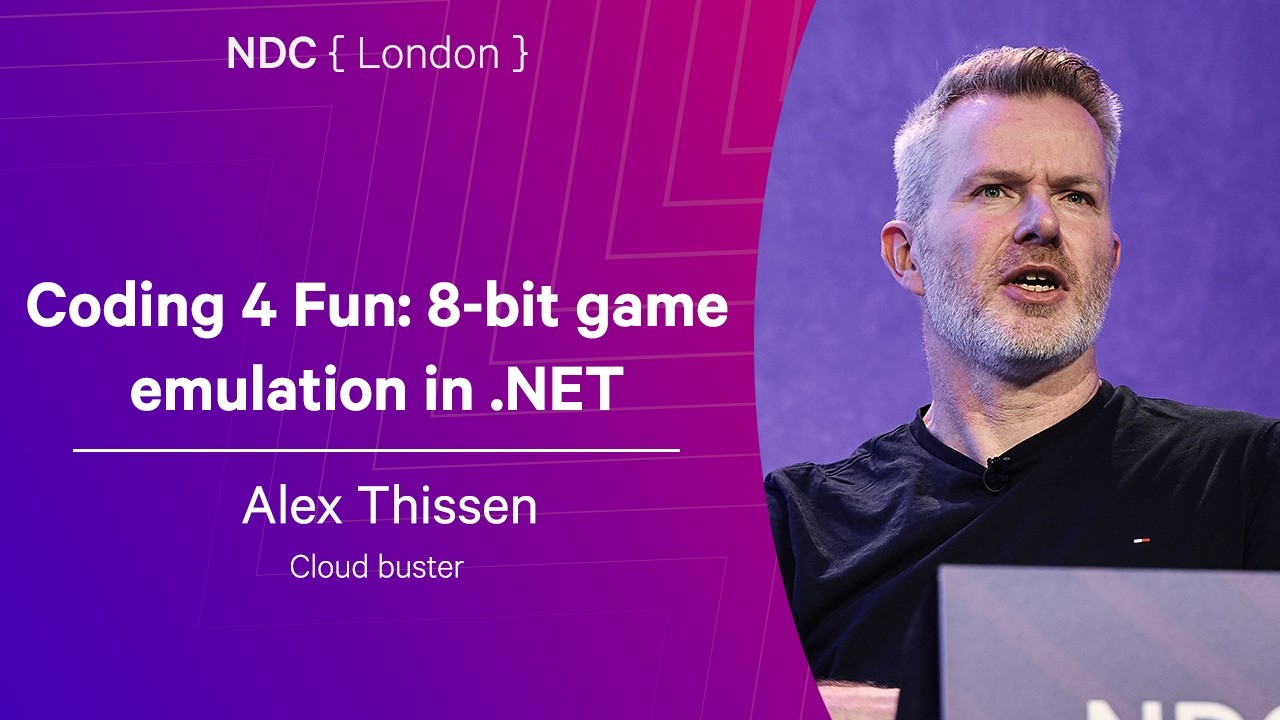
Coding 4 Fun: 8-bit game emulation in .NET - Alex Thissen - NDC London 2026
Keywords
Summary
106 words
Critical Evaluation
Value of the Information & Strength of the Argument
The talk provides valuable insights into the inner workings of 8-bit consoles and the practical steps to emulate them in a managed language like C#. The speaker’s argumentation is solid, grounded in his personal experience and technical knowledge. He clearly explains the trade-offs between different emulation approaches (interpretation, static/dynamic translation, high-level emulation) and justifies his choice of interpretation for simplicity and accuracy. The demonstration of the emulator loop and the abstract processor design is well-structured and easy to follow, making the content accessible to developers with some background in low-level programming.
Scientific Rigor, Source Quality, Title Accuracy
The talk demonstrates scientific rigor by accurately describing the hardware architecture and referencing documentation for the Atari Lynx. The speaker mentions the availability of official documentation and the importance of using logic analyzers for verification. The title accurately reflects the content, which is a coding-focused tutorial on emulation. The sources cited are primarily the NDC conference links, which are relevant but not directly related to the technical content. The talk does not explicitly cite academic sources, but the technical details are consistent with established knowledge in computer engineering.
194 words
Title / Content Match
The title accurately reflects the content: a fun, coding-focused session on 8-bit game emulation in .NET.
Quality & Reliability
8/10
The talk is a technical tutorial by an experienced developer, presenting accurate historical and technical details about 8-bit consoles and emulation. The speaker demonstrates practical implementation in C#/.NET, and the content aligns with established knowledge in the field. No major inaccuracies detected, though some simplifications are made for clarity.
Key Moments
Markers derived by PSI from the transcript: the creator did not define chapters.
- Introduction to retro gaming and the speaker's personal history with the Atari Lynx.
- Explanation of 8-bit console architecture: CPU, ROM, RAM, and bus structure.
- Deep dive into the 6502 processor: registers, flags, stack, and interrupts.
- Discussion of emulation approaches: interpretation vs. translation.
- Presentation of the main emulator loop and the abstract ProcessorBase class.
- Case study: Atari Lynx hardware and its custom chips (Mikey and Suzie).
- Live demo of the emulator running a game, with discussion of challenges and future work.
Cited Sources
- NDC Conferences — Official conference website, mentioned as the organizer of the event.
- NDC London — Specific conference page for NDC London, where the talk was recorded.
Concurring Sources
- 6502 processor — The talk's description of the 6502 aligns with this reference.
- Emulator — General emulation concepts discussed in the talk are consistent with this source.
Contribution & Novelties
The talk provides a practical, hands-on guide to building an 8-bit emulator in .NET, which is a relatively niche topic. It offers a clear architectural pattern for emulating processors and discusses the challenges of timing and hardware interaction. The speaker’s personal experience with the Atari Lynx adds a unique perspective.
Pour aller plus loin :
- 6502 processor — Overview of the 6502 CPU architecture, relevant to the talk’s focus.
- Emulator — General concept of emulation, including types and techniques.
- MonoGame — Cross-platform game framework used in the talk for graphics and audio.
92 words
Radar Profile
The radar profile shows high scores in information quantity, quality, and technical level, with a slightly lower score in global reliability due to the lack of explicit citations. This indicates a well-informed and technically detailed talk that could benefit from more formal references.
💬 Sur les 0 commentaires analysés, aucune tendance n'est disponible.