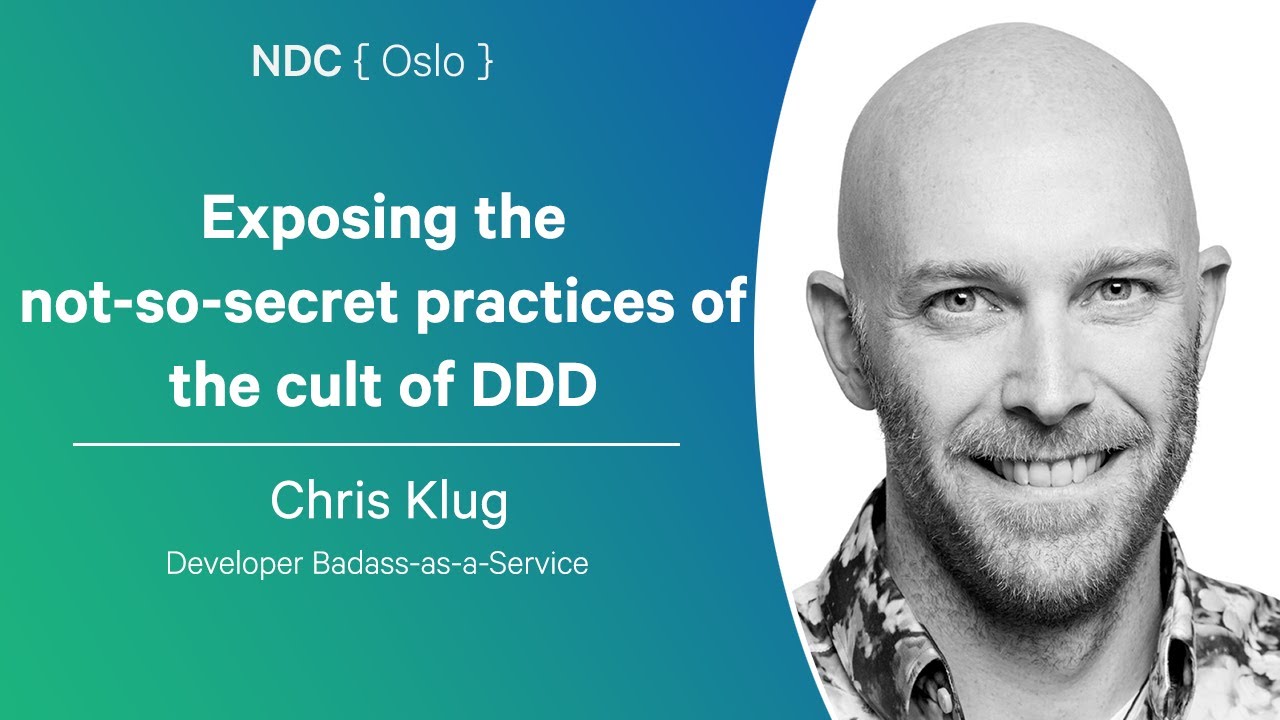
Exposing the not-so-secret practices of the cult of DDD - Chris Klug - NDC Oslo 2025
Keywords
Summary
177 words
Critical Evaluation
Value of the Information & Strength of the Argument
The talk provides valuable insights into DDD, particularly the tactical pattern of value objects, which are often misunderstood or underutilized. Klug’s argumentation is solid, grounded in his extensive experience and references to Eric Evans’s ‘Domain-Driven Design’ and Vaughn Vernon’s ‘Implementing Domain-Driven Design’. He effectively demonstrates the benefits of value objects through clear C# examples, showing how they improve code readability, maintainability, and domain alignment. He also addresses common objections, such as the complexity of DDD, by presenting it as a set of pragmatic tools rather than a rigid methodology. The argument that code is worthless unless it solves domain problems is a strong philosophical point that resonates with the audience. However, the talk is primarily opinion and anecdotal, lacking empirical evidence or comparative analysis, which limits its scientific rigor.
Scientific Rigor, Source Quality, Title Accuracy
The speaker demonstrates scientific rigor by referencing the foundational DDD literature (Evans, Vernon) and explaining concepts accurately. He also acknowledges the limitations of his examples and the need for simplification. The sources cited are the books themselves and the conference links, which are appropriate. The title is somewhat sensationalist but accurately reflects the content’s aim to demystify DDD. The talk is well-structured and the speaker’s expertise is evident. However, as a conference talk, it does not provide a systematic review or empirical data, which would be expected in a more formal scientific context. The audience comments are not provided, so no analysis of public reception is possible.
251 words
Title / Content Match
The title is somewhat clickbait but accurately reflects the content: the speaker exposes and demystifies DDD practices, though he is not actually bashing them.
Quality & Reliability
8/10
The speaker is an experienced software developer with 25 years in the field, and the talk is based on well-known DDD literature (Evans, Vernon). The content is practical and grounded in real-world experience, though it is primarily opinion and anecdotal rather than empirical research.
Key Moments
Markers derived by PSI from the transcript: the creator did not define chapters.
- Introduction: Chris Klug introduces himself and the talk's purpose, clarifying he is not bashing DDD.
- Discussion of the ubiquitous language and its importance in communication with domain experts.
- Explanation of tactical patterns and the role of value objects in DDD.
- Code example: refactoring a user object to use a value object for personal details.
- Characteristics of value objects: value equality, immutability, self-validation.
- Demonstration of a color value object with helper methods.
- Example of a Swedish personal number value object with creation methods and domain logic.
- Pop quiz on a code example to illustrate common mistakes.
- Discussion on the limitations of DDD and when it may not be applicable.
- Conclusion: recap of key takeaways and encouragement to explore DDD further.
Cited Sources
- NDC Conferences — Conference organizer and source of the talk.
- NDC Oslo — Specific conference where the talk was recorded.
Concurring Sources
- Domain-Driven Design: Tackling Complexity in the Heart of Software — Eric Evans's seminal book, referenced as the foundation of DDD.
- Implementing Domain-Driven Design — Vaughn Vernon's practical guide, mentioned as a complementary resource.
Contribution & Novelties
The talk provides a fresh, practical perspective on DDD, making it accessible to developers who may find the original literature too dry. It emphasizes the value of tactical patterns, especially value objects, and demonstrates their implementation in C# with modern language features like records. The speaker’s experience as a consultant adds a pragmatic angle, showing how DDD can be applied selectively.
Pour aller plus loin :
- Domain-Driven Design (Wikipedia) — Overview of DDD concepts and history.
- Value Object (Martin Fowler) — Detailed explanation of value objects and their characteristics.
- C# Records (Microsoft Docs) — Official documentation on C# records, which are used for value objects.
105 words
Radar Profile
The radar profile shows high scores in quality of information and technical level, indicating a well-informed and technically deep talk. The quantity of information is moderate, as the talk focuses on specific patterns rather than a broad overview. The overall reliability is high, reflecting the speaker's expertise and use of established literature.