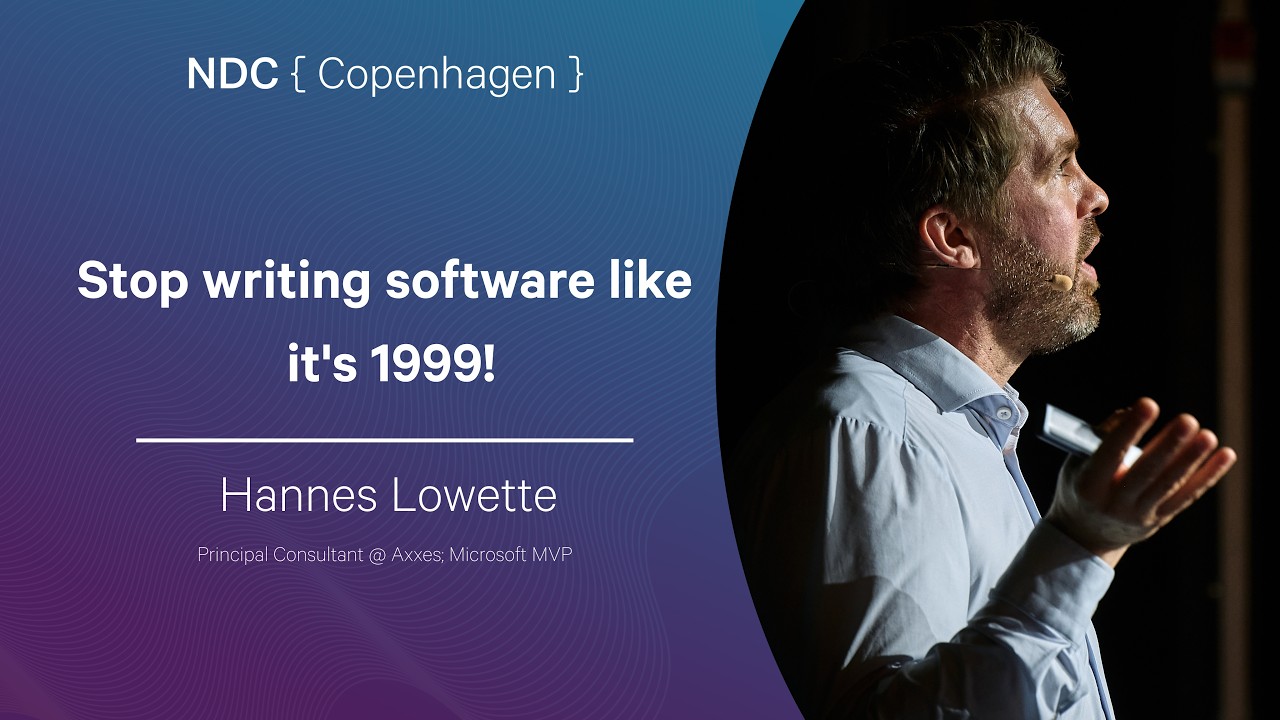
Stop writing software like it's 1999! - Hannes Lowette - NDC Copenhagen 2026
Keywords
Summary
173 words
Critical Evaluation
Value of the Information & Strength of the Argument
The talk provides valuable insights into common software architecture pitfalls and offers practical alternatives. The speaker’s argumentation is clear and structured, using relatable analogies and personal anecdotes. He effectively contrasts the historical context of these practices with modern development realities, making a compelling case for change. However, the arguments are largely based on anecdotal evidence and personal experience rather than empirical data, which limits their generalizability. The suggestion to use modular monoliths is well-reasoned and aligns with current industry trends, but the talk could benefit from more concrete examples or case studies.
Scientific Rigor, Source Quality, Title Accuracy
The talk is an expert opinion without formal citations, but it references well-known concepts and practices in software engineering. The speaker mentions Sam Newman’s book on microservices and the concept of service-oriented architecture, but does not provide specific sources. The title accurately reflects the content, and the talk is coherent and well-structured. The lack of external references is a minor weakness, but the speaker’s credibility and practical experience lend weight to his arguments.
180 words
Title / Content Match
The title accurately reflects the content: the speaker argues that many current software practices are outdated and should be modernized.
Quality & Reliability
7/10
The talk is an expert opinion based on two decades of industry experience, with practical examples and references to established concepts (layered architecture, microservices, modular monoliths, CI/CD). It lacks formal citations or empirical data, but the arguments are coherent and align with common software engineering practices.
Key Moments
Markers derived by PSI from the transcript: the creator did not define chapters.
- Introduction: speaker confesses nervousness and explains the talk's premise.
- Audience exercise: raising hands if they shipped code using 1990s practices.
- Discussion of layered architectures and their historical context.
- Problems with layered architectures in modern agile development.
- Alternative: organizing code by feature, with benefits for developer productivity and AI context.
- Introduction to microservices and their origins in SOA.
- Pitfalls of microservices: operational overhead, context switching, and cross-cutting concerns.
- Advocacy for modular monoliths as a default architecture.
- Case study: a customer project suffering from lack of CI/CD and formalized specifications.
- Importance of CI/CD from day one, with automation and continuous delivery.
Cited Sources
- NDC Conferences — Conference website where the talk was recorded.
- NDC Copenhagen — Specific conference event page.
Concurring Sources
- Sam Newman - Building Microservices — Referenced in the talk as a key book on microservices.
Contribution & Novelties
The talk offers a practical, experience-based critique of common software architecture choices, advocating for modular monoliths and feature-based organization. It uniquely ties these recommendations to the age of AI, emphasizing context management for LLMs. The speaker’s perspective as a consultant provides real-world insights.
Pour aller plus loin :
- Modular monolith architecture — Wikipedia overview of the concept.
- Service-oriented architecture — Historical context for microservices.
- Continuous delivery — Principles and practices for automated deployment.
73 words
Radar Profile
The radar profile shows a balanced talk with strong scores in information quantity and quality, moderate technical depth, and good reliability. The speaker provides a comprehensive overview of software architecture pitfalls and solutions, making it accessible to a broad technical audience.
💬 Sur les 0 commentaires analysés, aucune tendance n'est disponible.