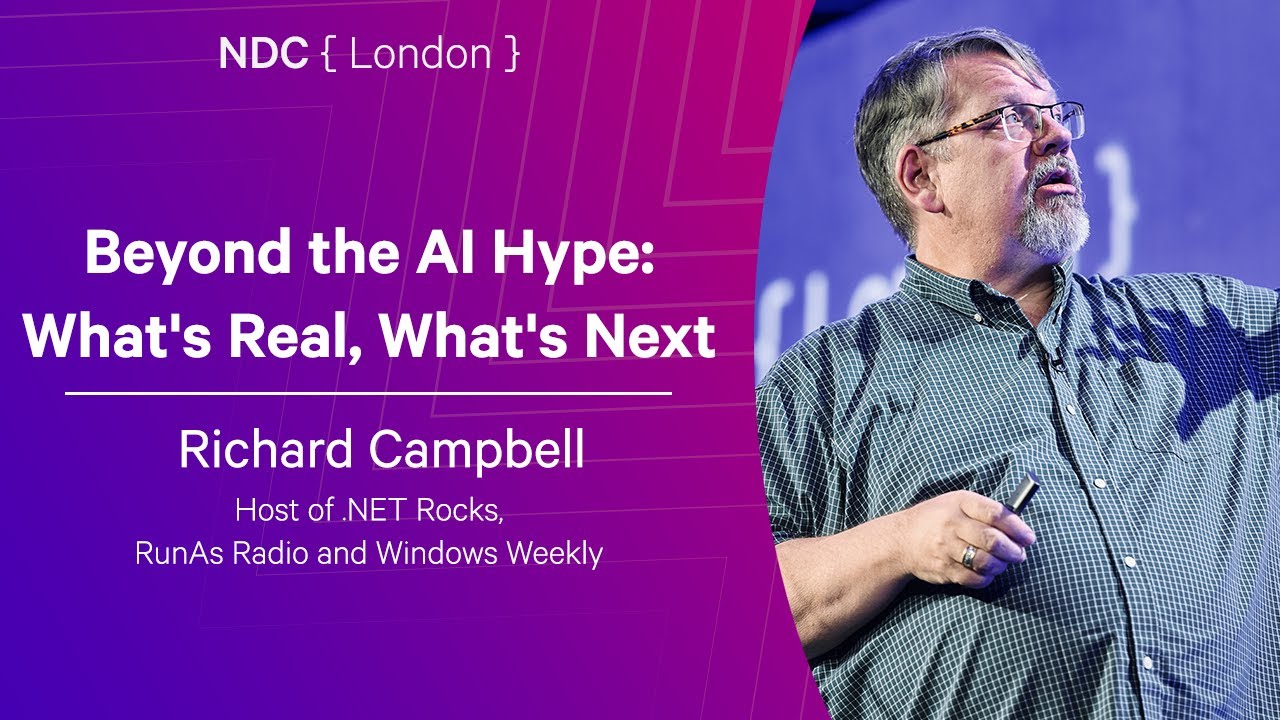
Beyond the AI Hype: What's Real, What's Next - Richard Campbell - NDC London 2026
Keywords
Summary
145 words
Critical Evaluation
Value of the Information & Strength of the Argument
The talk provides valuable insights into the AI hype cycle, offering a historical perspective that helps contextualize current developments. Campbell’s argument is well-structured, using the Gartner Hype Cycle as a framework to explain the trajectory of AI. He supports his points with personal anecdotes and references to key events, such as the ImageNet challenge and the founding of OpenAI. However, the argumentation relies heavily on anecdotal evidence and personal interpretation, lacking formal citations or data to back up some claims. The speaker’s experience and interviews with industry insiders add credibility, but the talk would benefit from more rigorous sourcing.
Scientific Rigor, Source Quality, Title Accuracy
The talk demonstrates a good level of scientific rigor in its historical account, but it lacks formal citations. The speaker mentions several key papers and events, such as the neural scaling laws and the ImageNet challenge, but does not provide specific references. The title accurately reflects the content, which separates hype from reality and discusses future trends. The talk is well-structured and the speaker’s expertise is evident, but the lack of formal sources limits its scientific rigor.
191 words
Title / Content Match
The title accurately reflects the content, which separates hype from reality and discusses future trends.
Quality & Reliability
7/10
The talk provides a historical overview and critical analysis of AI development, grounded in the speaker's extensive experience and interviews. However, it lacks formal citations and relies on anecdotal evidence and personal interpretation.
Key Moments
Markers derived by PSI from the transcript: the creator did not define chapters.
- Introduction and speaker's background
- History of AI: 1950s and the Dartmouth workshop
- Eliza and the anthropomorphization of AI
- The ImageNet challenge and the rise of deep learning
- The founding of OpenAI and the role of billionaires
- GPT-2 and the scaling laws
- The release of ChatGPT and its rapid adoption
- The Gartner Hype Cycle and the dot-com comparison
- Microsoft's co-pilot strategy and the future of AI
- Conclusion and final thoughts
Cited Sources
- NDC Conferences — Conference organizer and event page
- NDC London — Conference page for NDC London
Concurring Sources
- Gartner Hype Cycle — Framework for understanding technology hype cycles, consistent with the talk's argument.
- Neural scaling laws — Paper by OpenAI that supports the discussion on model scaling.
Dissenting Sources
- Radiology and AI — The talk claims that radiology has been significantly impacted by AI, but some sources suggest that the impact is more nuanced and that radiologists are not obsolete.
Contribution & Novelties
The talk provides a unique perspective on the AI hype cycle, drawing on the speaker’s extensive experience and interviews with industry insiders. It offers a historical context that is often missing in discussions about AI, helping to demystify the technology and its development. The talk also highlights the importance of understanding the hype cycle and its implications for businesses and developers.
Pour aller plus loin :
- Gartner Hype Cycle — Provides a framework for understanding the hype cycle and its phases.
- Neural scaling laws — The paper by OpenAI on scaling laws, which is central to the talk’s discussion.
- Eliza chatbot — The early chatbot that demonstrated the anthropomorphization of AI.
111 words
Radar Profile
The radar chart shows a balanced profile with high scores in information quantity and quality, but lower in technical depth and reliability. This suggests a talk that is informative and accessible, but not deeply technical or heavily sourced.
💬 Sur les 0 commentaires analysés, aucune tendance n'est disponible.