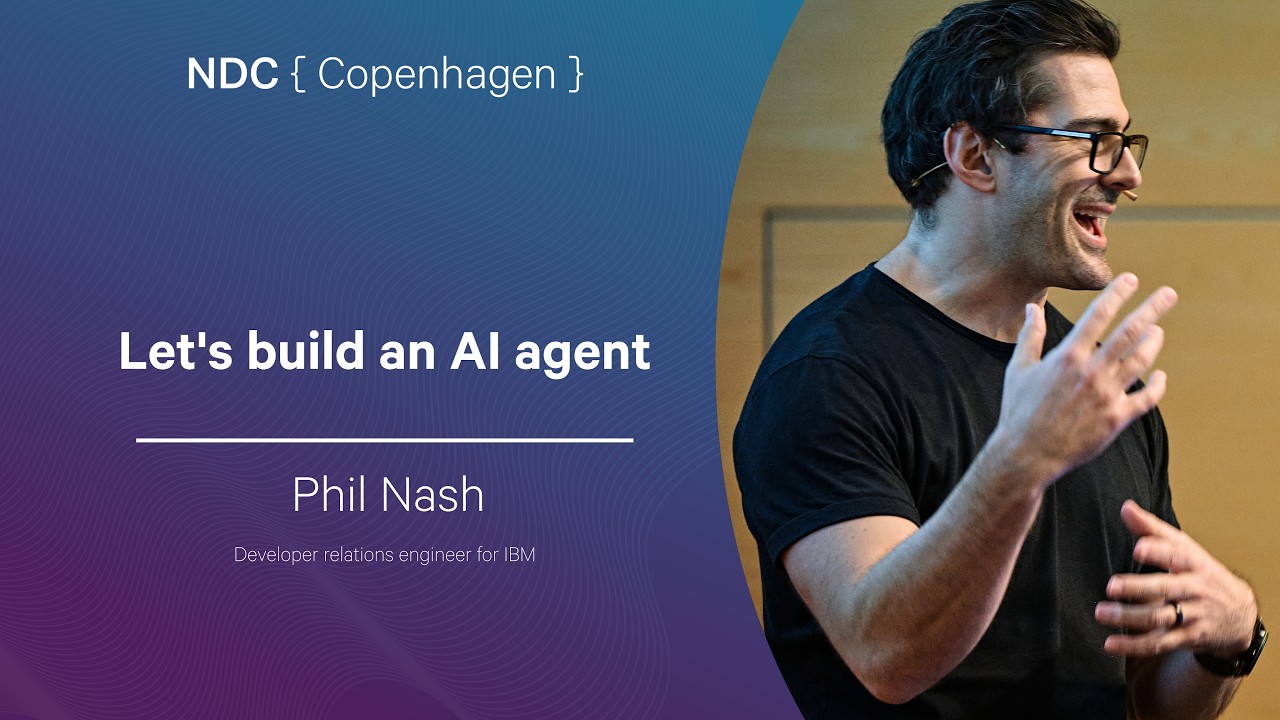
Let's build an AI agent - Phil Nash - NDC Copenhagen 2026
Keywords
Summary
182 words
Critical Evaluation
Value of the Information & Strength of the Argument
The talk provides high practical value by walking through the actual code for building an agent, making the concepts tangible. The argumentation is clear and logical, building from simple to complex. Nash effectively explains the underlying principles, such as the agent loop and tool declarations, and supports his points with live demonstrations. He also references authoritative sources like Google’s paper on agents and Simon Willison’s definition, adding credibility. The presentation is engaging and accessible, making complex topics understandable.
87 words
Title / Content Match
The title accurately reflects the content: a step-by-step guide to building an AI agent, from basic text generation to tool use and multi-agent systems.
Quality & Reliability
8/10
The talk is a live coding tutorial that demonstrates building an AI agent from scratch, with clear explanations of core concepts and practical implementation. The speaker is a developer relations engineer at IBM with relevant expertise. The content is technically accurate and well-structured, though it lacks formal citations and in-depth theoretical discussion.
Key Moments
Markers derived by PSI from the transcript: the creator did not define chapters.
Cited Sources
- NDC Conferences — Conference website mentioned in the description.
- NDC Copenhagen — Conference website mentioned in the description.
Concurring Sources
- Google's whitepaper on agents — Referenced in the talk as the source of the definition of an agent.
- Simon Willison's blog — Referenced for the simplified definition of an agent.
Contribution & Novelties
The talk provides a clear, hands-on demonstration of building an AI agent from scratch, demystifying the underlying mechanics. It emphasizes that the core is a simple loop and that tools are essential for real-world interaction. The speaker shares practical insights from his experience at IBM, such as using Gemini and MCP.
Pour aller plus loin :
- Model Context Protocol (MCP) — Official documentation for MCP, the standard protocol for agent-service interaction.
- Open RAG — IBM’s open-source stack for building RAG applications, mentioned by the speaker.
- Docling — IBM’s document processing tool, also mentioned.
- Simon Willison’s blog on agents — Articles and insights on AI agents from a well-known developer.
- Google’s paper on agents — The whitepaper referenced in the talk, defining generative AI agents.
124 words
Radar Profile
The radar profile shows high scores in information quantity, quality, and reliability, with a slightly lower technical level, indicating a well-balanced tutorial that is both informative and accessible. The speaker's expertise and clear explanations contribute to a strong overall rating.
💬 No comments were provided for analysis.