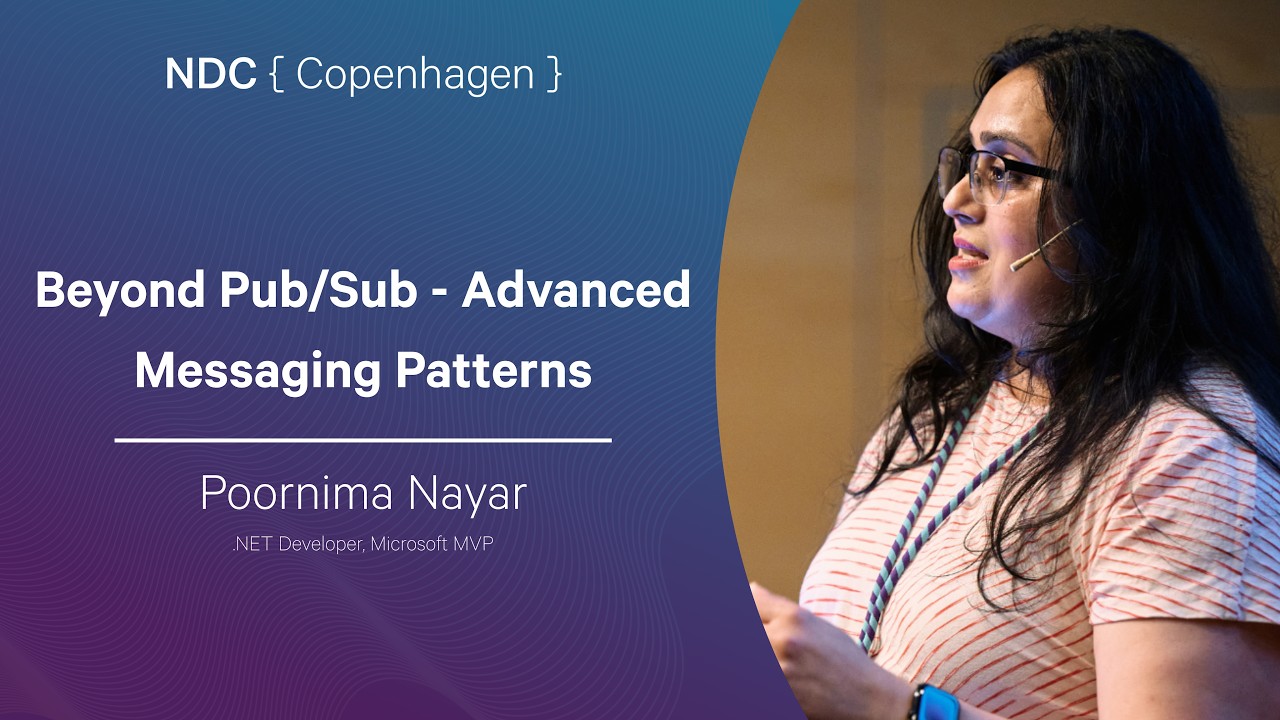
Beyond Pub/Sub - Advanced Messaging Patterns
Keywords
Summary
156 words
Critical Evaluation
Value of the Information & Strength of the Argument
The talk provides high practical value for engineers designing distributed systems. It clearly explains the limitations of basic pub/sub and offers concrete, battle-tested patterns to address them. The argumentation is solid, grounded in real-world experience and industry best practices. The speaker effectively uses analogies (e.g., passive-aggressive events) and a consistent order processing example to make complex concepts accessible. She also debunks common misconceptions, such as the illusion of exactly-once processing, by clarifying that it is achieved through at-least-once delivery plus idempotency. The reasoning is logical and well-structured, moving from problem identification to solution presentation.
Scientific Rigor, Source Quality, Title Accuracy
The speaker demonstrates strong scientific rigor by referencing industry-standard patterns and practices, though she does not cite specific academic sources. She is a recognized expert in the messaging space, which lends credibility. The title accurately reflects the content, which goes beyond basic pub/sub to cover advanced patterns. The talk is well-organized and technically sound, with no obvious errors or unsupported claims. The description includes links to NDC conferences, but no direct references to external sources are provided in the video itself.
190 words
Title / Content Match
The title accurately reflects the content, which goes beyond basic pub/sub to cover advanced messaging patterns.
Quality & Reliability
8/10
The speaker is a software architect at Particular Software, the company behind NServiceBus, giving her deep practical expertise. The talk is based on industry-proven patterns and best practices, though it is not a formal study or peer-reviewed. The content is coherent and aligns with established knowledge in distributed systems.
Key Moments
Markers derived by PSI from the transcript: the creator did not define chapters.
- Introduction and audience interaction about messaging usage.
- Explanation of publish/subscribe and its benefits.
- Discussion of common pitfalls and assumptions in pub/sub systems.
- Introduction to the dual-write problem and the need for consistency.
- Detailed explanation of the transactional outbox pattern.
- Discussion of idempotency and deduplication in message processing.
- Introduction to long-running workflows and sagas.
- Comparison of sagas with distributed transactions.
- Explanation of competing consumers pattern for elastic throughput.
- Operational safeguards: retries, dead-letter queues, back pressure, and idempotency.
Cited Sources
- NDC Conferences — Conference website where the talk was recorded.
- NDC Copenhagen — Specific conference event page.
Concurring Sources
- Microservices.io - Transactional Outbox — Describes the outbox pattern, which the speaker discusses in detail.
- Microservices.io - Saga — Explains the saga pattern for long-running workflows, a key topic in the talk.
Dissenting Sources
- Distributed Transactions — The speaker argues against distributed transactions in favor of sagas, which is a common debate in distributed systems design.
Contribution & Novelties
The talk synthesizes well-known patterns into a coherent guide for moving beyond basic pub/sub, emphasizing the importance of the outbox pattern and sagas. It provides practical advice on when and how to apply these patterns, filling a gap for engineers who may be familiar with pub/sub but unsure how to handle real-world distributed system challenges.
Pour aller plus loin :
- Transactional Outbox Pattern — A key reference for the outbox pattern.
- Saga Pattern — Detailed explanation of sagas for distributed transactions.
- Idempotency in Distributed Systems — Overview of idempotency concepts.
- Competing Consumers Pattern — Azure architecture pattern for competing consumers.
100 words
Radar Profile
The radar profile shows high scores in quantity and quality of information, indicating a content-rich and reliable talk. The technical level is also high, suitable for an audience with some background in messaging. The overall reliability is strong, reflecting the speaker's expertise and the use of established patterns.
💬 Sur les 0 commentaires analysés, aucune tendance n'a pu être dégagée.