Future of Energy – Panel Discussion on Trinity term seminars
Keywords
Summary
178 words
Critical Evaluation
Value of the Information & Strength of the Argument
The value of the information lies in the synthesis of multiple expert perspectives on the future of energy, covering technological, economic, and social dimensions. The panelists provide reasoned arguments based on their research and experience. For instance, Professor Rosnell highlights the dramatic cost reductions in renewables and the progress in electricity decarbonization, while also noting the slower progress in other sectors. Vafa Yelt brings a critical perspective on material dependencies and the need for circular economy approaches. The argumentation is generally solid, though it relies on qualitative assessments rather than detailed data. The discussion is balanced, acknowledging uncertainties and trade-offs, such as the potential benefits and risks of AI-driven electricity demand. However, the lack of specific citations and the brevity of some points limit the depth of the argumentation.
Scientific Rigor, Source Quality, Title Accuracy
The scientific rigor is moderate. The panelists are credible experts, and the content is based on a series of academic seminars. However, no specific sources are cited during the discussion, and the summary of prior talks is high-level. The title accurately reflects the content, which is a panel discussion summarizing the seminars. The adequacy between title and content is good. The video does not include any promotional or sponsored content. The discussion is well-structured, but the lack of detailed references and the reliance on expert opinion rather than peer-reviewed evidence reduce the overall rigor.
238 words
Title / Content Match
The title accurately reflects the content: a panel discussion on the future of energy, summarizing the Trinity term seminars.
Quality & Reliability
7/10
Panel discussion summarizing a seminar series, featuring expert opinions from academics and researchers. The content is largely qualitative, based on expert judgment and summaries of prior talks, with limited quantitative data. No formal citations are provided, but the speakers are credible experts in their fields.
Key Moments
Markers derived by PSI from the transcript: the creator did not define chapters.
- Introduction and welcome by moderator Tamo Kaladin.
- Tina Forset begins recap of the seminar series.
- Summary of talk on energy scenarios by Garv Card.
- Summary of talk on energy system resilience by Sarah Sparrow.
- Summary of talk on China's clean energy manufacturing by Anders Hoe.
- Summary of talk on AI data centers and US power grid by Prammod Konakar.
- Summary of talk on citizen engagement in energy modeling by Andy Ule.
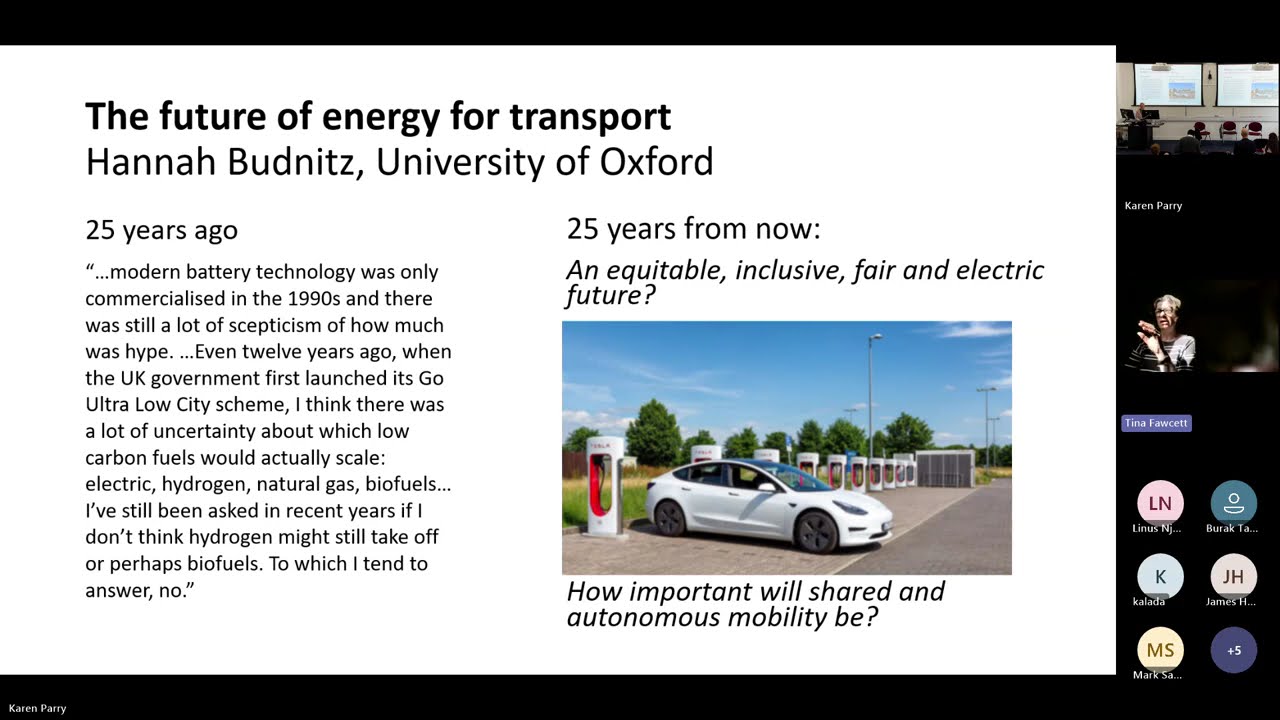
- Summary of talk on transport future by Hannah Budnitz.
- Summary of talk on home batteries and vehicle-to-grid by David Howe.
- Panel discussion begins with Professor Yan Rosnell and Vafa Yelt.
Cited Sources
- Oxford Energy Network — The host organization of the seminar series and panel discussion.
Concurring Sources
- IPCC Sixth Assessment Report — Provides scientific consensus on climate change and energy transition pathways.
Contribution & Novelties
The video provides a synthesis of multiple expert perspectives on the future of energy, highlighting key themes such as the uncertainty in energy demand scenarios, the importance of resilience, the role of China in clean energy manufacturing, and the material dependencies of the transition. The panel discussion adds value by bringing together experts from different backgrounds to discuss these issues, offering a holistic view. The emphasis on citizen engagement and the need for systemic thinking are notable contributions.
Pour aller plus loin :
- Energy scenarios and their limitations — Provides background on energy scenario modeling and its challenges.
- Critical raw materials — Discusses the importance of materials for clean energy technologies.
- Circular economy — Explores the concept of reducing material use and waste.
- Vehicle-to-grid — Explains the technology and its potential for grid balancing.
134 words
Radar Profile
The radar profile shows a balanced performance across all dimensions, with slightly higher scores in information quantity and quality, reflecting the comprehensive overview of the seminar series. The technical level is moderate, suitable for a general audience, while reliability is supported by the expertise of the panelists.